Zero-Click Search: How to Market When the Answer Comes Before the Click
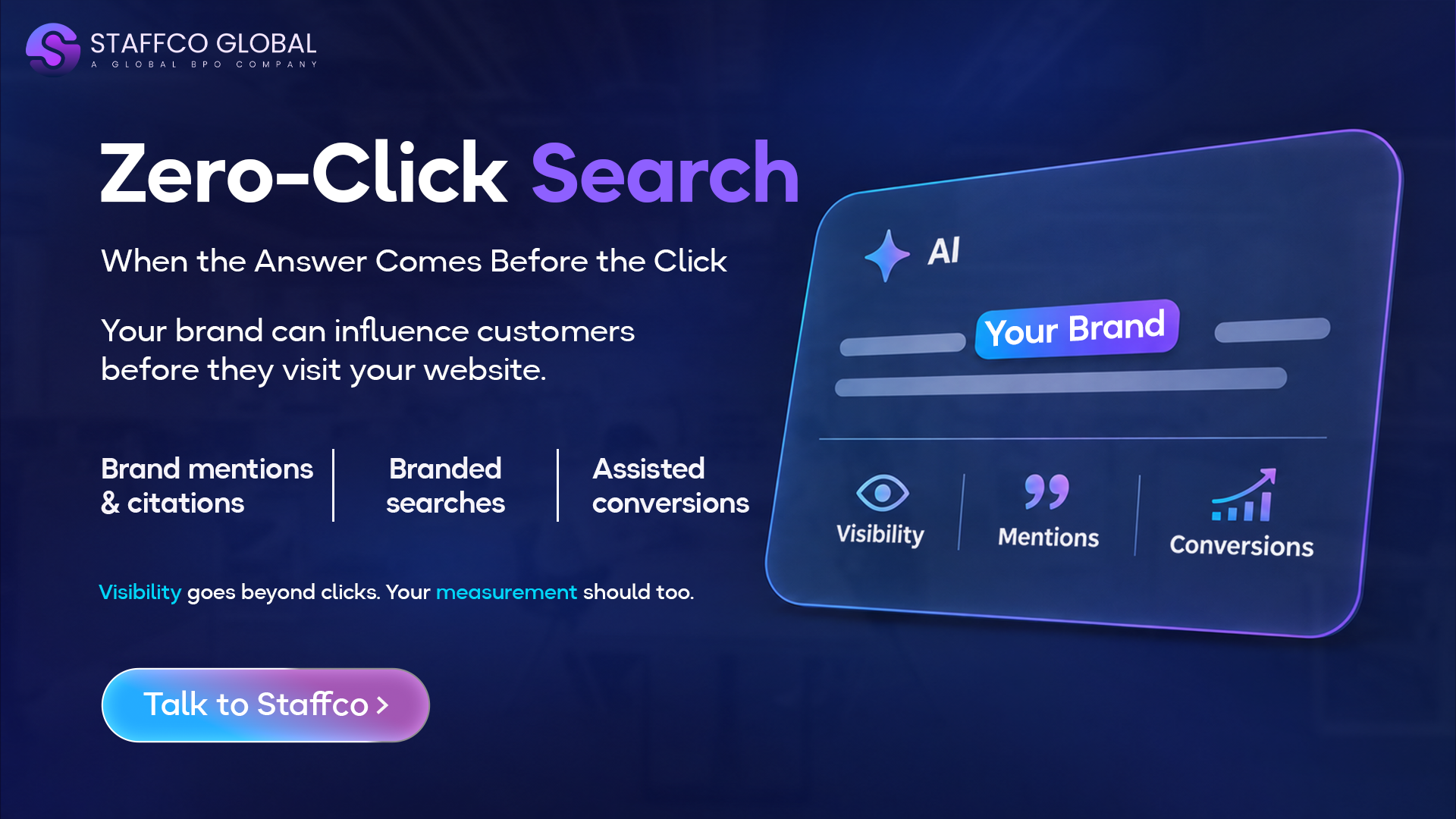
For years, one of the main goals of search marketing was simple:
Get someone to search.
Get your website to rank.
Get the click.
Bring the visitor to your website.
Convert the visitor into a lead.
But search is changing.
Today, a person can search for a question and receive a detailed answer directly inside the search experience.
They may see an AI-generated summary.
They may compare businesses without opening several websites.
They may discover a brand through a citation, review, video, social result, or other search feature.
They may even learn enough to make their next decision without clicking a traditional blue link.
This creates a new challenge for businesses:
How do you market when the answer comes before the click?
The answer is not to abandon SEO.
It is to think bigger about search visibility.
Your goal is no longer just to get a click.
Your goal is to become visible, credible, useful, and memorable throughout the customer's research process. What Is Zero-Click Search? Zero-click search describes situations where someone gets the information they need directly from the search experience without clicking through to another website.
This can happen through:
- AI-generated answers
- Featured search elements
- Knowledge panels
- Maps
- Reviews
- Calculators
- Direct answers
- Video results
- Other search features
AI-powered search adds another layer to this behavior.
Google's AI Overviews provide AI-generated summaries with links to supporting web resources, while AI Mode provides a more interactive experience where users can explore follow-up questions and supporting pages. Google Help
The important distinction is this:
A search impression does not always need to become a website session to influence a customer.
Your brand can become part of the customer's research process before they ever visit your website. Why Zero-Click Search Matters for Marketing Traditional SEO reporting often focuses heavily on:
- Rankings
- Clicks
- Organic traffic
- Click-through rate
These metrics remain important.
But they don't tell the entire story.
Google Search Console measures impressions, clicks, and click-through rate, and Google also provides visibility into traffic from different Search surfaces. Google Help
If someone sees your brand while researching a problem, that exposure can influence what they search for next, which companies they remember, and which businesses eventually make their shortlist.
That means search visibility can contribute to the customer journey even when the immediate result is not a click. The Difference Between Clicks and Visibility Consider two businesses.
Business A receives 1,000 search clicks.
Business B receives fewer clicks but appears repeatedly when potential customers research important questions in its category.
Which business has stronger visibility?
You cannot answer that question from clicks alone.
Clicks measure one form of action.
Visibility measures whether your business is appearing in the places where customers are researching.
The stronger marketing question is:
Are we becoming part of the customer's consideration set? AI Overviews Are Changing the Search Experience AI Overviews can provide an AI-generated summary directly within Google Search, supported by links to web resources. Google also says AI Mode expands the experience with more interactive responses and links to supporting webpages. Google Help
This changes how businesses should think about search content.
Instead of only trying to rank for:
"marketing agency"
you may need to create useful resources around questions such as:
- How should a business build a lead generation strategy?
- How much should a company invest in marketing?
- Why is my website getting traffic but no leads?
- What is customer acquisition?
- How does content marketing generate customers?
- What should a business measure in marketing?
These questions reflect real customer problems.
The business that consistently provides useful answers can become more visible throughout the research journey. Search Is Becoming More Conversational Traditional search often begins with a short phrase.
AI-powered search can begin with a complete question.
For example:
"marketing agency"
could become:
"What should a growing B2B company do if it has strong brand awareness but isn't generating enough qualified leads?"
That second question contains much more context.
It also reveals more about the user's intent.
Your content should be able to answer questions in a natural, useful, structured way. Zero-Click Does Not Mean Zero Value One of the biggest misconceptions about zero-click search is that an interaction only has value if it produces a website visit.
That is too narrow.
Imagine a potential customer asks an AI system for recommendations.
Your company is mentioned.
The customer sees your brand.
They don't click.
Two days later, they search your company name directly.
Then they visit your website.
Then they contact your team.
The original search did not produce the immediate click.
But it may have contributed to the customer journey.
This is why brand visibility matters. Brand Mentions Matter A customer does not need to click your website to learn that your business exists.
They can encounter your brand through:
- Search results
- AI answers
- Reviews
- Social media
- Video
- Industry content
- Communities
- Podcasts
- Publications
- Recommendations
Repeated exposure can increase familiarity.
And familiarity can make future interactions more meaningful.
This is particularly important for businesses with longer buying cycles. Citations Can Support Authority AI-powered search experiences can include links to sources supporting an answer.
Google documents how links appearing within AI Overviews and AI Mode are counted within Search Console's search performance methodology. Google Help
For businesses, this creates another reason to publish information worth referencing.
The goal is not to manufacture citations.
The goal is to create content that deserves to be referenced.
That means:
- Original insights
- Useful research
- Clear explanations
- Strong expertise
- Specific examples
- Helpful frameworks
- Accurate information
- Relevant data
The stronger the information, the more valuable the content becomes to both customers and search ecosystems. Search Visibility Is Bigger Than Rankings Ranking is still important.
But modern search visibility includes more than a traditional position number.
Your business may appear through:
- Traditional organic results
- AI Overviews
- AI Mode
- Images
- Videos
- Maps
- Reviews
- News
- Social discovery
- Brand searches
- Other search features
Google's Search Console also distinguishes traffic from different Search surfaces such as Image, Video, News, and Discover. Google Help
The broader lesson is simple:
Your customers can discover you in more places than a standard search result.
Your growth strategy should account for that.
- Create Content That Answers Real Questions
The foundation of zero-click visibility is useful content.
Start with the questions your customers actually ask.
For Staffco, these could include:
"What is customer acquisition?"
"How do I generate more qualified leads?"
"How much should a business spend on marketing?"
"Why is my marketing not generating leads?"
"How does content marketing support customer acquisition?"
"What is the difference between brand awareness and lead generation?"
These questions create opportunities to demonstrate expertise.
The goal is not to write content because a keyword tool says the phrase exists.
The goal is to answer a real customer question better than the alternatives.
- Build Topical Authority
One article is rarely enough to establish deep expertise.
Instead, create connected content around important subjects.
For example, Staffco's Growth & Acquisition content can cover:
- Growth strategy
- Marketing strategy
- Brand awareness
- Demand generation
- Lead generation
- Customer acquisition
- Conversion
- Content marketing
- Marketing measurement
- AI search visibility
These topics can be connected through internal links.
This creates a stronger knowledge structure around the brand.
- Create Content With Information Gain
AI can summarize generic information extremely quickly.
That means generic content is becoming less differentiated.
Businesses need to add something useful that goes beyond repeating what already exists.
That could be:
- Original analysis
- Customer examples
- Proprietary frameworks
- Industry experience
- Original research
- Data
- Case studies
- Expert commentary
- Practical recommendations
Google's current guidance emphasizes original, helpful, people-first content and specifically warns against producing content primarily to manipulate search rankings. Google for Developers
The lesson is important:
Don't create more content simply because AI makes content cheap. Create better content because expertise creates differentiation.
- Make Your Brand Easy to Understand
Search systems need context.
Your website should clearly communicate:
- Your company name
- What you do
- Who you serve
- Your services
- Your geographic market
- Your expertise
- Your positioning
For Staffco, that positioning should remain consistent:
Growth & Acquisition
The supporting services explain how Staffco delivers that value.
But the central idea should remain clear.
- Build Entity and Brand Authority
Your business should be consistently represented across the web.
Keep information aligned across:
- Website
- Social profiles
- Business listings
- Professional profiles
- Publications
- Industry directories
- Reviews
- Author pages
Consistency helps reinforce who your company is and what it does.
The goal is to build a recognizable entity rather than a collection of disconnected web pages.
- Structure Your Content Clearly
Good content should be easy to understand.
Use:
- Clear headings
- Short paragraphs
- Bullets
- Definitions
- Examples
- Internal links
- Descriptive titles
- Useful summaries
- Relevant supporting content
If a reader asks:
"What is zero-click search?"
Answer that question directly.
Then explain why it matters.
Then provide examples.
Then explain what the business should do.
Then provide a next step.
This structure helps people understand the topic quickly.
- Optimize for Search Intent
Not every search means the same thing.
Consider:
"What is zero-click search?"
This is informational.
"How does zero-click search affect SEO?"
This is research-oriented.
"Zero-click SEO strategy"
This indicates stronger solution intent.
"AI SEO agency"
This can indicate commercial intent.
Your content strategy should address different stages of intent. Informational Content Teach the audience. Research Content Help them evaluate options. Commercial Content Explain how your solution can help. Conversion Content Give qualified prospects a clear next step.
This creates a path from discovery to acquisition.
- Use Clear Next-Step Paths
Zero-click visibility is valuable.
But when someone wants more information, you need somewhere for them to go.
Every important content asset should have an appropriate next step.
That might be:
- Read a related article
- Visit a service page
- Request an assessment
- Book a consultation
- Contact your team
- Download a resource
- Explore a case study
The CTA should match the reader's intent.
Don't force a sales pitch into every interaction.
Build a journey.
- Make Your Website Worth Visiting
If search engines and AI systems can answer basic questions directly, why would someone click your website?
Because your website offers something deeper.
Give people reasons to visit.
That could include:
- Original research
- Interactive tools
- Detailed guides
- Case studies
- Proprietary frameworks
- Calculators
- Templates
- Examples
- Expert analysis
- Service information
The website should provide more value than the summary.
This is especially important in a zero-click environment.
- Measure Beyond Traffic
Traditional traffic metrics still matter.
But a modern search strategy should look at a broader set of signals.
Track: Visibility
- Impressions
- Search appearances
- Brand mentions
- Search visibility
- AI citations where measurable
Engagement
- Clicks
- CTR
- Website engagement
- Returning visitors
- Branded searches
Acquisition
- Qualified leads
- Appointments
- Sales opportunities
- Customers
- Customer acquisition cost
Business Impact
- Pipeline
- Revenue
- Customer value
- Conversion rate
The goal is to connect visibility to acquisition. Don't Abandon Clicks Zero-click search does not mean clicks are irrelevant.
A click still represents a valuable action.
Google's documentation explicitly counts clicks from links in AI Overviews and AI Mode when users follow those links to external pages. Google Help
The goal is not:
"Clicks don't matter anymore."
The better perspective is:
Clicks are one part of a larger visibility and acquisition system. Search Console Can Still Help Google Search Console remains important for understanding how your site performs in Search.
It provides information about:
- Impressions
- Clicks
- CTR
- Search performance
- Search surfaces
- Queries
- Pages
Google has also expanded Search Console's reporting around generative AI features, reflecting the growing importance of AI-driven discovery. Google for Developers
Businesses should use the available data to understand both visibility and conversion. What Should You Track in a Zero-Click Strategy? A useful reporting framework is:
Visibility
Are we being discovered?
↓
Recognition
Are people searching for our brand?
↓
Engagement
Are people interacting with our content?
↓
Intent
Are people moving toward a solution?
↓
Leads
Are qualified prospects contacting us?
↓
Customers
Are those opportunities becoming customers?
This connects search visibility to business growth. Zero-Click Search and Customer Acquisition The biggest mistake is treating zero-click search as an SEO problem only.
It is a customer acquisition issue.
A customer may discover your business through an AI answer.
They may encounter your brand through a review.
They may watch your video.
They may see your social content.
They may read your article.
Then they may search your company directly.
Then they may visit your website.
Then they may contact you.
That is a customer journey.
The original search was simply one part of it. Build a Search Strategy Around the Customer Don't start by asking:
"What keyword should we rank for?"
Start with:
"What is our customer trying to understand?"
Then:
"What questions do they ask?"
Then:
"Where do they research?"
Then:
"What information do they need?"
Then:
"How can we provide something genuinely useful?"
Then:
"How do we move interested people toward becoming customers?"
This is a much stronger way to think about search. Zero-Click Search Is Part of a Bigger Change The search environment is becoming more diverse.
Customers can discover businesses through:
AI
↓
Search
↓
Social
↓
Video
↓
Reviews
↓
Communities
↓
Brand Search
↓
Website
↓
Customer Acquisition
Your brand needs to be visible throughout the journey. What Businesses Should Do Now If your business wants to adapt to zero-click and AI-powered discovery, start with these steps: Audit Your Existing Visibility Find out where your brand already appears. Identify Customer Questions Build content around real questions and problems. Improve Your Positioning Make it obvious who you help and what you do. Build Topic Authority Create connected content around your core expertise. Add Original Insight Give people something they cannot get from a generic summary. Improve Content Structure Make your information easy to understand and navigate. Strengthen Your Website Give visitors a reason to go deeper than the search answer. Build Clear CTAs Give interested prospects an appropriate next step. Measure Acquisition Connect visibility to qualified leads and customers. Don't Chase AI. Build Authority. AI search will continue to evolve.
The specific interfaces will change.
The platforms will change.
The way people phrase questions will change.
But the fundamentals remain strong:
Be useful.
Be clear.
Be credible.
Be relevant.
Be discoverable.
Be consistent.
Create information worth referencing.
Build a brand worth remembering.
Then connect that visibility to a customer acquisition system. The Goal Is to Become Part of the Answer The future of search isn't simply about getting someone to click your website.
It is about becoming part of the customer's research journey.
Sometimes that means earning the click.
Sometimes it means earning the mention.
Sometimes it means being cited.
Sometimes it means being remembered.
Sometimes it means influencing the customer's next search.
The strongest brands understand that all of these interactions can contribute to acquisition. Visibility Should Lead to Acquisition At Staffco Global, our focus is Growth & Acquisition.
We help businesses build marketing systems designed to create visibility, generate demand, capture qualified leads, and acquire customers.
SEO is one channel.
AI search is an emerging discovery environment.
Social media is another channel.
Content creates value.
Websites support conversion.
Measurement connects marketing activity to business results.
The strategy connects everything. Not Sure How Your Brand Performs Beyond Clicks? If your marketing report only tells you how many people clicked your website, you may be missing part of the customer journey.
Your customers may be discovering you through answers, recommendations, reviews, videos, communities, and AI-powered search experiences before they ever visit your site.
The question is:
Are you visible where your customers are researching?
Not sure how your brand performs beyond clicks? Let's look at your acquisition strategy.
Talk to Staffco About Your Growth Strategy