Your Website Isn't Your Marketing Strategy
Your Website Isn't Your Marketing Strategy
Your business has a website.
It looks professional.
Your services are listed.
Your contact information is there.
Your branding looks great.
So where are the customers?
This is a common problem for businesses investing in their digital presence.
They build a beautiful website and expect it to generate business on its own.
But a website is not a marketing strategy.
It is a tool within a larger marketing and customer acquisition system.
Your website can support growth, but it needs the right traffic, messaging, content, offers, calls to action, and acquisition strategy behind it.
The goal isn't simply to have a website.
The goal is to build a marketing system that uses your website to help generate demand, capture qualified leads, and acquire customers.
What Is a Marketing Strategy?
A marketing strategy is a plan for reaching the right audience, communicating your value, generating demand, creating opportunities, and supporting customer acquisition.
It answers questions such as:
- Who are we trying to reach?
- What problem do we solve?
- Why should people choose us?
- How will potential customers discover us?
- How will we create demand?
- How will we generate leads?
- How will we convert prospects?
- How will we measure performance?
- How will we improve the process?
A website can support many of these objectives.
But it cannot answer all of them by itself.
That's why your website should be viewed as one component of your marketing system, not the entire strategy.
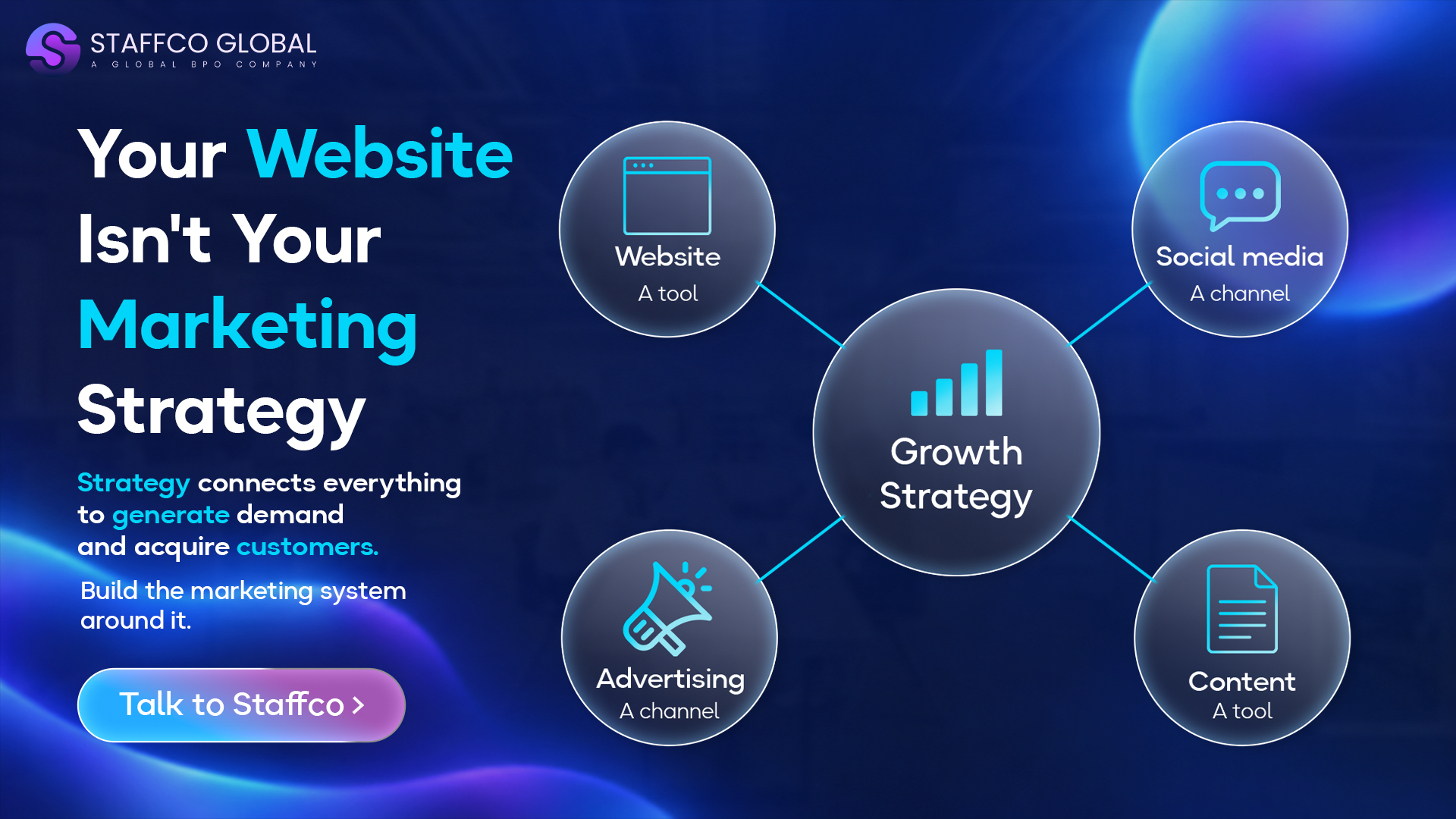
A Website Is a Tool
Your website is one of the most important digital assets your business can have.
It can:
- Explain your services
- Communicate your positioning
- Build credibility
- Educate prospects
- Showcase your expertise
- Capture leads
- Support conversions
- Provide information
- Support SEO
- Give customers a way to contact you
But the website needs people to reach it.
If nobody discovers your website, it cannot generate meaningful business.
This is why website development and marketing strategy need to work together.
A website gives your marketing somewhere to send people.
Marketing gives your website a reason to be visited.
Social Media Is a Channel
Social media can help your business reach potential customers and build awareness.
It can help people:
- Discover your business
- Learn about your expertise
- Engage with your content
- Build familiarity with your brand
- Visit your website
- Take the next step
But social media is not a complete marketing strategy either.
Posting every day does not automatically create growth.
You need to understand:
Who you're targeting.
What you're communicating.
Why the audience should care.
What action you want them to take.
How social media contributes to customer acquisition.
Social media is a channel.
The strategy determines how that channel should be used.
Advertising Is a Channel
Paid advertising can help businesses reach specific audiences quickly.
It can generate:
- Website traffic
- Brand awareness
- Leads
- Sales opportunities
- Customers
But advertising alone does not guarantee results.
An advertising campaign needs:
- The right audience
- The right message
- The right offer
- The right creative
- The right landing page
- The right call to action
- Proper tracking
- A conversion strategy
If your advertisement generates traffic but your website doesn't convert that traffic, increasing your advertising budget may simply increase the amount of traffic that doesn't convert.
The advertisement is a channel.
The acquisition strategy connects the channel to the outcome.
Content Is a Tool
Content marketing can help businesses attract and educate potential customers.
Content can include:
- Blog articles
- Videos
- Social media posts
- Case studies
- Guides
- Podcasts
- Email content
- Webinars
- Research
Content can help people:
Discover you.
Understand their problem.
Learn about solutions.
Trust your expertise.
Take action.
But content should not exist simply to fill your calendar.
It should support a marketing objective.
A blog article might target a search query.
A video might create awareness.
A case study might build trust.
A guide might generate leads.
Each piece should have a purpose within the larger customer journey.
The Website Needs a Strategy Behind It
A website can be visually impressive and still fail to generate enough business.
Why?
Because design is only one part of the equation.
A website also needs:
- Clear positioning
- Strong messaging
- Relevant traffic
- Useful content
- Clear offers
- Calls to action
- Lead capture
- Conversion paths
- Trust signals
- Analytics
Without these components, a website can become an online brochure instead of a growth asset.
Your Website Needs the Right Traffic
Imagine you build the perfect website.
It loads quickly.
It looks professional.
It works perfectly on mobile.
The branding is excellent.
But only a few people visit it.
The website cannot generate significant business without traffic.
This is why your marketing strategy needs a traffic strategy.
Traffic can come from:
- Search engines
- Social media
- Paid advertising
- Referrals
- Partnerships
- Content marketing
- Direct outreach
- Online communities
The goal isn't simply to generate traffic.
It is to generate relevant traffic from people who could become customers.
More Traffic Doesn't Always Mean More Customers
This is another important distinction.
A website can receive thousands of visitors and still generate very few leads.
Why?
The visitors may not be the right audience.
The messaging may be unclear.
The offer may be weak.
The calls to action may be missing.
The conversion process may be complicated.
The website may not build enough trust.
This is why website traffic should not be viewed as the final goal.
The goal is to turn relevant traffic into action.
Your Website Needs Clear Positioning
When someone lands on your website, they should quickly understand:
What do you do?
Who do you help?
What problem do you solve?
Why should they choose you?
What should they do next?
If the answers aren't obvious, visitors may leave.
Your homepage should communicate your value quickly.
Instead of making visitors search through multiple pages to understand your business, give them a clear reason to continue.
Strong positioning makes the rest of the marketing system more effective.
Your Website Needs a Conversion Strategy
A website should not simply provide information.
It should guide visitors toward the appropriate next step.
That could be:
- Book a consultation
- Request a quote
- Contact your team
- Schedule a call
- Submit an inquiry
- Download a resource
- Request an assessment
- Start a conversation
This is where conversion strategy becomes important.
A visitor should never have to wonder:
"What am I supposed to do now?"
Build Clear Conversion Paths
A simple acquisition path might look like:
Social Media
↓
Website
↓
Relevant Landing Page
↓
Offer
↓
Call to Action
↓
Lead
↓
Sales Conversation
↓
Customer
Each step should have a purpose.
If the visitor clicks from social media to your website but cannot find the relevant information, the journey breaks.
If they understand your service but there is no clear CTA, the journey breaks.
If they submit a form but nobody follows up, the journey breaks.
Your website is part of the path.
It is not the entire path.
Your Website Needs Content
A website without useful content can struggle to attract organic traffic and educate potential customers.
Content gives your website opportunities to rank for relevant searches and answer questions your audience is already asking.
For example, businesses can create:
- Educational blog articles
- Service guides
- Industry insights
- FAQs
- Case studies
- Comparison pages
- Resource pages
Each piece of content can support a different stage of the customer journey.
Some content attracts visitors.
Some educates them.
Some builds trust.
Some helps generate leads.
SEO Makes Your Website Discoverable
Search engine optimization can help potential customers discover your website when they search for relevant information.
Without SEO, even a well-designed website may have limited organic visibility.
SEO can involve:
- Keyword research
- Search intent
- On-page optimization
- Technical SEO
- Internal linking
- Content strategy
- Metadata
- Site structure
- Local SEO where relevant
- Authority building
The objective is not simply to rank.
The objective is to attract the right visitors.
Your Website Needs a Lead Generation Strategy
A website should give interested visitors opportunities to become leads.
Lead generation can include:
- Contact forms
- Consultation requests
- Quote forms
- Downloads
- Appointment booking
- Newsletter signups
- Assessments
- Direct calls
The best lead-generation approach depends on your audience and sales cycle.
A high-value B2B service may benefit from a consultation.
An ecommerce business may focus on purchases.
A professional service may use an assessment or discovery call.
The website should reflect the acquisition model of the business.
Your Website Needs Trust
Before contacting a business, potential customers often want evidence that the company is credible.
Your website can build trust through:
- Testimonials
- Case studies
- Client results
- Reviews
- Industry experience
- Credentials
- Team information
- Thought leadership
- Clear service explanations
Trust reduces uncertainty.
The more confidence a prospect has in your business, the more comfortable they may become taking the next step.
Don't Build a Website and Wait for Customers
This is one of the biggest mistakes businesses make.
They launch a new website.
Then they wait.
But websites don't create demand by themselves.
Your website needs to be connected to marketing activities that bring the right people to it.
That can include:
SEO
↓
Content
↓
Social Media
↓
Paid Advertising
↓
↓
Website
↓
Lead Generation
↓
Conversion
↓
Customer Acquisition
This is a marketing system.
Your Website Should Support Your Growth Strategy
The role of your website should be defined by the larger business objective.
If your goal is lead generation, your website should be designed around lead capture.
If your goal is customer acquisition, it should support the entire acquisition journey.
If your goal is brand awareness, it should communicate your positioning and build recognition.
If your goal is entering a new market, it should speak directly to that market.
The website should support the strategy.
The strategy should not be built around the website alone.
The Difference Between a Website and a Marketing System
Consider these two approaches.
Website-First Approach
Build website.
↓
Publish website.
↓
Wait for traffic.
↓
Hope visitors contact you.
Growth-Focused Approach
Define growth goal.
↓
Identify target audience.
↓
Create positioning.
↓
Build content strategy.
↓
Generate traffic.
↓
Send traffic to website.
↓
Capture leads.
↓
Convert prospects.
↓
Measure performance.
↓
Optimize.
The second approach creates a system.
The website becomes one important part of that system.
Your Website Is Part of the Customer Journey
A potential customer may interact with your business many times before contacting you.
They may first see your social media.
Then search your company.
Then read a blog.
Then visit your website.
Then watch a video.
Then return to your website.
Then read a case study.
Then request a consultation.
The website can appear at multiple stages.
That makes it an important asset.
But the customer journey extends beyond the website.
Your marketing strategy needs to support the entire journey.
Measure What Your Website Contributes
Website performance should not be measured only by traffic.
Track metrics such as:
- Qualified leads
- Conversion rate
- Contact form submissions
- Consultation requests
- Calls
- Landing page performance
- Traffic sources
- Lead sources
- Customer acquisition cost
- Customers generated
A website receiving 100,000 visitors but producing very few qualified opportunities may have a different problem from a website receiving 10,000 visitors and consistently generating customers.
The goal is not simply traffic.
The goal is business impact.
Your Website Should Work With Your Marketing
A strong website and strong marketing should reinforce one another.
Marketing brings people to the website.
The website educates and builds trust.
The offer creates an opportunity.
The CTA creates action.
The lead enters the acquisition process.
Sales continues the conversation.
The customer is acquired.
Measurement shows what worked.
Optimization improves the system.
That is how a website becomes part of a growth engine.
Build the Marketing System Around Your Website
Your website should sit inside a broader system:
Strategy
↓
Positioning
↓
Content
↓
Traffic
↓
Website
↓
Leads
↓
Conversion
↓
Customers
↓
Growth
Every part has a job.
The website is the digital environment where much of the customer journey can happen.
But the surrounding marketing system creates the visibility and demand that bring people there.
What Should You Fix First?
If your website is not generating enough business, don't immediately assume you need a redesign.
Start by asking:
Are we reaching the right audience?
Is our positioning clear?
Are we generating enough relevant traffic?
Does our content answer customer questions?
Is our offer compelling?
Are our calls to action clear?
Is the website easy to navigate?
Are we capturing leads?
Are we following up?
Are we measuring conversions?
These questions can reveal whether the problem is actually the website or something further upstream in the marketing system.
Don't Confuse Design With Growth
A beautiful website can strengthen your brand.
It can create credibility.
It can improve the customer experience.
But design alone does not create growth.
Growth requires a connected system.
Your website needs:
Visibility
Demand
Traffic
Conversion
Lead Generation
Customer Acquisition
The design supports the system.
The strategy drives the system.
Staffco Global: Growth & Acquisition
At Staffco Global, our focus is Growth & Acquisition.
We believe websites, content, social media, advertising, and other marketing tools should work together around a clear business objective.
The goal isn't simply to create a beautiful digital presence.
The goal is to build marketing that creates visibility, generates demand, captures qualified leads, and supports customer acquisition.
Your website is an important part of that system.
But it is not the strategy.
Build the Marketing System Around Your Website
Your website should not be the place where your marketing strategy ends.
It should be one of the places where your strategy comes together.
Bring the right audience to it.
Give them the right message.
Help them understand their problem.
Show them why your solution matters.
Build trust.
Make the next step clear.
Capture the lead.
Continue the conversation.
Turn qualified opportunities into customers.
That's how a website supports growth.
Your website should support acquisition, not simply exist online.
Talk to Staffco About Your Growth Strategy