Why Your Marketing Gets Leads but Not Enough Customers
Why Your Marketing Gets Leads but Not Enough Customers
STAFFCO GLOBAL · GROWTH & ACQUISITION | NOVEMBER 2026
Your marketing campaigns are generating leads. Website visitors are filling out forms, people are clicking your ads, and potential customers are showing interest in your services.
But there is one problem: the number of new customers isn't growing at the same rate.
Sound familiar?
Many businesses focus heavily on generating more leads without paying enough attention to what happens after someone expresses interest.
The result is a marketing system that creates activity but struggles to produce actual business growth.
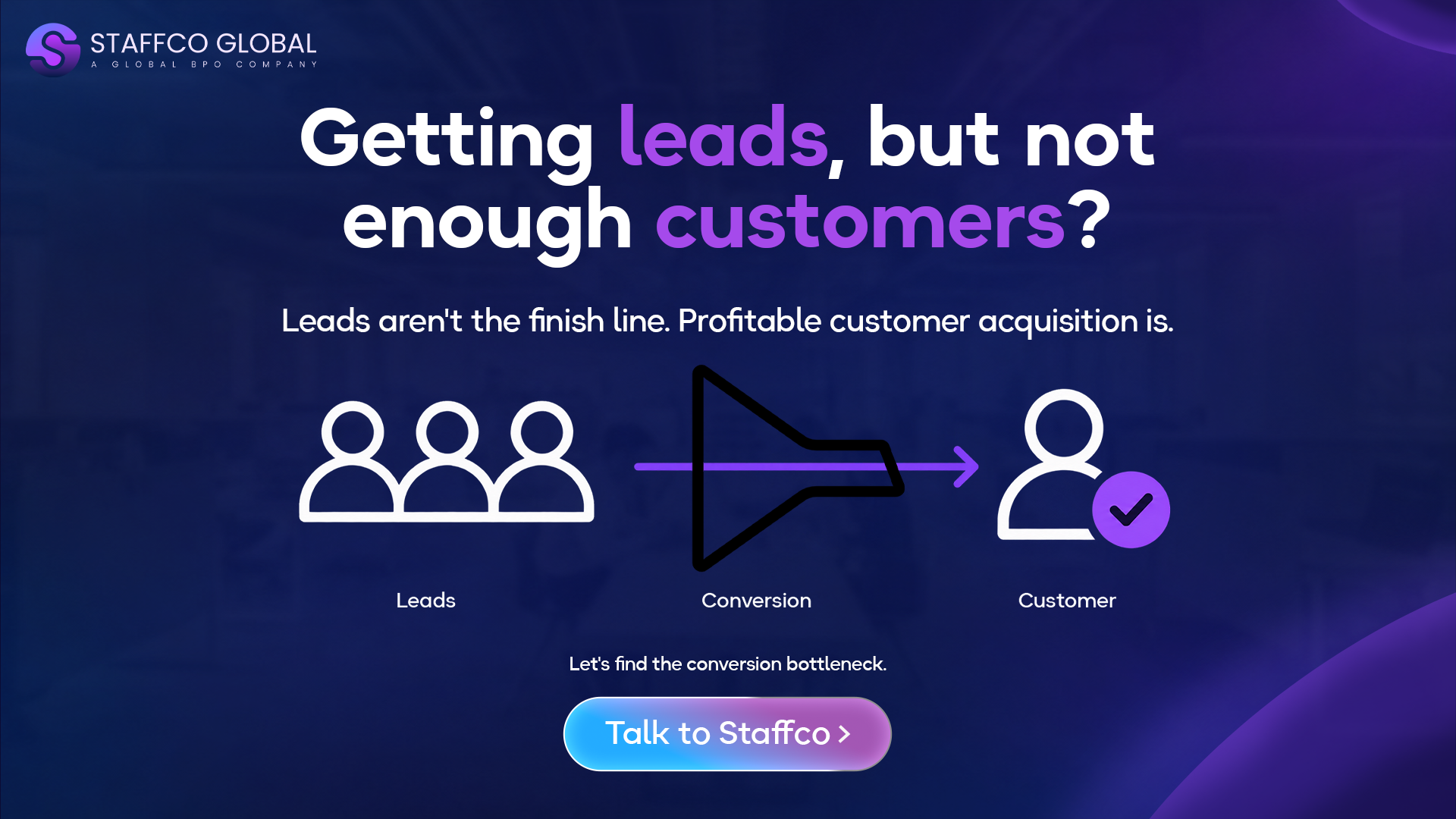
The truth is that lead generation and customer acquisition are not the same thing.
Generating a lead is the beginning of the sales journey. Turning that lead into a paying customer requires the right audience, a compelling offer, effective follow-up, a coordinated sales process, and a smooth conversion experience.
At StaffCo Global, we believe successful marketing should be measured by more than the number of inquiries it generates. It should contribute to a system that attracts qualified prospects and turns opportunities into customers.
Lead Generation vs. Customer Acquisition: What's the Difference?
Lead generation is the process of attracting potential customers and encouraging them to express interest in your products or services.
Customer acquisition goes further. It focuses on the complete process of converting prospects into paying customers and understanding the cost and value of acquiring them.
For example, imagine a business receives 100 inquiries through its marketing campaigns.
Those inquiries may look impressive in a marketing report. However, if only a small percentage become customers, the business needs to understand why.
Are the leads qualified? Are prospects receiving the right information? Is the sales team following up quickly? Is the offer aligned with customer expectations?
These questions reveal an important distinction:
- Lead generation: How many potential customers are entering your pipeline?
- Lead qualification: How many of those prospects match your target customer profile?
- Lead conversion: How many qualified prospects become paying customers?
- Customer acquisition: How effectively does your business turn marketing and sales investment into new customers?
A successful acquisition strategy connects all four.
1. Lead Quality: Are You Attracting the Right People?
One of the most common reasons marketing generates leads without generating enough customers is poor lead quality.
Not every person who fills out a form is ready to buy. Some are researching options, some are comparing providers, and others may not be a suitable fit for your services at all.
When marketing focuses exclusively on lead volume, it can attract inquiries that have little chance of becoming customers.
Businesses should evaluate lead quality based on factors such as:
- Audience fit: Does the prospect match your target market?
- Business needs: Does the prospect actually need the service you provide?
- Budget: Does the potential customer have a realistic budget?
- Decision-making authority: Is the person involved in the purchasing decision?
- Purchase intent: Is the prospect actively considering a solution?
- Timing: Is the customer ready to move forward?
For B2B businesses, these factors are particularly important because purchasing decisions may involve multiple stakeholders, longer evaluation periods, and more detailed requirements.
The goal should not simply be to attract more inquiries. It should be to attract more of the right inquiries.
2. Offer Mismatch: Does Your Marketing Promise What Customers Need?
Your marketing may successfully attract attention, but if the offer does not match what customers are looking for, conversion becomes difficult.
Consider a business advertising a service as a simple, low-cost solution when its actual offering is a comprehensive, higher-value service.
The campaign may attract plenty of inquiries, but those prospects may have very different expectations from what the business provides.
This is an offer mismatch.
To improve alignment, businesses should make sure their marketing communicates:
- What the service actually includes.
- Which customer problems it solves.
- Who the service is designed for.
- What makes the offering different.
- What customers can realistically expect.
- What the next step involves.
Your advertisements, website, landing pages, and sales conversations should communicate a consistent value proposition.
A strong offer does more than generate clicks. It attracts people who understand the value of what you provide and have a reason to consider purchasing it.
3. Follow-Up: How Quickly Are You Responding to Leads?
A potential customer submits an inquiry because something has caught their attention.
But what happens next?
If a business takes too long to respond, provides unclear information, or fails to follow up, the prospect may lose interest or choose another provider.
Lead follow-up is a critical part of customer acquisition.
An effective follow-up process should include:
Prompt responses: Acknowledge inquiries as quickly as practical and establish clear response expectations.
Personalized communication: Address the prospect's specific questions and business needs rather than sending generic messages.
Consistent follow-up: Create a structured process for reconnecting with prospects who have not yet made a decision.
Useful information: Provide relevant explanations, resources, and answers that help customers evaluate their options.
Clear next steps: Make it easy for prospects to schedule a meeting, request a proposal, or continue the conversation.
Businesses should also use appropriate CRM reminders and automation to help prevent promising opportunities from being overlooked.
Automation can support consistency, but personal communication remains important when customers need advice or assistance.
4. Sales Alignment: Marketing and Sales Must Work Together
Marketing and sales are often treated as separate departments with different responsibilities.
Marketing generates leads. Sales converts them.
However, when these teams operate without shared goals and clear communication, valuable opportunities can fall through the cracks.
For example:
- Marketing may send leads that sales considers unqualified.
- Sales may not communicate which campaigns generate the strongest opportunities.
- Marketing may continue promoting offers that attract the wrong audience.
- Follow-up responsibilities may be unclear.
- Lead information may not be transferred correctly.
These problems create unnecessary friction throughout the customer journey.
To improve sales and marketing alignment, businesses should establish:
Shared definitions of qualified leads: Both teams should understand what makes a prospect worth pursuing.
Clear handoff procedures: Every lead should have an appropriate owner and next step.
Consistent feedback: Sales should communicate lead quality, objections, and common customer questions to marketing.
Shared performance indicators: Both teams should evaluate results based on qualified opportunities and customer conversions, not just lead volume.
Regular performance reviews: Review which campaigns produce the most valuable customers and identify where opportunities are being lost.
When marketing and sales work toward the same objective, the entire acquisition process becomes more effective.
5. Conversion Friction: Is Something Making It Difficult to Become a Customer?
Sometimes a prospect is genuinely interested but encounters unnecessary obstacles before completing a purchase.
This is known as conversion friction.
It can happen at almost any stage of the customer journey.
For example:
- A website form asks for too much information.
- Service descriptions are confusing.
- Pricing or next steps are unclear.
- The website is difficult to navigate on mobile devices.
- Customers cannot easily schedule a consultation.
- The sales process involves unnecessary delays.
- Important questions remain unanswered.
Each obstacle can make a potential customer reconsider their decision.
Businesses should regularly review their conversion journey from the customer's perspective.
Ask yourself:
- Can visitors understand our services quickly?
- Is our website easy to navigate?
- Are our contact forms simple and relevant?
- Do customers know what happens after submitting an inquiry?
- Can prospects easily speak with someone?
- Are we addressing common objections?
Small improvements can make the customer journey clearer and reduce unnecessary barriers.
The objective is to make moving from interest to action as straightforward as possible.
6. Attribution: Do You Know Which Marketing Activities Generate Customers?
Another challenge is understanding which marketing activities actually contribute to customer acquisition.
A campaign may generate many clicks and form submissions, but that does not automatically mean it produces profitable customers.
Businesses need to look beyond surface-level marketing metrics.
For example, a company may invest in:
- Google search advertising.
- Social media campaigns.
- SEO and blog content.
- Email marketing.
- LinkedIn outreach.
- Referral programs.
Each channel may influence the buyer journey differently.
Some channels introduce the brand. Others educate prospects, build trust, or encourage direct inquiries.
If businesses measure only the last click or initial lead submission, they may overlook other interactions that contributed to the final decision.
A stronger attribution approach connects marketing activity with CRM and sales outcomes.
Important metrics include:
- Cost per lead (CPL): How much does it cost to generate an inquiry?
- Lead qualification rate: What percentage of leads meet your qualification criteria?
- Lead-to-customer conversion rate: What percentage of leads become paying customers?
- Customer acquisition cost (CAC): How much does it cost to acquire a new customer?
- Sales cycle length: How long does it take to convert a prospect?
- Customer lifetime value (CLV): What is the estimated value of a customer over the relationship?
- Return on marketing investment: How does marketing investment compare with the business value it generates?
These measurements provide a clearer understanding of whether marketing is contributing to sustainable growth.
7. How to Improve Your Lead-to-Customer Conversion Rate
Improving customer acquisition does not always require increasing your advertising budget.
In many cases, businesses can achieve better results by improving the processes already in place.
Here is a practical framework:
Step 1: Review Your Existing Leads
Analyze the inquiries your business receives.
Identify which sources generate qualified prospects, which audiences show the strongest purchase intent, and which leads are unlikely to convert.
Step 2: Improve Your Targeting
Refine your campaigns around the customers who are most likely to benefit from your services.
Use audience insights, customer feedback, and previous sales data to improve your targeting.
Step 3: Strengthen Your Offer
Make sure your advertisements, landing pages, and service descriptions communicate a consistent value proposition.
Explain the problem you solve and why your solution is relevant.
Step 4: Build a Structured Follow-Up System
Use a CRM to organize inquiries, assign responsibilities, schedule follow-ups, and track each prospect's progress.
Make sure leads do not disappear after the first interaction.
Step 5: Connect Marketing and Sales
Establish clear lead qualification criteria, handoff procedures, and feedback processes.
Give marketing teams visibility into which leads are becoming customers.
Step 6: Reduce Conversion Barriers
Review your website, forms, communication process, and sales journey.
Remove unnecessary steps and make it easier for potential customers to take action.
Step 7: Measure Customer Acquisition Performance
Track the complete journey from initial inquiry to paying customer.
Use the data to identify bottlenecks, improve campaigns, and allocate resources more effectively.
Build a Customer Acquisition System, Not Just a Lead Generation Campaign
A business can generate hundreds of leads and still struggle to grow if its acquisition process is not designed to convert them.
Successful marketing requires more than attracting attention.
It requires understanding your audience, communicating the right offer, generating qualified opportunities, following up consistently, and creating a smooth path toward becoming a customer.
When these elements work together, marketing becomes more than a lead-generation activity. It becomes part of a coordinated business growth system.
At StaffCo Global, we understand that growth requires the right combination of digital marketing, content, customer support, technology, and operational processes.
Our goal is to help businesses connect their marketing activities with the systems and support needed to move opportunities forward.
Leads are not the finish line. The real goal is profitable customer acquisition.
Getting Leads but Not Enough Customers?
If your business is attracting inquiries but struggling to turn them into paying customers, it may be time to identify the conversion bottleneck.
Let's build a stronger acquisition system that connects marketing, follow-up, and business operations.
Talk to StaffCo Global.
📞 +1 (646) 799-5220 ✉️ marketing@staffcoglobal.com
Visit StaffCo Global to explore how strategic marketing and operational support can help your business grow.