Why Your Business Gets Attention But Not Customers
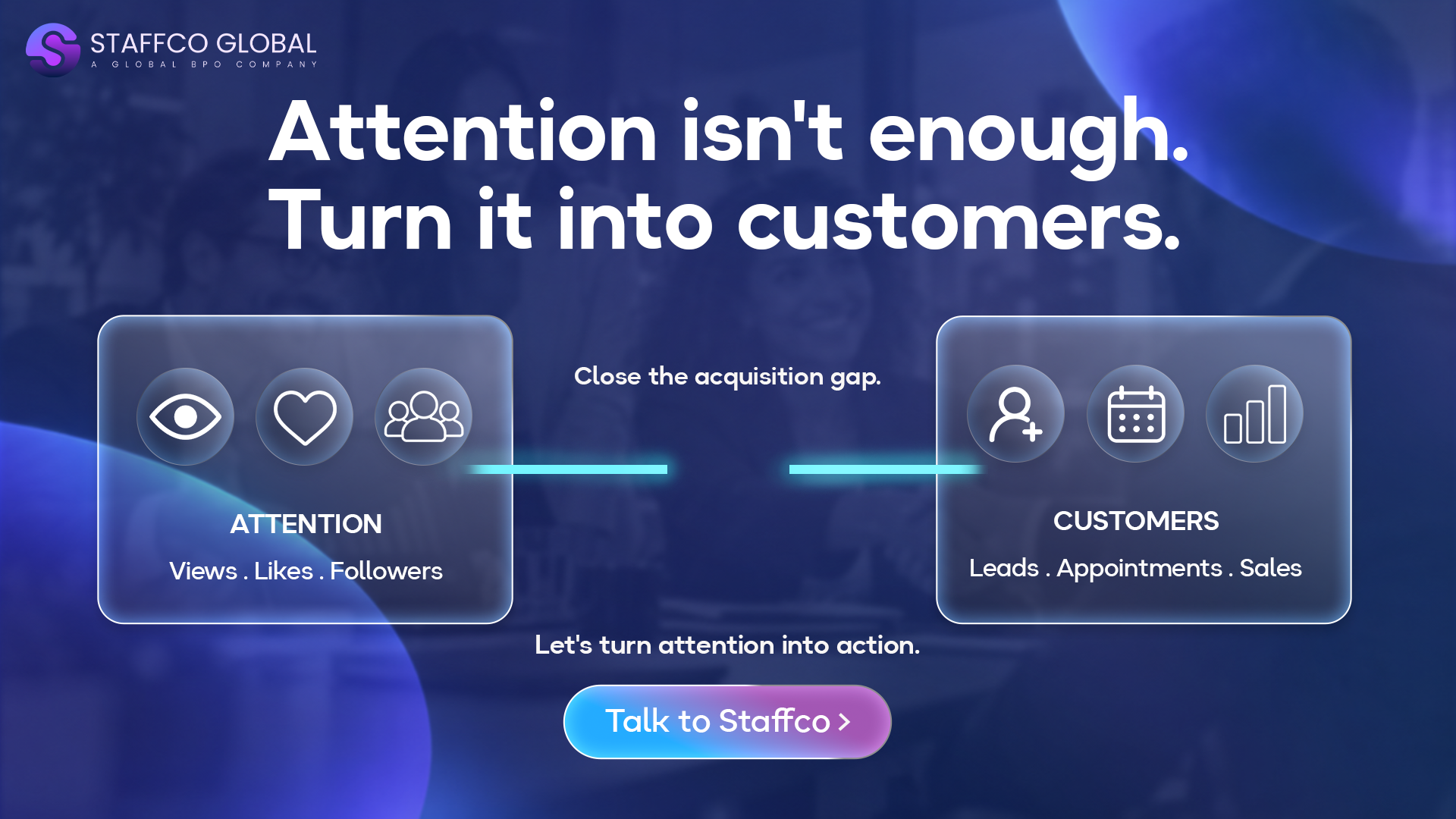
Why Your Business Gets Attention But Not Customers
Your business is getting attention.
People are viewing your content.
Your social media posts are receiving likes.
Your follower count is increasing.
Your website is getting traffic.
But the customers aren't coming in at the same rate.
If this sounds familiar, you are not alone.
One of the biggest marketing challenges businesses face is the gap between attention and customer acquisition.
Getting people to notice your business is important. But attention is only the beginning.
The real question is:
What happens after someone notices you?
If your marketing generates views but not leads, traffic but not appointments, or engagement but not sales, there may be a problem somewhere between awareness and conversion.
Your business does not necessarily need more attention.
It may need a better system for turning attention into action.
Attention Is Not the Same as Customer Acquisition
Marketing can generate a lot of activity.
You may see:
- More views
- More likes
- More followers
- More website traffic
- More impressions
- More engagement
These metrics can be useful indicators of awareness.
But they do not automatically represent business growth.
A person can watch your video without contacting you.
Someone can like your post without becoming a customer.
A visitor can spend several minutes on your website without filling out a form.
A large follower count does not guarantee revenue.
This is the difference between attention and acquisition.
Attention means people are noticing your business.
Acquisition means those people are moving toward becoming customers.
The goal of growth-focused marketing is to connect the two.
Why Are You Getting Views But Not Leads?
If your content is getting attention but generating very few inquiries, one of the first things to examine is whether the content gives people a reason to take the next step.
People may enjoy your content without understanding:
- What you actually offer
- Who your service is for
- What problem you solve
- Why they should choose you
- What they should do next
Content can create awareness without creating action.
For example, a business may publish an entertaining video that receives 50,000 views.
That is excellent reach.
But if the video does not connect the audience to a relevant problem, solution, or next step, those 50,000 views may produce very few business opportunities.
The question is not only:
"How many people saw it?"
It is:
"How many of the right people took action?"
1. Your Audience May Be Wrong
One reason businesses get attention but not customers is that they are reaching the wrong audience.
It is possible to create highly engaging content that attracts people who will never purchase your product or service.
For example, a post may go viral because it is entertaining.
But viral does not necessarily mean valuable for customer acquisition.
Your marketing should reach people who have a genuine need for what you offer.
Ask:
- Who is our ideal customer?
- What problem are they trying to solve?
- What motivates them to buy?
- What type of content do they respond to?
- Where do they search for solutions?
- What makes them trust a business?
The goal is not to reach everyone.
The goal is to reach the right people.
2. Your Messaging May Not Be Clear
Even if you reach the right audience, your marketing may fail to generate leads if people don't understand your value.
A potential customer should be able to quickly understand:
What do you do?
Who do you help?
What problem do you solve?
Why should I choose you?
If your marketing is filled with vague statements, industry jargon, or generic descriptions, prospects may not understand why your business matters to them.
Clear messaging connects your service to the customer's problem.
Instead of simply saying:
"We provide marketing services."
A stronger message might communicate:
"We help businesses increase visibility, generate qualified leads, and acquire customers."
The second message focuses on the outcome.
That distinction can make a major difference in customer acquisition.
3. Your Content Creates Engagement But Not Demand
Engagement is valuable.
But engagement alone does not necessarily create demand.
Your content should help potential customers understand something that matters to them.
Effective content can:
- Identify a problem
- Explain an opportunity
- Educate the audience
- Answer questions
- Demonstrate expertise
- Build trust
- Introduce a solution
- Encourage action
This is how content moves beyond entertainment and begins supporting customer acquisition.
A strong content strategy should not only ask:
"What should we post?"
It should ask:
"What does our audience need to understand before they become a customer?"
That question creates much more strategic content.
4. Your Website Gets Traffic But Doesn't Convert
Website traffic is only valuable when visitors have a clear path toward taking action.
If your website receives visitors but generates very few leads, examine the conversion experience.
Can visitors immediately understand what you do?
Is your value proposition clear?
Can they quickly find your services?
Are there strong calls to action?
Is it easy to contact your business?
Does the website build trust?
Does it work well on mobile devices?
Are visitors being directed toward a specific next step?
A website should not simply provide information.
It should support your customer acquisition strategy.
What Should a High-Converting Website Do?
A strong website should guide visitors through a simple journey:
Understand → Trust → Explore → Act
First, visitors should understand what your business does.
Then they should understand why your solution matters.
Next, they should find evidence that your business is credible.
Finally, they should have a clear opportunity to take action.
That action could be:
- Book a consultation
- Request a quote
- Contact your team
- Schedule a call
- Submit an inquiry
- Request more information
If the next step is unclear, you may lose potential customers even when your marketing successfully drives traffic.
5. Your Calls to Action Are Weak
A potential customer should not have to figure out what to do next.
This is where calls to action matter.
Weak CTAs include:
"Learn More"
"Click Here"
"Explore"
"Contact Us"
These aren't always wrong, but they often fail to communicate the value of taking the next step.
A stronger CTA can be more specific:
"Book a Growth Strategy Call"
"Get Your Marketing Assessment"
"Talk to a Growth Strategist"
"Build Your Acquisition Strategy"
"Request a Consultation"
The CTA should tell the prospect what happens next.
6. Your Marketing Doesn't Create a Clear Customer Journey
People rarely move directly from seeing a business for the first time to becoming a customer.
The customer journey often looks more like:
Awareness
They discover your business.
↓
Interest
They want to understand more.
↓
Demand
They recognize a problem or opportunity.
↓
Consideration
They evaluate your solution.
↓
Lead
They take an identifiable action.
↓
Conversation
They communicate with your business.
↓
Customer
They become a customer.
If your marketing focuses only on awareness, you may be creating attention without creating enough opportunities.
Growth requires a strategy that supports the entire journey.
7. You Are Measuring the Wrong Things
If your marketing report focuses heavily on followers, impressions, and likes, you may be missing the bigger picture.
These metrics can tell you whether people are seeing and engaging with your marketing.
But businesses also need to understand whether marketing is creating opportunities.
Important metrics include:
- Qualified leads
- Lead conversion rate
- Website conversion rate
- Cost per lead
- Customer acquisition cost
- Appointments
- Sales opportunities
- Customers acquired
- Revenue generated
The right metrics depend on your business and objectives.
The important thing is connecting marketing performance to business outcomes.
From Vanity Metrics to Business Metrics
Consider the difference.
Attention Metrics
Views
Likes
Followers
Impressions
Reach
Acquisition Metrics
Qualified Leads
Appointments
Sales Conversations
Customers
Customer Acquisition Cost
Revenue
Attention metrics can help you understand visibility.
Acquisition metrics help you understand business impact.
A strong marketing strategy should monitor both.
8. Your Marketing and Sales Are Disconnected
Sometimes the problem isn't marketing alone.
A business may generate leads successfully but still struggle to convert them into customers.
Why?
Because marketing and sales are not working together.
Marketing may generate an inquiry.
But then:
The lead isn't contacted quickly.
The prospect receives no follow-up.
The sales process is unclear.
The offer isn't communicated effectively.
The prospect doesn't understand the next step.
This creates a gap between lead generation and customer acquisition.
Marketing should create opportunities.
Sales should help turn qualified opportunities into customers.
These functions need to work together.
9. You Don't Have a Follow-Up System
A lead is not a customer yet.
Someone who fills out a form or sends a message may still be considering their options.
Without consistent follow-up, valuable opportunities can disappear.
A follow-up system may include:
- Immediate confirmation
- Phone follow-up
- Email follow-up
- Educational content
- Case studies
- Retargeting
- Consultation reminders
- Personalized outreach
The objective is to keep the conversation moving.
A strong acquisition strategy doesn't stop when someone becomes a lead.
It continues until that opportunity is either converted or appropriately qualified out.
10. You Are Doing Marketing Without an Acquisition Strategy
This may be the biggest issue.
You can have:
A social media strategy.
A content calendar.
Paid advertisements.
A website.
Email marketing.
SEO.
Video.
But if these activities are not connected to a customer acquisition strategy, they can operate independently.
The result can be a lot of marketing activity without predictable growth.
A growth strategy connects the pieces.
The Attention-to-Acquisition Framework
A strong growth marketing system can look like this:
1. Visibility
Get discovered by the right audience.
↓
2. Awareness
Help people recognize your business.
↓
3. Demand
Help them understand the problem you solve.
↓
4. Interest
Give them a reason to explore your solution.
↓
5. Lead Generation
Create a clear opportunity to take action.
↓
6. Conversion
Turn qualified opportunities into customers.
↓
7. Retention
Create long-term customer value.
This is how attention becomes acquisition.
How to Turn Attention Into Action
If your business is getting attention but not enough customers, start by examining the entire marketing journey.
Step 1: Identify Your Audience
Make sure you're reaching people who can actually become customers.
Step 2: Clarify Your Message
Explain the problem you solve and the outcome you provide.
Step 3: Create Demand
Use useful content to help prospects understand why the problem matters.
Step 4: Build a Strong Offer
Give people a compelling reason to take the next step.
Step 5: Improve Your Conversion Path
Make contacting your business simple.
Step 6: Strengthen Follow-Up
Respond quickly and consistently to qualified leads.
Step 7: Measure Results
Track leads, conversions, customers, and acquisition costs.
Step 8: Optimize
Identify where prospects are dropping off and improve that stage.
More Attention Is Not Always the Answer
When marketing isn't producing enough customers, businesses often respond by trying to get more attention.
More followers.
More views.
More traffic.
More impressions.
But more attention isn't necessarily the solution.
If the acquisition system is weak, increasing attention may simply create a larger audience that doesn't convert.
Before spending more money or producing more content, ask:
Where is the customer journey breaking down?
Are we reaching the right people?
Is our message clear?
Are we creating demand?
Are we generating qualified leads?
Is our website converting?
Are we following up?
Are we measuring results?
These questions can reveal more than simply looking at your follower count.
Build Marketing Around Growth
The purpose of marketing should not simply be to make your business look active.
Marketing should support a larger business objective.
That objective may be:
- More qualified leads
- More appointments
- More customers
- Lower acquisition costs
- Higher customer value
- Expansion into new markets
- Sustainable revenue growth
Once the goal is clear, marketing tactics can be selected based on what supports that goal.
Social media is a channel.
Advertising is a channel.
Content is a tool.
A website is an asset.
SEO is a visibility strategy.
None of these should exist in isolation.
They should work together as part of a larger growth and acquisition system.
Attention Is Only the Beginning
Getting noticed is important.
But being noticed is not the same as being chosen.
The goal of marketing is not simply to get people to see your business.
It is to help the right people:
Discover → Understand → Trust → Act → Become Customers
That's where marketing becomes connected to growth.
Turn Attention Into Acquisition
At Staffco Global, our focus is Growth & Acquisition.
We help businesses develop marketing strategies designed to increase visibility, create demand, generate qualified leads, and support customer acquisition.
The goal isn't simply more followers.
It isn't simply more views.
It isn't simply more website traffic.
The goal is to build a marketing system that contributes to measurable business growth.
If your business is getting attention but not enough customers, there may be a gap between your marketing activity and your acquisition strategy.
If you're getting attention but not enough customers, let's identify where your acquisition process is breaking down.
Talk to Staffco About Your Growth Strategy