Why Is Your Business Not Growing?
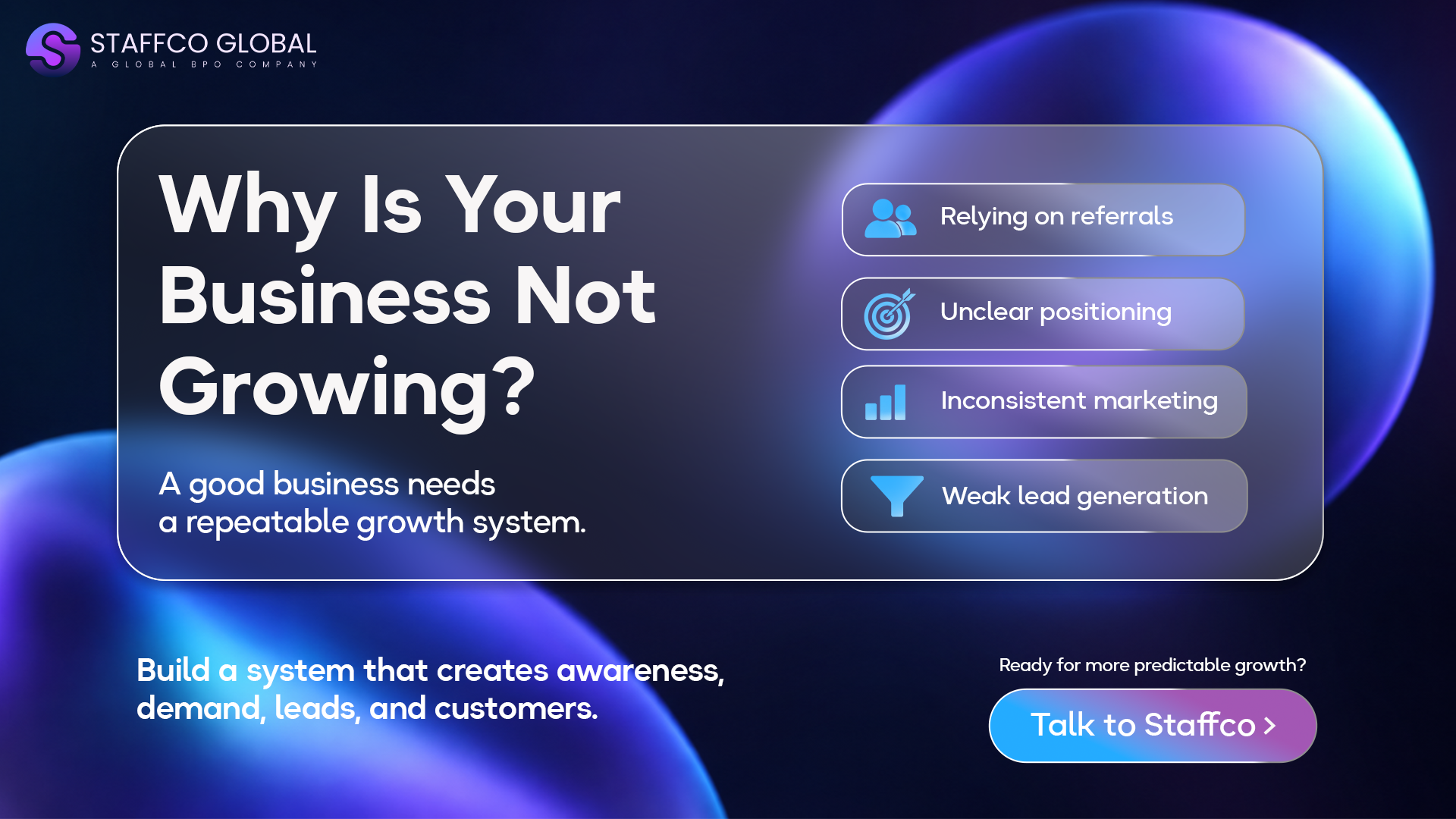
Why Is Your Business Not Growing?
You have a good product. You provide a valuable service. Your customers are satisfied. So why isn't your business growing as quickly as you expected?
This is one of the most common challenges business owners face.
A business can have an excellent product or service and still struggle to generate consistent growth. The problem is often not the quality of the business itself. Instead, the problem can be the system behind its marketing, visibility, lead generation, and customer acquisition.
Growth rarely happens by accident.
To create consistent growth, businesses need a strategy that connects awareness, demand generation, lead generation, conversion, and customer acquisition.
If your business feels stuck, here are some of the most common reasons why.
1. Your Business Relies Too Heavily on Referrals
Referrals can be one of the best sources of new business. When a satisfied customer recommends your company, you are starting the sales process with a level of trust that can take years to build.
But referrals alone are difficult to scale.
If most of your new customers come from people you already know, your growth may depend on factors you cannot control.
What happens when referrals slow down?
What happens when you want to enter a new market?
What happens when you want to double your customer base?
A strong business growth strategy should create additional channels for discovering and acquiring customers.
Marketing gives your business the opportunity to reach people who have never heard of you before.
2. Your Marketing Is Inconsistent
Many businesses market aggressively for a few weeks and then disappear for several months.
They post when they have time.
They run an advertisement when sales slow down.
They create content when someone has a good idea.
This creates inconsistent visibility.
Your potential customers need multiple opportunities to discover, understand, and remember your business before they are ready to take action.
Consistent marketing helps build familiarity and keeps your business visible throughout the customer journey.
The goal is not simply to post more.
The goal is to create a consistent marketing system that supports business growth.
3. Your Positioning Is Unclear
One of the biggest problems businesses face is trying to speak to everyone.
If your message is designed for everyone, it often connects strongly with no one.
Your potential customer should be able to understand three things quickly:
- What do you do?
- Who do you help?
- Why should they choose you?
Strong positioning makes those answers clear.
Instead of simply describing your services, your marketing should communicate the problem you solve and the value you create.
Clear positioning can make your marketing more effective because the right audience can recognize that your business is relevant to them.
4. You Are Getting Attention but Not Enough Leads
Followers are not customers.
Website traffic is not revenue.
Views are not sales.
Attention is valuable, but attention alone does not create business growth.
The next step is converting attention into interest and interest into action.
That means your marketing needs clear calls to action, compelling offers, relevant landing pages, and an easy way for prospects to contact your business.
A strong lead generation strategy creates a bridge between visibility and customer acquisition.
The question should not only be:
"How many people saw us?"
The better question is:
"How many qualified people took the next step?"
5. You Don't Have a Repeatable Lead Generation Strategy
If your business never knows where the next customer will come from, growth becomes difficult to predict.
You might have a great month because of referrals or one successful campaign.
Then the following month can be completely different.
A repeatable lead generation strategy gives your business a process for consistently attracting potential customers.
That process can include:
- Search engine optimization
- Content marketing
- Social media
- Paid advertising
- Email marketing
- Landing pages
- Strategic partnerships
- Retargeting
- Conversion optimization
The right combination depends on your business, audience, industry, and growth goals.
The important part is having a strategy behind the channels.
6. Your Marketing Is Focused on Activity Instead of Results
Marketing teams can become very busy without actually creating meaningful growth.
You may be:
- Posting every week
- Creating videos
- Designing graphics
- Sending emails
- Running advertisements
- Updating your website
But if these activities are not connected to measurable business goals, they can become marketing for the sake of marketing.
Every marketing activity should have a purpose.
Is it increasing awareness?
Is it generating demand?
Is it producing leads?
Is it improving conversion?
Is it helping acquire customers?
The goal is not to do more marketing.
The goal is to do marketing that contributes to growth.
7. Your Website Exists, But It Doesn't Convert
A website is an important part of your digital presence, but having a website does not automatically generate customers.
Your website should help visitors understand:
- What your business does
- Who you serve
- What problem you solve
- Why they should trust you
- What they should do next
A strong website supports your marketing and customer acquisition strategy.
It should give prospects a clear path from discovery to action.
That could mean booking a consultation, requesting information, submitting a form, calling your business, or making a purchase.
Your website should not simply exist online.
It should support growth.
8. You're Targeting the Wrong Audience
More traffic is not always better traffic.
If your marketing reaches thousands of people who are unlikely to become customers, increasing traffic will not solve the problem.
Effective customer acquisition starts with understanding the right audience.
You need to know:
- Who is your ideal customer?
- What problem are they trying to solve?
- What motivates them to buy?
- What objections do they have?
- Where do they search for solutions?
- What makes them trust a company?
When your marketing is built around the right audience, your messaging becomes more relevant and your lead generation efforts can become more efficient.
9. You Don't Measure Your Marketing Performance
If you don't know which marketing activities are producing results, it becomes difficult to make smart decisions.
Businesses should track meaningful performance indicators such as:
- Qualified leads
- Cost per lead
- Conversion rate
- Customer acquisition cost
- Website conversions
- Campaign performance
- Lead sources
- Customer value
The goal of measurement is not simply to create more reports.
It is to understand what is working, what is not working, and where your marketing investment can produce better results.
Growth becomes easier to manage when decisions are based on data instead of assumptions.
10. You Don't Have a Growth System
This may be the biggest issue of all.
Many businesses have individual marketing activities, but they do not have a connected growth system.
They have a website.
They have social media.
They may run advertisements.
They may publish content.
But these activities are not connected.
A growth system connects the pieces.
Strategy
First, define the business growth objective and target audience.
Positioning
Create a clear message that communicates why the business matters to the right audience.
Visibility
Put the business in front of potential customers through the right marketing channels.
Demand Generation
Create content and campaigns that help potential customers understand their problem and the available solution.
Lead Generation
Give interested prospects a clear reason and opportunity to take action.
Conversion
Create a simple path from lead to customer.
Measurement
Track performance and identify opportunities for improvement.
Optimization
Continuously improve the strategy based on real results.
This is how marketing becomes more than a collection of activities.
It becomes a growth engine.
What Does Your Business Actually Need to Grow?
If your business is not growing, the answer may not be "more marketing."
You may need better positioning.
You may need stronger lead generation.
You may need a clearer offer.
You may need better conversion.
You may need consistent content.
You may need to reach a different audience.
Or you may need to connect the marketing activities you already have into one cohesive customer acquisition strategy.
The first step is understanding where the growth process is breaking down.
Build a More Predictable Path to Growth
Sustainable business growth requires more than having a great product or service.
It requires visibility.
It requires demand.
It requires qualified leads.
It requires conversion.
And it requires a strategy that connects all of these pieces together.
At Staffco Global, our focus is helping businesses build marketing strategies around growth and customer acquisition.
From strategy and content to digital marketing, lead generation, creative, and web experiences, every marketing activity should have a purpose: helping your business become more visible and acquire more customers.
Ready to Grow?
If your business has a strong product or service but your growth feels inconsistent, it may be time to look at your marketing and acquisition strategy.
Want to build a more predictable growth strategy? Talk to Staffco.
Talk to Staffco About Your Growth Strategy