What Is Customer Acquisition and Why Does Every Business Need a Strategy?
What Is Customer Acquisition and Why Does Every Business Need a Strategy?
Every business needs customers.
But where those customers come from should not be left entirely to chance.
Many businesses rely heavily on referrals, word of mouth, existing relationships, or occasional opportunities to generate new business. These sources can be valuable, but they can also make growth unpredictable.
A strong customer acquisition strategy gives a business a structured way to attract potential customers, generate interest, create qualified leads, start conversations, and ultimately acquire new customers.
Customer acquisition is not simply about getting more people to see your business.
It is about creating a repeatable process that moves the right people from discovering your business to becoming customers.
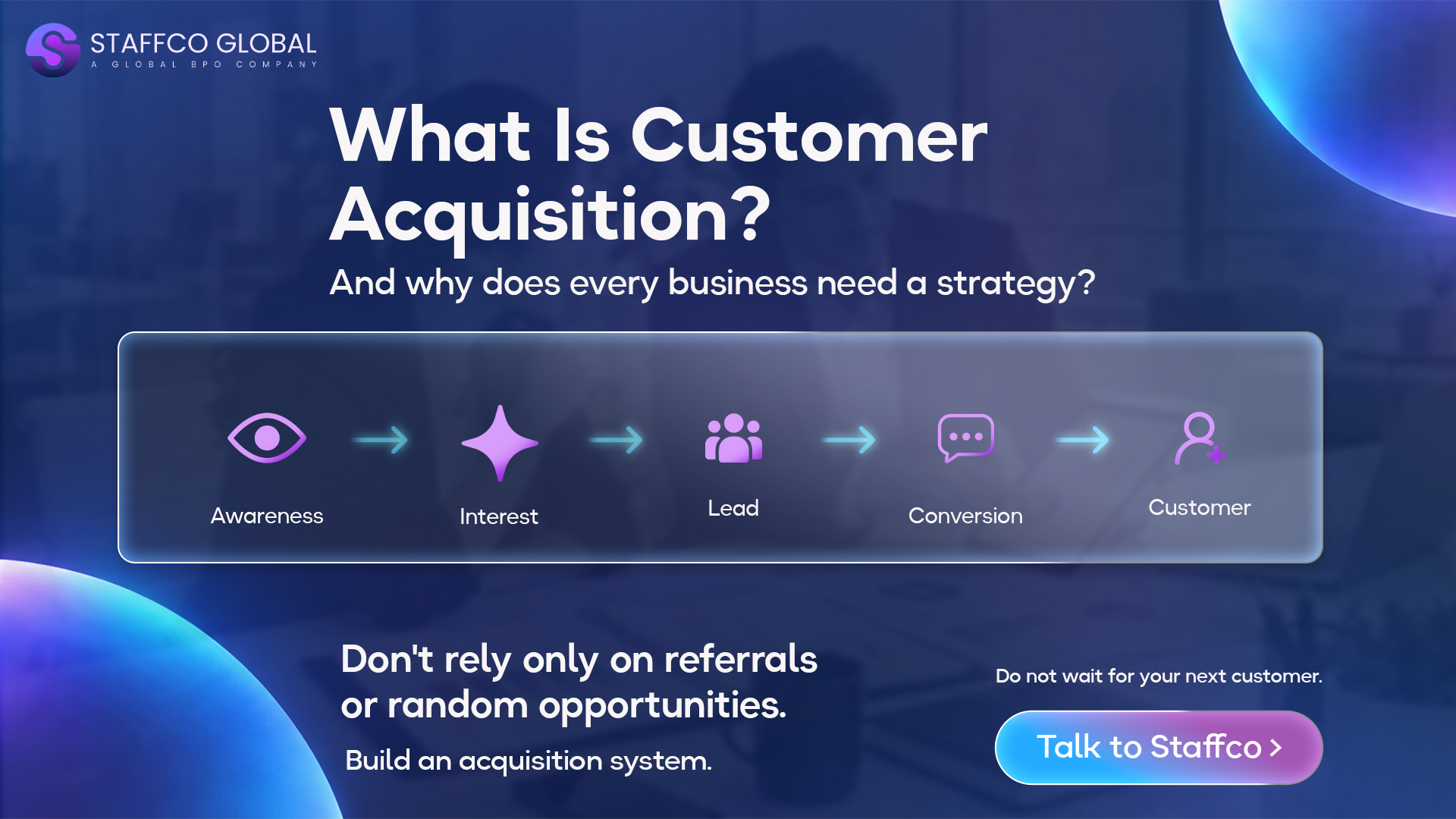
A simple customer acquisition journey looks like this:
Awareness → Interest → Lead → Conversation → Customer
When these stages work together, marketing becomes more closely connected to business growth.
What Is Customer Acquisition?
Customer acquisition is the process a business uses to attract, engage, convert, and gain new customers.
It includes the marketing and sales activities that move someone from being unfamiliar with your business to becoming a customer.
Customer acquisition can involve:
- Search engine optimization
- Content marketing
- Social media marketing
- Paid advertising
- Email marketing
- Lead generation
- Landing pages
- Sales outreach
- Consultations
- Referrals
- Strategic partnerships
The specific channels will vary from business to business.
A local service company may rely heavily on local search, referrals, and paid search.
A B2B company may use content marketing, LinkedIn, outbound sales, webinars, and strategic partnerships.
An ecommerce company may focus on search, paid advertising, social media, email marketing, and retargeting.
There is no single customer acquisition channel that works for every business.
The important part is having a strategy behind the channels you choose.
Why Does Customer Acquisition Matter?
A business cannot depend entirely on existing customers forever.
Even businesses with strong retention eventually need to attract new customers to continue growing.
Customer acquisition provides the foundation for expanding your customer base.
Without a consistent acquisition process, businesses may experience unpredictable sales cycles.
One month may be strong because several referrals came in.
The next month may be slow because those referrals stopped.
A customer acquisition strategy helps create a more predictable process for generating new business.
Instead of waiting for the next opportunity, your business actively creates opportunities.
Customer Acquisition vs. Marketing
Marketing and customer acquisition are closely connected, but they are not exactly the same.
Marketing is broader.
It includes the activities businesses use to communicate with audiences, build awareness, establish their brand, create demand, and promote their products or services.
Customer acquisition focuses specifically on gaining new customers.
For example, a social media post may increase awareness.
A blog article may educate a potential customer.
An advertisement may generate interest.
A landing page may capture a lead.
A consultation may create a sales opportunity.
A sales process may convert that opportunity into a customer.
The customer acquisition strategy connects these activities together.
The Five Stages of Customer Acquisition
A simple acquisition system can be organized into five stages:
Awareness → Interest → Lead → Conversation → Customer
Each stage has a different purpose.
Let's look at how they work.
1. Awareness: Getting Discovered
Before someone can become a customer, they need to know your business exists.
Awareness is the first stage of customer acquisition.
Your business can build awareness through:
- Search engines
- Social media
- Paid advertising
- Content
- Video
- Public relations
- Events
- Partnerships
- Referrals
The objective is to reach people who may have a need for what your business provides.
But awareness alone does not create customers.
Someone can see your advertisement or social media post and never take another action.
That is why awareness needs to lead to interest.
2. Interest: Giving People a Reason to Pay Attention
Once people discover your business, your marketing needs to give them a reason to continue paying attention.
This is where interest develops.
Potential customers may become interested when they:
- Recognize a problem
- Discover a need
- See a potential opportunity
- Learn something useful
- Identify with your message
- Understand your solution
Your marketing should help prospects understand why your business is relevant to them.
For example, instead of simply saying:
"We provide marketing services."
A growth-focused message might explain:
"We help businesses increase visibility, generate qualified leads, and acquire customers."
The second message connects the service to an outcome.
That connection can help move a prospect from awareness toward interest.
3. Lead: Turning Interest Into an Opportunity
Interest becomes valuable when a potential customer takes an identifiable action.
That is where lead generation comes in.
A lead is someone who has shown enough interest to take a step toward communicating with your business.
Examples include someone who:
- Completes a contact form
- Requests information
- Books a consultation
- Calls your business
- Sends a direct message
- Requests a quote
- Downloads a resource
- Schedules a meeting
Lead generation creates an opportunity for the business to continue the conversation.
This is an important transition.
Before the lead, the business may only know that someone viewed its content or visited its website.
After the lead, the business has an opportunity to communicate directly with a potential customer.
4. Conversation: Understanding the Prospect
Generating a lead does not automatically mean you have acquired a customer.
The next stage is the conversation.
Depending on the business, this could be:
- A sales call
- A consultation
- A product demonstration
- An email conversation
- A discovery meeting
- A proposal
- A personalized follow-up
The purpose is to understand the prospect's needs and determine whether your solution is a good fit.
This stage is where marketing and sales often come together.
Marketing creates awareness, demand, and leads.
Sales and business development help move qualified opportunities toward a purchase.
When these functions work together, customer acquisition becomes more effective.
5. Customer: Turning Opportunity Into Business
The final stage is acquiring the customer.
This happens when a qualified prospect chooses to purchase your product or service.
But customer acquisition should not end with the transaction.
A successful acquisition strategy should also consider what happens afterward.
The customer experience can influence:
- Repeat business
- Referrals
- Reviews
- Customer lifetime value
- Cross-selling
- Upselling
- Brand reputation
Acquiring a customer is the beginning of a relationship, not necessarily the end of the marketing process.
Why Referrals Alone Are Not Enough
Referrals can be an excellent source of business.
They often come with trust already established, which can make the sales process easier.
However, referrals are difficult to control.
You cannot always predict when a customer will recommend your company.
You also cannot easily scale referrals at the same rate as a structured marketing and acquisition system.
If referrals are your only meaningful source of new business, your growth may become dependent on factors outside your control.
A customer acquisition strategy gives your business additional ways to reach potential customers.
You can actively create awareness.
You can generate demand.
You can capture leads.
You can start conversations.
You can measure the results.
That creates more control over your growth process.
What Makes a Customer Acquisition Strategy Effective?
A strong customer acquisition strategy starts with the business objective.
Before choosing a marketing channel, ask:
What are we trying to achieve?
Are we trying to increase awareness?
Generate qualified leads?
Enter a new market?
Acquire a specific type of customer?
Increase revenue?
Reduce customer acquisition costs?
Once the objective is clear, the strategy can determine which marketing channels make sense.
This is why businesses should not start with:
"We need to post more."
"We need to run ads."
"We need a new website."
"We need more followers."
Those are tactics.
The better starting point is:
"What do we need to accomplish?"
Then determine which tactics can help achieve that goal.
Customer Acquisition Requires the Right Audience
Not every potential customer is the right customer.
Your acquisition strategy should begin by identifying the audience most likely to benefit from your product or service.
Consider:
- Industry
- Company size
- Location
- Job title
- Business needs
- Buying behavior
- Budget
- Pain points
- Goals
- Decision-making process
Understanding your audience allows you to build more relevant messaging and choose more effective channels.
The goal is not to reach everyone.
The goal is to reach the right people.
Customer Acquisition Requires Strong Positioning
Once you know who you want to reach, you need to communicate why they should care.
Positioning helps your business answer:
Who do we help?
What problem do we solve?
What makes our approach different?
What outcome do we help create?
Strong positioning makes marketing clearer.
It helps potential customers quickly understand whether your business is relevant to them.
Without clear positioning, businesses can spend money reaching people without giving them a compelling reason to take action.
Customer Acquisition Requires Consistent Marketing
A customer may not become a customer after seeing your business once.
They may need multiple interactions before they are ready to act.
They might:
Discover your company on social media.
Visit your website.
Read a blog.
See an advertisement.
Watch a video.
Read a case study.
Return to your website.
Then contact your team.
This is why consistent marketing matters.
Consistency creates familiarity and gives potential customers more opportunities to understand your business.
However, consistency should not mean producing content without purpose.
Every marketing activity should contribute to a larger objective.
Customer Acquisition Requires Measurement
You cannot improve what you do not understand.
A customer acquisition strategy should track meaningful performance data.
Important metrics can include:
- Qualified leads
- Lead conversion rate
- Customer acquisition cost
- Website conversion rate
- Cost per lead
- Lead source
- Campaign performance
- Sales conversion rate
- Customer lifetime value
These metrics help answer important questions.
Which channels are generating qualified leads?
Which campaigns are producing customers?
Where are prospects dropping out?
Which marketing investments are creating the strongest results?
Measurement allows businesses to make better decisions.
Build a Repeatable Customer Acquisition System
The goal of customer acquisition is not simply to generate one successful campaign.
The goal is to build a repeatable system.
A strong system can look like this:
Strategy
Define the growth objective and target customer.
↓
Positioning
Communicate your value clearly.
↓
Awareness
Reach potential customers.
↓
Interest
Create demand around their problems and goals.
↓
Lead Generation
Give prospects a clear opportunity to take action.
↓
Conversation
Understand their needs and demonstrate your value.
↓
Customer Acquisition
Convert qualified opportunities into customers.
↓
Measurement
Track performance.
↓
Optimization
Improve the process continuously.
This creates a marketing engine that can become more predictable over time.
Customer Acquisition Is a Growth Strategy
Customer acquisition should not be treated as a single marketing activity.
It is a business growth system.
Social media can create awareness.
Content can create demand.
SEO can help people discover your business.
Advertising can generate targeted traffic.
Landing pages can capture leads.
Sales can convert opportunities.
Customer experience can increase retention and referrals.
The acquisition strategy connects these pieces.
That connection is what makes the system powerful.
How Staffco Thinks About Customer Acquisition
At Staffco Global, our focus is Growth & Acquisition.
We believe businesses should not simply "do marketing."
Marketing should have a purpose.
It should help businesses become more visible, create demand, generate qualified leads, and acquire customers.
The right strategy may include content, social media, paid advertising, SEO, creative, web experiences, or other marketing channels.
But the channel is not the strategy.
The strategy determines which channels make sense based on the business goal.
That is the difference between marketing activity and growth marketing.
Stop Waiting for Your Next Customer
Your next customer should not always depend on a referral, a random opportunity, or someone happening to discover your business.
A strong customer acquisition strategy creates a repeatable path from:
Awareness → Interest → Lead → Conversation → Customer
When that system is continuously measured and improved, your marketing becomes more connected to business growth.
The goal is not simply to get more attention.
The goal is to turn attention into opportunity and opportunity into customers.
Build an Acquisition System Instead of Waiting
If your business has a strong product or service but your customer flow feels unpredictable, it may be time to build a more structured acquisition strategy.
At Staffco Global, we help businesses connect marketing activity to growth objectives through strategies focused on visibility, demand generation, lead generation, conversion, and customer acquisition.
Build an acquisition system instead of waiting for your next customer.
Talk to Staffco About Your Growth Strategy