What Does a Scalable Marketing System Look Like?
What Does a Scalable Marketing System Look Like?
Many businesses are constantly doing marketing.
They publish social media posts.
They create videos.
They run advertisements.
They update their website.
They send emails.
They publish blog articles.
They may even generate website traffic and engagement.
But there is a problem.
The activities are often disconnected.
There is no clear system connecting marketing activity to business growth.
As a result, marketing can become reactive instead of strategic.
One month may be busy with campaigns and content.
The next month may be quiet.
One campaign may generate leads.
Another may generate traffic but no customers.
A scalable marketing system solves this problem by connecting the major components of marketing into a repeatable process designed to support growth.
The goal isn't to constantly "do marketing."
The goal is to build a system that continuously supports growth.
What Is a Scalable Marketing System?
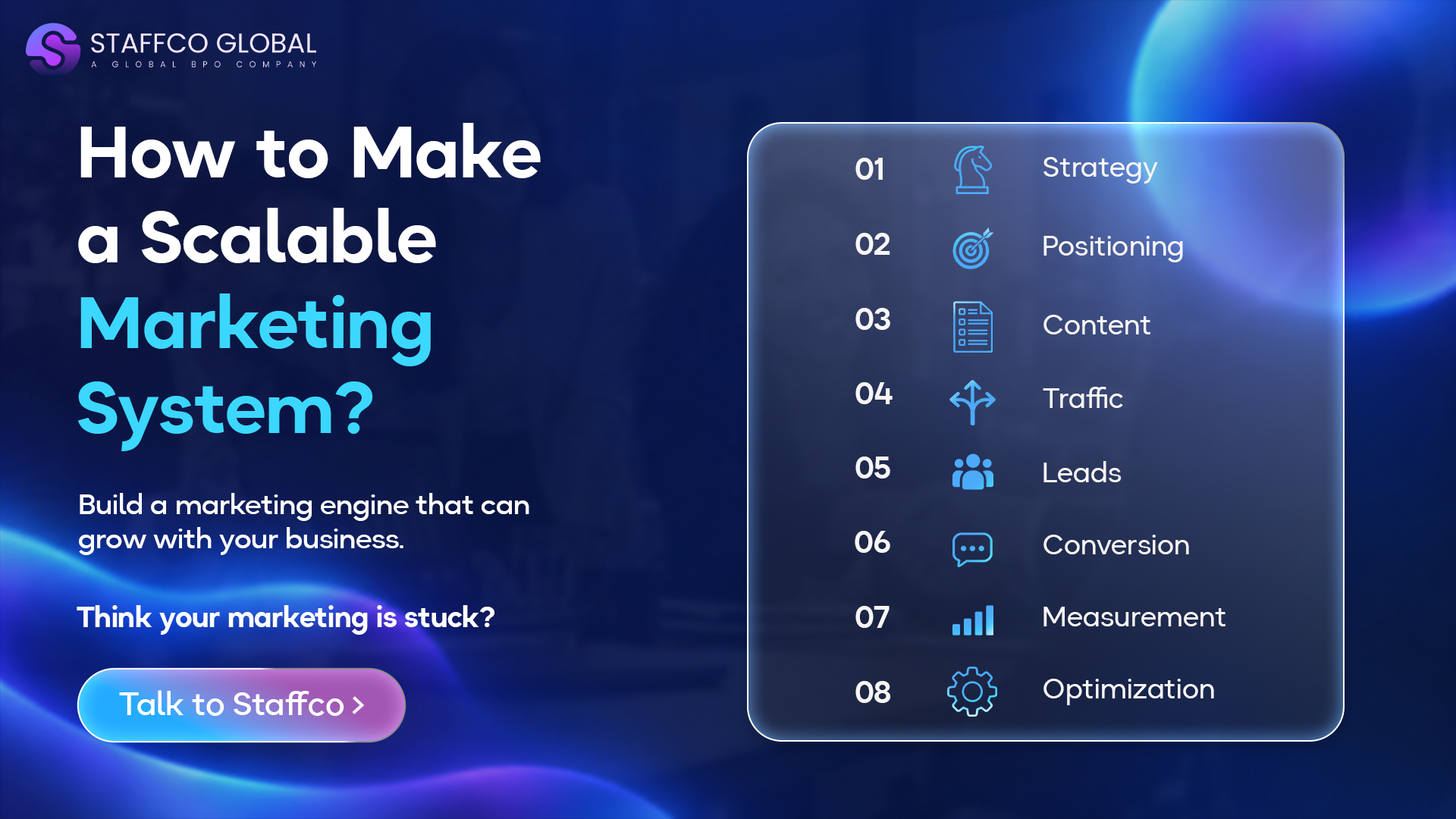
A scalable marketing system is a structured process that connects marketing strategy, positioning, content, traffic, lead generation, conversion, measurement, and optimization.
Instead of treating every marketing activity as an individual task, the system connects them around a common business objective.
A simplified scalable marketing system looks like this:
Strategy → Positioning → Content → Traffic → Leads → Conversion → Measurement → Optimization
Each stage has a specific purpose.
When the stages work together, businesses can create a more predictable path from marketing activity to customer acquisition and growth.
Why Businesses Need a Scalable Marketing System
Marketing becomes difficult to scale when everything depends on individual efforts.
If your marketing only works when someone remembers to post, launch an advertisement, or create new content, your growth process may be difficult to predict.
A scalable system creates structure.
It helps businesses answer:
- Who are we trying to reach?
- What do we want to accomplish?
- What message should we communicate?
- What content should we create?
- How will people discover us?
- How will we generate leads?
- How will we convert those leads?
- What is working?
- What needs to improve?
These questions create a foundation for repeatable growth.
1. Strategy: Start With the Growth Goal
The first stage of a scalable marketing system is strategy.
Before choosing a social media platform, advertising campaign, content format, or website update, define what the business is trying to achieve.
Your growth objective might be:
- Generate more qualified leads
- Acquire more customers
- Increase revenue
- Enter a new market
- Improve customer acquisition costs
- Increase brand awareness
- Launch a new service
- Improve conversion rates
The marketing strategy should support the business objective.
Start With the Outcome
Instead of asking:
"What should we post this week?"
Ask:
"What does the business need marketing to accomplish?"
That shift changes how you approach every marketing decision.
The goal determines the strategy.
The strategy determines the channels.
The channels determine the tactics.
The tactics should support the outcome.
2. Positioning: Make Your Value Clear
Once the objective is defined, the next step is positioning.
Positioning determines how your business is understood by the market.
Your audience should quickly understand:
- Who you help
- What you do
- What problem you solve
- What makes you different
- What outcome you create
Weak positioning makes marketing harder.
If people don't understand why your business is relevant, even strong marketing campaigns can struggle.
Strong Positioning Connects Problems to Outcomes
Instead of focusing only on services, communicate the value behind them.
For example:
"We provide digital marketing services."
is a description.
"We help businesses increase visibility, generate qualified leads, and acquire customers."
is a growth-oriented positioning statement.
The second message connects the service to a business outcome.
That is much more useful for a growth strategy.
3. Content: Create Marketing With a Purpose
Content is one of the main engines of a scalable marketing system.
But content should not simply fill a social media calendar.
Every piece of content should have a role.
Content can help:
- Build awareness
- Educate prospects
- Create demand
- Demonstrate expertise
- Build trust
- Generate leads
- Support conversion
- Retain customers
Different content serves different stages of the customer journey.
For example:
A short social media post may create awareness.
A blog article may answer a search question.
A case study may build trust.
A comparison article may support consideration.
A landing page may generate a lead.
The goal is to create content that supports the larger acquisition strategy.
4. Traffic: Get in Front of the Right People
Great content doesn't create growth if nobody sees it.
The next component is traffic.
Businesses can generate traffic through:
- Search engine optimization
- Social media
- Paid advertising
- Email marketing
- Content distribution
- Partnerships
- Referral marketing
- Direct outreach
- Industry platforms
The right combination depends on the audience and business model.
Traffic Quality Matters
The goal isn't simply more traffic.
The goal is relevant traffic.
A website receiving 100,000 visitors who have no interest in your services may generate fewer opportunities than a website receiving 5,000 highly relevant visitors.
A scalable marketing system focuses on reaching the right people.
5. Leads: Turn Attention Into Opportunity
Traffic becomes valuable when interested visitors have an opportunity to take action.
This is where lead generation enters the system.
Lead generation can include:
- Contact forms
- Consultation requests
- Quote requests
- Appointment bookings
- Downloads
- Direct messages
- Email signups
- Demonstration requests
The objective is to turn anonymous attention into identifiable prospects.
Build a Clear Lead Path
The customer should understand what to do next.
For example:
Content
↓
Landing Page
↓
Offer
↓
Call to Action
↓
Lead
The simpler and clearer this path is, the easier it can be for interested prospects to take action.
6. Conversion: Turn Leads Into Customers
A lead is not automatically a customer.
The next stage is conversion.
Conversion can involve:
- Sales calls
- Consultations
- Proposals
- Demonstrations
- Follow-up
- Email communication
- Offers
- Testimonials
- Case studies
The marketing and sales processes need to work together.
Marketing creates awareness, demand, and opportunities.
The conversion process helps turn qualified opportunities into customers.
Don't Stop at Lead Generation
A common marketing mistake is focusing entirely on lead volume.
100 leads may sound better than 20 leads.
But if those 20 leads are significantly more qualified and convert at a higher rate, they may create more business.
A scalable system measures the quality of leads, not just the quantity.
7. Measurement: Know What Is Working
You cannot scale what you cannot measure.
Measurement allows businesses to understand which parts of their marketing system are producing results.
Important metrics can include:
- Website traffic
- Qualified leads
- Lead conversion rate
- Cost per lead
- Customer acquisition cost
- Conversion rate
- Appointments
- Sales opportunities
- Customers acquired
- Revenue generated
The exact metrics depend on the business objective.
The important thing is connecting marketing data to business outcomes.
Move Beyond Vanity Metrics
Views, likes, and followers can help measure awareness.
But growth-focused marketing should also measure:
- Leads
- Customers
- Revenue
- Acquisition costs
- Conversion
The goal is to understand whether marketing is contributing to growth.
8. Optimization: Make the System Better
A scalable marketing system is not static.
It improves over time.
Once you have data, you can identify where the system is underperforming.
Maybe your traffic is strong but conversion is weak.
Maybe your content generates traffic but few leads.
Maybe you generate many leads but few become customers.
Maybe one channel generates significantly better customers than another.
Optimization means finding these bottlenecks and improving them.
Improve the Biggest Bottleneck First
Don't change everything at once.
Identify the biggest problem.
If traffic is low, improve distribution.
If leads are low, improve the offer or conversion path.
If lead quality is poor, improve targeting.
If customers aren't converting, improve the sales and conversion process.
If acquisition costs are too high, optimize your channels and campaigns.
Small improvements across the system can compound into meaningful growth.
The Difference Between Marketing Activity and a Marketing System
Consider two businesses.
Business A
Posts three times a week.
Runs occasional advertisements.
Creates videos when there is time.
Updates the website occasionally.
Sends emails inconsistently.
Measures likes and views.
Business B
Defines a growth objective.
Targets a specific audience.
Uses clear positioning.
Creates content around customer problems.
Distributes content through selected channels.
Drives traffic to relevant pages.
Captures qualified leads.
Follows up consistently.
Measures performance.
Optimizes the system.
Business B is not necessarily doing more marketing.
It is doing marketing with a system.
That is the difference.
A Scalable Marketing System Connects Everything
The complete framework looks like this:
Strategy
Define the growth objective.
↓
Positioning
Communicate your value clearly.
↓
Content
Create useful marketing assets.
↓
Traffic
Reach the right audience.
↓
Leads
Turn interest into opportunities.
↓
Conversion
Turn opportunities into customers.
↓
Measurement
Understand performance.
↓
Optimization
Improve the system.
↓
Growth
Create a more predictable path to business growth.
Every stage supports the next.
Why a Scalable System Is Better Than Constant Marketing
Without a system, businesses can become dependent on constant effort.
Every week starts from zero.
Every campaign feels separate.
Every content piece has to be invented from scratch.
Every marketing decision becomes reactive.
A scalable system creates structure.
You can build:
- Repeatable content processes
- Consistent acquisition channels
- Standardized lead capture
- Organized follow-up
- Performance dashboards
- Testing processes
- Optimization cycles
This makes marketing easier to manage as the business grows.
Scalability Does Not Mean Doing Everything Automatically
A scalable marketing system does not mean removing humans from marketing.
It means creating processes that can handle increasing volume without requiring the same increase in effort.
For example, a business might create a content framework that allows one strategic topic to become:
- A blog article
- LinkedIn posts
- Instagram posts
- Short-form videos
- Email content
- A downloadable resource
One strategic idea can support multiple channels.
That is a form of scalability.
Scalable Marketing Requires Consistency
A system only works when it is consistently executed.
Consistency helps create:
- Brand familiarity
- Audience trust
- Search visibility
- Content momentum
- Lead opportunities
- Performance data
But consistency should not mean publishing content simply because the calendar says it is time to post.
The content should remain connected to the strategy.
Every campaign should have a purpose.
Every channel should have a role.
Every CTA should support the customer journey.
Build Around the Customer Journey
A scalable marketing system should follow the way customers actually make decisions.
A simplified journey is:
Discover
↓
Understand
↓
Trust
↓
Consider
↓
Contact
↓
Customer
↓
Retain
Your marketing should provide the right information at each stage.
Awareness content can help people discover you.
Educational content can help them understand their problem.
Case studies can build trust.
Offers can create action.
Sales conversations can support conversion.
Customer communication can support retention.
This creates a connected customer experience.
The Role of Technology in a Scalable Marketing System
Technology can help businesses manage and scale marketing processes.
Examples include:
- CRM systems
- Marketing analytics
- Email automation
- Lead tracking
- Advertising platforms
- Content management systems
- Website analytics
- Conversion tracking
- Reporting dashboards
But technology should support the strategy.
Technology cannot fix unclear positioning or a weak offer.
The system should come first.
The tools should support the system.
How to Build a Scalable Marketing System
If your marketing feels disconnected, start with these steps.
Step 1: Define Your Growth Goal
Choose the business outcome you want marketing to support.
Step 2: Identify Your Audience
Determine who you need to reach.
Step 3: Clarify Your Positioning
Explain what problem you solve and why your business matters.
Step 4: Build Your Content Strategy
Create content around the problems and questions your audience cares about.
Step 5: Choose Your Channels
Focus on the channels where your audience is most likely to discover you.
Step 6: Create a Lead Generation Process
Give interested prospects a clear opportunity to take action.
Step 7: Build Your Conversion Path
Create a clear process for turning qualified leads into customers.
Step 8: Measure Performance
Track the metrics connected to your business objective.
Step 9: Optimize
Identify bottlenecks and improve them continuously.
This turns marketing from a series of activities into a repeatable growth system.
What Should You Automate?
Once the strategy is working, technology can help automate repetitive processes.
Potential areas include:
- Lead notifications
- Email follow-up
- Appointment reminders
- Reporting
- Lead routing
- Data collection
- Campaign tracking
- Customer communication
Automation can improve efficiency.
But automation should come after strategy.
Don't automate a process simply because it exists.
First determine whether the process is effective.
Then determine whether technology can make it more efficient.
How to Know If Your Marketing System Is Scalable
Ask yourself:
Can someone else understand our marketing strategy?
Do we know exactly who we're targeting?
Is our positioning consistent?
Do we have a repeatable content process?
Do we know which channels generate qualified traffic?
Do we have a defined lead generation process?
Do we have a clear conversion path?
Are we measuring performance?
Do we regularly optimize?
Can we increase marketing volume without rebuilding the entire process?
If the answer to most of these questions is no, your marketing may still depend too heavily on individual activities rather than a scalable system.
The Goal Is Not More Marketing
This is the most important point.
The goal isn't to constantly "do marketing."
The goal is to build a marketing engine that continuously supports growth.
That means:
Strategy creates direction.
Positioning creates clarity.
Content creates value.
Traffic creates visibility.
Lead generation creates opportunity.
Conversion creates customers.
Measurement creates understanding.
Optimization creates improvement.
Together, these components create a system.
Build a Marketing Engine That Can Grow With Your Business
Your business should not have to reinvent its marketing every month.
It should have a system that becomes stronger as you learn more about your audience, your channels, and your customers.
At Staffco Global, our focus is Growth & Acquisition.
We help businesses build marketing strategies that connect visibility, demand generation, lead generation, conversion, and customer acquisition.
The objective isn't simply to produce more content or run more campaigns.
It is to create a marketing engine that supports measurable business growth.
Build a marketing engine that can grow with your business.
Talk to Staffco About Your Growth Strategy