The Difference Between Marketing and Growth
The Difference Between Marketing and Growth
Marketing and business growth are often treated as if they mean the same thing.
They don't.
A business can have an active social media presence, run paid advertising, publish content, and have a professionally designed website without having a real growth strategy.
Marketing creates opportunities.
Growth connects those opportunities to business results.
This distinction matters because businesses don't grow simply because they are marketing themselves. They grow when their marketing activities work together to create awareness, generate demand, attract qualified leads, convert prospects into customers, and build lasting customer relationships.
If your marketing feels like a collection of disconnected activities, it may be time to look at the bigger picture.
What Is Marketing?
Marketing is the process of communicating your business's value to the people you want to reach.
It can include:
- Social media marketing
- Content marketing
- Search engine optimization
- Paid advertising
- Email marketing
- Website marketing
- Branding
- Video marketing
- Public relations
- Digital campaigns
Each of these activities can play an important role in attracting attention and building relationships with potential customers.
But individual marketing activities are only tools.
The bigger question is what those tools are designed to accomplish.
A business may post five times a week, run advertisements, publish blogs, and send emails. If those activities aren't connected to a clear business objective, the company may be spending time and money without creating predictable growth.
What Is Business Growth?
Business growth is the measurable improvement of a company's ability to generate revenue, customers, market presence, and long-term value.
Growth can involve:
- Acquiring more customers
- Increasing qualified leads
- Expanding into new markets
- Increasing revenue
- Improving customer retention
- Increasing customer lifetime value
- Building stronger brand awareness
- Improving conversion rates
Marketing can support all of these objectives.
But marketing itself is not the final objective.
The goal is to create a system where marketing contributes directly to business growth.
Marketing vs. Growth: What's the Difference?
The simplest way to understand the difference is this:
Marketing asks:
"How do we reach and engage our audience?"
Growth asks:
"How do we turn that attention into measurable business results?"
Marketing may focus on impressions, engagement, traffic, content, and campaigns.
A growth strategy looks at the entire customer journey and asks how each stage contributes to acquiring and retaining customers.
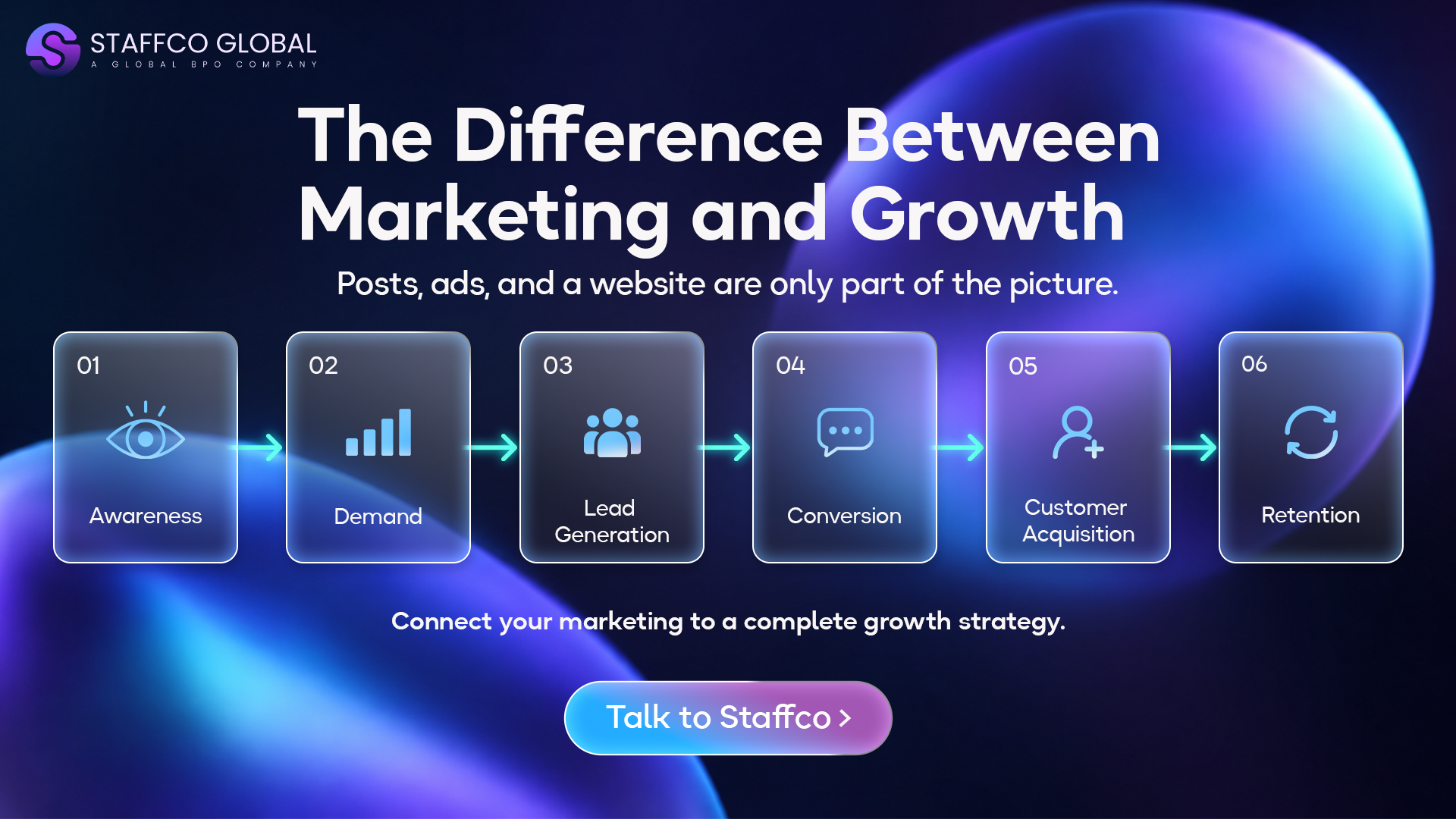
That journey can be broken into six important stages:
- Awareness
- Demand
- Lead Generation
- Conversion
- Customer Acquisition
- Retention
Let's look at each one.
1. Awareness: Getting Your Business Discovered
Before someone can become a customer, they need to know your business exists.
Awareness is the first stage of the growth process.
Your business may create awareness through:
- Social media
- Search engines
- Advertising
- Video
- Content marketing
- Public relations
- Partnerships
- Referrals
- Events
The objective is to put your business in front of the right audience.
But awareness alone isn't enough.
Thousands of people can see your content without ever becoming customers.
That is why awareness should be connected to the next stage: demand.
2. Demand: Giving People a Reason to Care
Awareness gets your business noticed.
Demand gives people a reason to pay attention.
Demand generation is about helping your audience understand a problem, recognize an opportunity, and see why your business may be able to help.
For example, a company may publish an article explaining why businesses struggle to generate qualified leads.
The article creates awareness.
But when it helps a business owner recognize that inconsistent lead generation is affecting their growth, it begins creating demand for a solution.
Effective marketing doesn't just say:
"Here is our company."
It communicates:
"Here is a problem you may be experiencing, and here is why solving it matters."
3. Lead Generation: Turning Interest Into Opportunity
Once someone becomes interested, your marketing needs to give them an opportunity to take action.
This is where lead generation comes in.
Lead generation can include:
- Contact forms
- Consultation requests
- Phone calls
- Email inquiries
- Downloads
- Newsletter signups
- Demo requests
- Appointment bookings
- Direct messages
The objective is to turn anonymous attention into an identifiable prospect.
This is one of the biggest differences between marketing activity and growth strategy.
A social media post may receive thousands of views.
But if the post creates no meaningful next step, its contribution to customer acquisition may be limited.
Growth-focused marketing asks:
"How can we turn this attention into an opportunity?"
4. Conversion: Turning Leads Into Customers
Generating leads is important.
But leads alone don't create revenue.
Businesses also need a conversion strategy.
Conversion is the process of moving a potential customer from interest toward becoming an actual customer.
This can involve:
- Strong offers
- Clear messaging
- Effective landing pages
- Sales follow-up
- Consultations
- Demonstrations
- Testimonials
- Case studies
- Clear calls to action
- A simple customer journey
Your marketing and sales processes need to work together.
If marketing generates leads but the conversion process is weak, growth will be limited.
This is why a growth strategy looks beyond marketing campaigns and considers the entire path from first interaction to customer.
5. Customer Acquisition: Turning Strategy Into Growth
Customer acquisition is where the pieces begin to come together.
Customer acquisition is the process of attracting, converting, and gaining new customers through your marketing and sales efforts.
A strong customer acquisition strategy considers:
- Who you want to reach
- Where they spend time
- What they need
- What message will resonate
- What offer will attract them
- How they will contact you
- How they will become customers
- How much it costs to acquire them
This is where marketing becomes directly connected to business growth.
Instead of asking:
"How many posts should we publish?"
You start asking:
"How can we acquire more of the right customers?"
That is a fundamentally different approach.
6. Retention: Growth Doesn't End With the First Sale
Acquiring a customer is only part of the growth equation.
Keeping that customer matters too.
Customer retention can improve the long-term value of your marketing investment because existing customers may purchase again, expand their relationship with your company, and recommend your business to others.
Retention strategies can include:
- Customer communication
- Email marketing
- Educational content
- Customer support
- Loyalty programs
- Personalized experiences
- Follow-up campaigns
- Cross-selling
- Upselling
A strong growth strategy considers the entire customer lifecycle, not just the first transaction.
Why Social Media Is Not a Growth Strategy by Itself
Social media can be an extremely valuable marketing channel.
But social media alone is not a growth strategy.
Posting content can create awareness.
A strong content strategy can create demand.
A clear call to action can generate leads.
A good sales process can convert those leads.
Customer experience and retention can create long-term value.
The growth strategy connects all of these stages.
Without that connection, businesses can become focused on vanity metrics such as:
- Followers
- Likes
- Views
- Impressions
These metrics can be useful, but they don't tell the entire story.
The more important question is:
"Is our marketing helping us acquire the right customers?"
Why Having a Website Is Not a Growth Strategy
A website is another important marketing tool.
But simply having a website does not guarantee business growth.
A website should support your overall acquisition strategy.
It should help visitors:
Understand your business
Understand your value
Recognize their problem
Trust your company
Explore your solution
Take the next step
A website becomes much more valuable when it is connected to content, search, advertising, social media, lead generation, analytics, and conversion.
The website is part of the system.
It is not the system itself.
Why Running Ads Is Not a Growth Strategy
Paid advertising can generate significant results when it is strategically managed.
But spending money on advertisements doesn't automatically create growth.
A successful advertising strategy needs:
- The right audience
- The right offer
- The right message
- The right creative
- The right landing page
- The right conversion process
- Proper tracking
- Continuous optimization
Without these elements, a business can spend more money without necessarily acquiring more customers.
Growth-focused advertising starts with the business objective and works backward toward the campaign.
The Difference Between Marketing Activity and Growth Strategy
Consider these two approaches.
Marketing Activity
"We need to post three times this week."
"We should run an ad."
"We need a new website."
"We should create more videos."
"We need more followers."
These are individual activities.
Growth Strategy
"We need to increase qualified leads by 30%."
"Which audience should we target?"
"What message will create demand?"
"Which channel can reach them?"
"What offer will generate action?"
"How will we convert those leads?"
"What is our customer acquisition cost?"
"How can we improve the results?"
This is a growth strategy.
The difference is the objective.
A Growth Strategy Connects Everything
A strong growth strategy creates a clear connection between your marketing activities and your business objectives.
The system can look like this:
Strategy
Define the business goal.
↓
Positioning
Clarify who you help and why you are different.
↓
Awareness
Get your business discovered by the right audience.
↓
Demand Generation
Give prospects a reason to care.
↓
Lead Generation
Turn interest into identifiable opportunities.
↓
Conversion
Turn opportunities into customers.
↓
Retention
Build long-term customer value.
↓
Measurement
Track what is working.
↓
Optimization
Improve the system continuously.
This is what turns marketing from a list of activities into a growth engine.
How to Know If Your Marketing Is Actually Supporting Growth
Ask your business these questions:
Are we reaching the right audience?
Do people understand what makes us different?
Are we consistently generating demand?
Are our marketing activities generating qualified leads?
Do we know where our leads come from?
Do we know our customer acquisition cost?
Are our leads converting into customers?
Are we measuring marketing performance?
Are we retaining our customers?
Are we continuously improving our marketing strategy?
If you cannot answer these questions, your business may have marketing activities without a complete growth strategy.
Marketing Should Have a Business Objective
Marketing should never exist simply because a business believes it "needs to do marketing."
Every marketing activity should have a purpose.
A social media campaign should support an objective.
A blog should support an objective.
An advertisement should support an objective.
A website should support an objective.
A video should support an objective.
That objective could be awareness, demand generation, lead generation, conversion, customer acquisition, or retention.
When those objectives connect together, marketing becomes much more powerful.
Build Marketing Around Growth
The best marketing strategy isn't necessarily the one with the most posts, the biggest advertising budget, or the most followers.
It is the strategy that connects the right audience with the right message and creates a clear path toward becoming a customer.
Business growth requires more than visibility.
It requires a system.
Awareness creates visibility.
Demand creates interest.
Lead generation creates opportunity.
Conversion creates customers.
Customer acquisition creates growth.
Retention creates long-term value.
When these pieces work together, marketing becomes more than communication.
It becomes a growth engine.
Ready to Connect Your Marketing to Growth?
If your marketing feels like a collection of disconnected activities, the problem may not be that you need to do more marketing.
You may need a strategy that connects everything.
At Staffco Global, we help businesses build marketing strategies around growth, visibility, demand generation, lead generation, and customer acquisition.
The goal isn't simply to make your business look active.
The goal is to build marketing that contributes to business growth.
If your marketing feels like a collection of disconnected activities, Staffco can help build a growth strategy around your business.
Talk to Staffco About Your Growth Strategy