Social Search Is Changing How Customers Discover Businesses
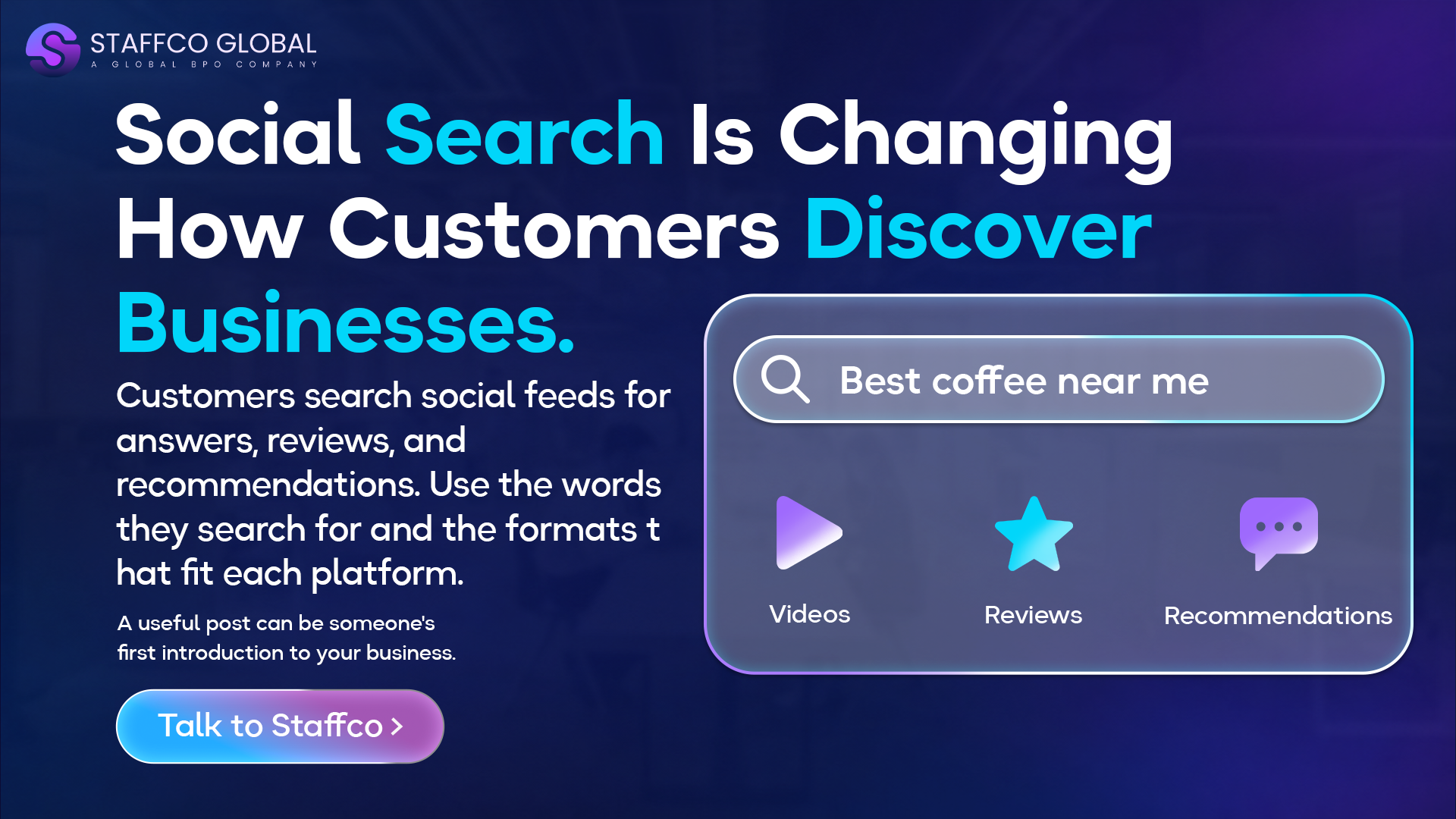
Social Search Is Changing How Customers Discover Businesses
STAFFCO GLOBAL · GROWTH & ACQUISITION | NOVEMBER 2026
The way customers discover businesses is changing. Not long ago, the typical customer journey started with a search engine. Someone needed a product or service, entered a few keywords into Google, compared websites, and eventually contacted a business.
Today, that journey can begin almost anywhere.
A customer might discover a company through a TikTok video, find a recommendation in an Instagram post, watch a YouTube review, browse comments on Facebook, or search LinkedIn for an industry expert. Before visiting a company's website, they may already have seen its content, evaluated its reputation, and formed an opinion about its services.
This shift is changing the role of social media.
Social platforms are no longer just channels for publishing updates or building followers. They are increasingly becoming discovery environments where people search for information, evaluate businesses, and decide whom to trust.
For businesses, this creates an important opportunity: your social content can be both a marketing asset and a discovery asset.
What Is Social Search?
Social search is the process of using social media platforms to find information, businesses, products, services, recommendations, and answers.
Instead of relying exclusively on traditional search engines, people use the search features and recommendation systems within platforms such as:
- TikTok: Discovering products, tutorials, recommendations, and real-world experiences.
- Instagram: Exploring brands, services, visual portfolios, customer feedback, and industry content.
- YouTube: Finding detailed explanations, product demonstrations, reviews, and educational videos.
- Facebook: Researching local businesses, reading community recommendations, and exploring customer discussions.
- LinkedIn: Discovering professional services, industry insights, business solutions, and potential partners.
The important difference is that social search combines search with content, community, and personal recommendations.
Customers are not simply looking for a business name. They want to see what a business does, how it operates, what others say about it, and whether it can solve their particular problem.
That means businesses need to think beyond posting regularly. They need to create content that answers the questions customers are already asking.
Why Customers Are Searching on Social Media
Modern customers want more than a list of websites. They want context, examples, opinions, and evidence.
Social platforms make it possible to explore these elements in one place.
1. People Want Real Examples, Not Just Marketing Claims
A traditional advertisement tells customers what a company offers. Social content can show them.
A potential customer researching an insurance agency, for example, might want to understand how the agency helps clients, what types of coverage it handles, and what working with the team actually looks like.
A short video, educational post, customer testimonial, or behind-the-scenes explanation can help answer those questions.
Businesses that demonstrate their expertise through useful content give potential customers more reasons to engage.
2. Recommendations Influence Discovery
People often look for opinions from other customers, industry professionals, creators, and communities before making a decision.
Reviews, testimonials, comments, and recommendations can influence how a business is perceived.
This makes reputation an important part of social visibility. A company should not only focus on what it publishes; it should also pay attention to how customers discuss and experience its brand.
3. Short-Form Video Makes Information Easier to Explore
Short-form video has become a powerful format for introducing ideas, explaining services, demonstrating products, and answering common questions.
A well-structured 30-second video can communicate something that might otherwise require several paragraphs.
For example, a professional services company could create videos explaining common customer problems, sharing practical tips, answering frequently asked questions, or demonstrating how its process works.
The goal is not simply to create entertaining videos. It is to make useful information easy to discover and understand.
Searchable Content: Make Every Post Easier to Find
One of the biggest mistakes businesses make on social media is treating every post as a temporary announcement.
A strong social content strategy considers how people might discover a post days, weeks, or even months after it is published.
Searchable social content is created around topics, questions, and phrases that customers naturally use when looking for information.
Consider the difference:
General post: "We're excited to share our latest services!"
Search-focused post: "How Can Insurance Agencies Reduce Back-Office Work Without Expanding Their Internal Team?"
The second example communicates a specific subject and addresses a recognizable business challenge.
To make social content more discoverable, businesses should focus on:
- Clear headlines: Use descriptive titles that communicate the subject immediately.
- Relevant keywords: Include the language customers use when searching for your products or services.
- Useful captions: Explain what the content covers instead of relying on vague promotional statements.
- On-screen text: Add clear, relevant wording to videos so viewers can quickly understand the topic.
- Accurate hashtags: Use a focused selection of relevant hashtags rather than filling every post with unrelated terms.
- Descriptive profiles: Make sure your business name, bio, services, and location information are clear where relevant.
Search features and ranking systems differ across platforms, so there is no single formula that guarantees visibility. The objective is to make your content understandable, relevant, and useful wherever customers encounter it.
Short-Form Video: A Powerful Tool for Business Discovery
Video is one of the most effective ways to communicate expertise and demonstrate what makes a business valuable.
Unlike a static promotional graphic, video can combine explanation, personality, visuals, and practical examples.
For businesses targeting other businesses, short-form video can be particularly useful for answering questions that influence purchasing decisions.
Here are five content formats worth incorporating into a social media strategy:
1. Educational Videos
Explain industry concepts, common mistakes, frequently asked questions, and practical solutions.
2. Problem-and-Solution Videos
Identify a challenge your target audience faces and explain how your business approaches it.
3. Behind-the-Scenes Content
Show your team's processes, working environment, technology, and approach to delivering services.
4. Customer Experience Stories
Share approved testimonials, success stories, and real examples of how your business helps customers.
5. Expert Insights
Let team members and subject-matter experts explain trends, answer questions, and share their professional perspectives.
The strongest videos are not necessarily the most complicated. They are the ones that communicate a relevant idea clearly and give viewers a reason to learn more.
Reviews and Social Proof: Turning Discovery Into Trust
Being discovered is only the first step. Customers also need a reason to believe that your business can deliver.
This is where social proof becomes important.
When someone finds your company through a social platform, they may look for reviews, testimonials, customer stories, comments, and examples of previous work.
These signals help potential customers understand what others think about your business and what they might expect from working with you.
Businesses can strengthen their credibility by:
- Encouraging satisfied customers to leave honest reviews.
- Sharing genuine testimonials with appropriate permission.
- Publishing case studies that explain the challenge, approach, and outcome.
- Responding professionally to customer questions and feedback.
- Highlighting team expertise and relevant industry experience.
- Keeping business profiles accurate and up to date.
Trust cannot be created through content alone. It must be supported by real customer experiences and consistent service.
For businesses operating in professional or regulated industries, testimonials and promotional claims should also be reviewed for accuracy and compliance with applicable requirements.
Every Platform Has Its Own Discovery Behavior
A common social media mistake is publishing the exact same content across every platform without considering how people use each one.
Your message can remain consistent while the format, presentation, and delivery change.
Different platforms attract different audiences and support different discovery behaviors.
Instagram: Visual Brand Discovery
Instagram is useful for showcasing brand identity, sharing short videos, publishing educational carousels, and communicating a company's personality.
Businesses can use it to make their services easier to understand through visual explanations and practical content.
TikTok: Interest-Based Content Discovery
TikTok can help introduce businesses and ideas to audiences who may not already follow them.
Short, focused videos that answer questions, explain concepts, and address common challenges can help businesses reach new viewers.
YouTube: Educational and Search-Oriented Content
YouTube is particularly valuable for tutorials, demonstrations, detailed explanations, interviews, and industry education.
Businesses can build a library of useful videos that continues to serve potential customers beyond the day a video is published.
Facebook: Community and Recommendation Discovery
Facebook can support customer discussions, community engagement, business updates, recommendations, and local discovery.
For businesses serving specific communities or geographic markets, maintaining an accurate and active presence can be valuable.
LinkedIn: Professional and B2B Discovery
LinkedIn is especially relevant for businesses selling professional services and solutions to other businesses.
Industry insights, leadership perspectives, educational posts, company updates, and employee expertise can help establish credibility with decision-makers.
The key is to understand where your audience spends time and what type of information they expect to find on each platform.
How to Build a Social Search Strategy That Supports Business Growth
Social visibility should not be treated as an isolated marketing objective. It should connect to a broader system designed to attract, engage, and convert potential customers.
A practical strategy includes six essential steps.
Step 1: Understand What Your Customers Search For
Start by identifying your audience's questions, problems, priorities, and purchasing concerns.
Research the phrases they use, the topics they engage with, and the information they need before choosing a provider.
Build your content around real customer intent rather than simply promoting your services.
Step 2: Develop Clear Brand Positioning
Your audience should understand what your business does, whom it serves, and why it is relevant.
Define your core services, competitive strengths, industry focus, and key messages.
Without clear positioning, even highly visible content can struggle to create meaningful interest.
Step 3: Create Content Around Search Intent
Develop posts and videos that answer specific questions and address recognizable customer needs.
Organize content into recurring themes, such as educational insights, frequently asked questions, industry updates, service explanations, and customer experiences.
This creates a more consistent and useful content library.
Step 4: Adapt Content to Each Platform
Do not simply copy and paste every post.
Turn one useful idea into several platform-specific formats. An industry article could become a LinkedIn post, a short Instagram video, a TikTok explanation, and a longer YouTube discussion.
Keep the central message consistent while adapting the presentation to each platform.
Step 5: Build Credibility Through Engagement
Respond to comments, answer questions, encourage genuine customer feedback, and participate in relevant industry conversations.
Social media is not just a publishing channel. It is also an opportunity to build relationships and understand what your audience cares about.
Step 6: Measure More Than Followers and Likes
A growing follower count may indicate increased visibility, but it does not necessarily mean your marketing is generating business.
Track meaningful indicators such as:
- Search and discovery visibility, where platform analytics provide it.
- Video views and audience retention.
- Saves, shares, and meaningful engagement.
- Profile visits and website clicks.
- Qualified inquiries and lead conversions.
- Customer acquisition performance.
The objective is to understand which content attracts the right audience and contributes to business growth.
Social Search and Traditional SEO Should Work Together
Social search does not replace traditional search engine optimization. It expands the number of places where businesses need to be discoverable.
Your website, blog, social media profiles, videos, and customer reviews should reinforce the same brand positioning and provide consistent information.
For example, a business publishing an article about outsourcing insurance back-office operations can turn that article into a series of social posts, short videos, and professional insights.
Each format reaches people in a different context while reinforcing the same subject.
This creates more opportunities for potential customers to discover the business, understand its expertise, and take the next step.
A connected strategy also helps businesses make better use of the content they already produce instead of constantly starting from scratch.
The Future of Business Discovery Is Searchable, Social, and Strategic
Customer discovery is no longer limited to one search engine, one website, or one marketing channel.
People are exploring businesses through videos, recommendations, reviews, professional discussions, and platform-specific search experiences.
For companies, this means social media needs to become more intentional.
Publishing frequently is not enough. Businesses need content that answers questions, demonstrates expertise, communicates a clear identity, and helps potential customers make informed decisions.
The opportunity is not simply to get more views. It is to become easier to find when the right customer is looking for the right solution.
At StaffCo Global, we understand that effective digital marketing requires more than content production. It requires connecting audience insights, brand positioning, creative execution, and customer acquisition into a coordinated growth strategy.
Your content should do more than fill a social media calendar. It should help customers discover why your business matters.
Is Your Content Built to Be Discovered?
If your business is publishing content but struggling to turn visibility into meaningful engagement and qualified inquiries, it may be time to rethink your approach.
StaffCo Global helps businesses strengthen their digital presence through marketing, creative, and operational support designed around their business objectives.
Let's build a demand strategy around your content.
Visit StaffCo Global to explore how a more strategic approach to digital marketing can support your business growth.