How to Build a Lead Generation Strategy That Actually Works
How to Build a Lead Generation Strategy That Actually Works
Getting more leads is one of the biggest priorities for businesses that want to grow.
But simply running an advertisement, posting on social media, or increasing website traffic does not guarantee that qualified prospects will contact your business.
Effective lead generation requires a strategy.
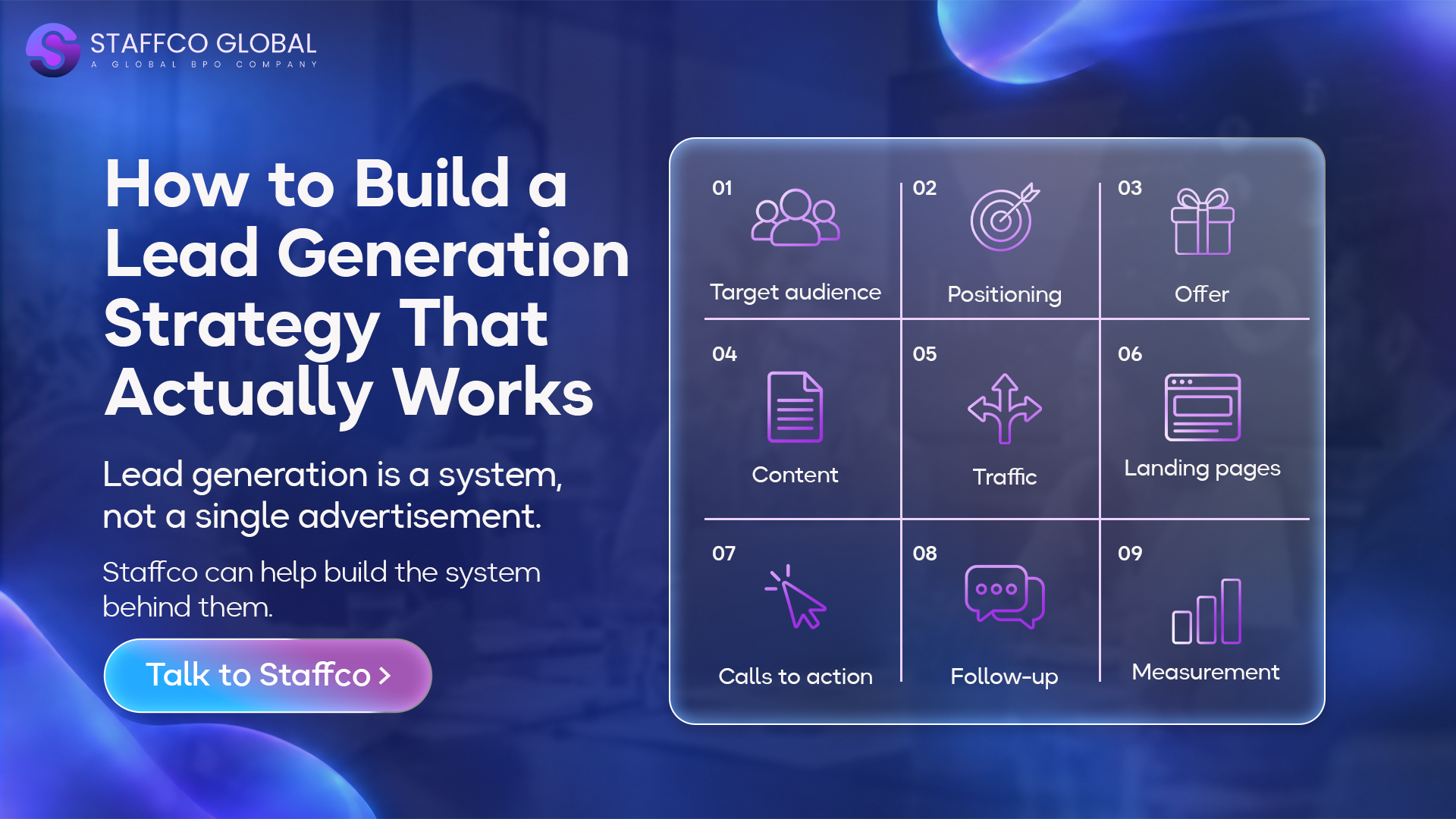
A strong lead generation strategy connects your target audience, positioning, offer, content, traffic, landing pages, calls to action, follow-up, and measurement into one system.
The goal is not simply to generate more leads.
The goal is to generate the right leads and create a repeatable path from potential customer to actual customer.
In this guide, we'll break down the essential components of a lead generation strategy and explain how they work together.
What Is a Lead Generation Strategy?
A lead generation strategy is a structured approach to attracting potential customers and encouraging them to take an action that allows your business to begin a relationship with them.
That action could be:
- Completing a contact form
- Requesting a consultation
- Calling your business
- Booking an appointment
- Requesting a quote
- Sending a direct message
- Downloading a resource
- Signing up for an email list
- Scheduling a demonstration
Lead generation is an important part of customer acquisition because it creates opportunities for your business to start conversations with people who may have a genuine interest in your products or services.
However, effective lead generation is not one tactic.
It is a system.
Lead Generation Is a System, Not a Single Advertisement
One of the most common mistakes businesses make is treating lead generation as a single marketing activity.
They run an advertisement and expect leads.
Or they publish content and expect customers.
Or they redesign their website and expect inquiries.
Each of these activities can contribute to lead generation, but none of them is a complete lead generation strategy by itself.
A strong system connects multiple elements:
Target Audience → Positioning → Offer → Content → Traffic → Landing Page → CTA → Follow-Up → Measurement
When these elements work together, your marketing becomes much more intentional.
Instead of simply hoping someone contacts you, you create a clear path that moves the right audience toward taking action.
1. Define Your Target Audience
Every effective lead generation strategy starts with the right audience.
If you try to market to everyone, your messaging can become too broad to connect strongly with anyone.
Your ideal audience should be clearly defined.
Consider:
- Industry
- Company size
- Location
- Job title
- Business model
- Pain points
- Goals
- Buying behavior
- Budget
- Decision-making process
Ask yourself:
Who is most likely to need what we offer?
Who benefits the most from our solution?
Who has the authority to make a purchasing decision?
What problem are they actively trying to solve?
Where do they look for solutions?
The more clearly you understand your audience, the easier it becomes to create relevant marketing.
The Goal Is Qualified Leads
More leads are not necessarily better.
Imagine two businesses.
Business A generates 500 leads, but most are outside its target market.
Business B generates 100 leads, but many are highly relevant prospects.
Business B may have a much stronger acquisition opportunity.
The objective of lead generation should be to attract qualified leads, not simply increase lead volume.
2. Build Clear Positioning
Once you know your audience, you need to communicate why your business is relevant to them.
This is where positioning becomes important.
Your positioning should make it easy for potential customers to understand:
- What you do
- Who you help
- What problem you solve
- What makes your approach different
- What outcome you help create
Weak positioning often focuses heavily on the company.
Strong positioning focuses on the customer.
For example:
"We provide digital marketing services."
is very broad.
A more outcome-focused message could be:
"We help businesses increase visibility, generate qualified leads, and acquire customers through strategic marketing."
The second message tells the audience what the service is designed to accomplish.
Your Message Should Match Your Audience
Different audiences have different problems.
A startup may be focused on awareness.
A growing company may need more qualified leads.
An established business may want to reduce customer acquisition costs.
Your positioning should reflect the problem and outcome that matter most to the audience you want to attract.
3. Create a Compelling Offer
A lead generation strategy needs something valuable for the prospect to respond to.
This is your offer.
An offer could be:
- A consultation
- A strategy session
- A free assessment
- A quote
- A demonstration
- A downloadable guide
- A free audit
- A discovery call
The offer should give the potential customer a clear reason to take the next step.
Make the Value Clear
A weak call to action might simply say:
"Learn More."
A stronger offer might say:
"Get Your Free Marketing Growth Assessment."
The second option communicates what the person receives.
Your offer should reduce uncertainty and make the next step feel worthwhile.
4. Create Content That Generates Demand
Content is one of the most effective ways to attract and educate potential customers.
But content should have a purpose.
Your content can help potential customers:
- Discover your business
- Understand their problem
- Learn about solutions
- Compare options
- Build trust
- Recognize your expertise
- Take action
Content can include:
- Blog articles
- Videos
- Social media posts
- Case studies
- Guides
- Webinars
- Email content
- Infographics
- Podcasts
The goal is not simply to publish more content.
The goal is to create content that moves potential customers closer to becoming leads.
Educational Content Can Generate Better Leads
Someone searching for information about a problem is already demonstrating interest.
For example, someone searching for:
"how to generate more business leads"
may be actively looking for a solution.
A useful article can introduce your business while providing genuine value.
If the content is relevant and the next step is clear, the visitor may become a lead.
5. Generate the Right Traffic
You can have an excellent offer and strong content, but you still need people to see it.
Traffic is the next part of the system.
Businesses can generate traffic through:
- Search engine optimization
- Paid advertising
- Social media
- Email marketing
- Referral traffic
- Partnerships
- Content marketing
- Online communities
- Direct outreach
Different channels work differently.
SEO can attract people actively searching for information.
Paid advertising can put your offer in front of a specific audience.
Social media can build awareness and demand.
Email can nurture existing prospects.
The best channel depends on your audience and objectives.
Traffic Quality Matters
More website visitors do not necessarily mean more leads.
If the traffic is irrelevant, visitors may leave without taking action.
The goal is to attract people who have a genuine reason to consider your product or service.
6. Build Landing Pages That Convert
When someone clicks on your marketing, where do they go?
Sending every visitor to your homepage may not always be the most effective option.
A dedicated landing page can be designed around one specific offer or objective.
A strong landing page should clearly communicate:
- What the offer is
- Who it is for
- Why it matters
- What the visitor receives
- Why they should trust you
- What they should do next
Keep the page focused.
Avoid overwhelming visitors with too many competing messages.
A Strong Landing Page Has One Primary Goal
If the objective is generating consultation requests, the page should make booking that consultation easy.
If the objective is downloading a guide, the download should be obvious.
If the objective is requesting a quote, the quote request should be the primary action.
The fewer unnecessary decisions a visitor has to make, the easier it can be for them to take action.
7. Use Clear Calls to Action
Your potential customer should never have to guess what to do next.
A call to action, or CTA, gives the visitor a clear next step.
Examples include:
- Book a Consultation
- Request a Quote
- Get a Free Assessment
- Talk to Our Team
- Schedule a Call
- Request More Information
- Start Your Strategy Session
Your CTA should match the customer's stage in the buying journey.
Someone discovering your business for the first time may need educational content before they are ready to schedule a call.
A highly interested prospect may be ready to speak with your team immediately.
Make Your CTA Specific
Instead of:
"Click Here"
Try:
"Build Your Growth Strategy"
Instead of:
"Contact Us"
Try:
"Talk to a Growth Strategist"
Specific CTAs communicate value and create a clearer next step.
8. Follow Up With Your Leads
Generating a lead is not the end of the process.
It is the beginning of a conversation.
Many businesses lose opportunities because leads are not followed up with consistently.
A follow-up process can include:
- Confirmation emails
- Phone calls
- Personalized messages
- Educational content
- Case studies
- Retargeting
- Consultation reminders
- Sales outreach
The follow-up process should be organized and consistent.
Speed Matters
When someone has just expressed interest in your business, that interest is often at its highest.
A prompt response can help maintain momentum.
Your business should have a clear process for receiving, assigning, and following up with new leads.
9. Measure Your Lead Generation Performance
A lead generation strategy should be measurable.
You need to understand where your leads are coming from and which channels are producing meaningful business opportunities.
Important metrics can include:
- Number of leads
- Qualified leads
- Cost per lead
- Lead conversion rate
- Website conversion rate
- Customer acquisition cost
- Lead source
- Campaign performance
- Sales conversion rate
- Customer lifetime value
These metrics help answer important questions.
Which channel generates the most leads?
Which channel generates the most qualified leads?
Which campaign creates the most customers?
Where are prospects dropping out?
What is your cost to acquire a customer?
Without measurement, it is difficult to know what should be improved.
10. Optimize Your Lead Generation Strategy
A strong lead generation system should never be considered finished.
Marketing performance can change.
Audience behavior can change.
Competition can change.
Channels can change.
Your offer can change.
That is why optimization is essential.
Test different:
- Headlines
- Offers
- CTAs
- Landing pages
- Audiences
- Content formats
- Advertising messages
- Follow-up sequences
Then compare the results.
The objective is not to change everything at once.
Identify the biggest bottleneck and improve it.
Common Lead Generation Mistakes
Even businesses investing heavily in marketing can struggle with lead generation because of common strategic mistakes.
Mistake 1: Targeting Everyone
A broad audience often produces weak messaging and lower-quality leads.
Mistake 2: Focusing Only on Traffic
Traffic is valuable, but traffic without conversion does not create customers.
Mistake 3: Having No Clear Offer
People need a reason to take the next step.
Mistake 4: Using Weak CTAs
If the next action is unclear, prospects may simply leave.
Mistake 5: Ignoring Follow-Up
A lead that never receives a response is a missed opportunity.
Mistake 6: Measuring Vanity Metrics
Followers and impressions can be useful, but qualified leads and customers are closer to the actual business objective.
Mistake 7: Treating Marketing Channels Separately
Social media, SEO, advertising, content, websites, and email should work together rather than operate as disconnected activities.
What a Complete Lead Generation System Looks Like
A strong lead generation strategy connects every stage.
Target Audience
Know exactly who you want to reach.
↓
Positioning
Explain why your business is relevant.
↓
Offer
Give prospects a compelling reason to act.
↓
Content
Educate and create demand.
↓
Traffic
Bring the right people to your marketing.
↓
Landing Page
Give visitors a focused destination.
↓
Call to Action
Make the next step clear.
↓
Follow-Up
Turn leads into conversations.
↓
Measurement
Track what is producing results.
↓
Optimization
Improve the system continuously.
This is how lead generation becomes a repeatable process rather than a collection of disconnected marketing activities.
Lead Generation and Customer Acquisition
Lead generation is an important part of customer acquisition, but the two are not identical.
Lead generation creates opportunities.
Customer acquisition turns those opportunities into customers.
That means a business should not measure its lead generation strategy only by the number of leads it produces.
It should also consider:
Are the leads qualified?
Are they converting?
Are they becoming customers?
What does it cost to acquire them?
What is the value of those customers?
These questions connect lead generation to the larger growth strategy.
Lead Generation Should Support Business Growth
The ultimate purpose of lead generation is not to create a bigger spreadsheet.
It is to create more opportunities for the business to grow.
That means your lead generation strategy should connect to larger business objectives.
If the goal is to increase revenue, your lead generation system should support that goal.
If the goal is entering a new market, your strategy should reach that market.
If the goal is acquiring higher-value customers, your targeting and messaging should reflect that.
Marketing should begin with the growth objective and work backward.
Build a Lead Generation Strategy That Actually Works
There is no single advertisement, social media post, website, or marketing channel that can guarantee consistent lead generation.
The strongest results come from connecting the pieces.
Target the right audience.
Position your business clearly.
Create a compelling offer.
Publish useful content.
Generate relevant traffic.
Build focused landing pages.
Use clear calls to action.
Follow up consistently.
Measure the results.
Optimize what is working and fix what is not.
That is how you build a lead generation system.
Need More Qualified Leads?
If your business is generating attention but not enough qualified leads, the answer may not be more marketing activity.
You may need a stronger system behind your marketing.
At Staffco Global, our focus is Growth & Acquisition. We help businesses build marketing strategies designed to increase visibility, generate demand, create qualified leads, and support customer acquisition.
Lead generation is not about running one more advertisement.
It is about building a system that consistently moves the right people toward becoming customers.
Need more qualified leads? Staffco can help build the system behind them.
Talk to Staffco About Your Growth Strategy