How Much Should a Business Spend on Marketing?
How Much Should a Business Spend on Marketing?
One of the most common questions business owners ask is:
"How much should we spend on marketing?"
There is no single percentage or dollar amount that works for every business.
A marketing budget that makes sense for one company may be completely wrong for another.
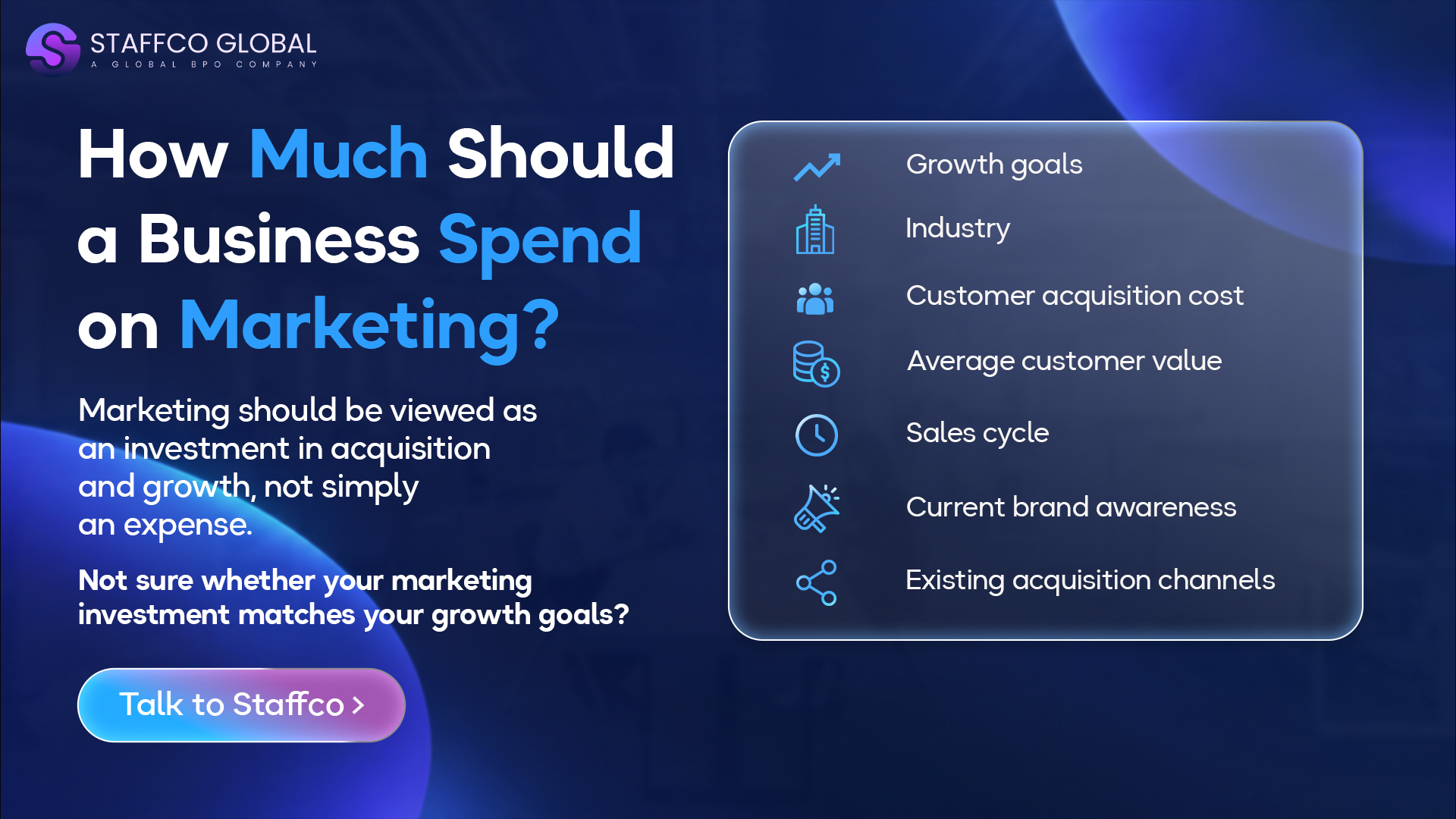
The right marketing investment depends on what the business is trying to accomplish, who it is trying to reach, how much it costs to acquire customers, how much those customers are worth, how long the sales process takes, and what acquisition channels are already working.
That is why marketing should not simply be treated as an expense.
It should be viewed as an investment in customer acquisition and business growth.
The right question is not only:
"How much should we spend on marketing?"
It is:
"How much should we invest to achieve our growth goals?"
Is There a Standard Marketing Budget?
You may have heard recommendations that businesses should spend a specific percentage of revenue on marketing.
While benchmarks can provide context, they should not be treated as a universal rule.
Every business has different:
- Growth goals
- Industries
- Profit margins
- Customer acquisition costs
- Average customer values
- Sales cycles
- Competitive environments
- Brand awareness levels
- Acquisition channels
A business trying to enter a new market may need a very different marketing investment from an established company with strong brand recognition.
A company selling a high-value service may have a different acquisition model from a company selling low-cost products.
The right budget depends on the economics and objectives of the business.
1. Start With Your Growth Goals
The first factor to consider is what you want marketing to accomplish.
Your business might want to:
- Increase brand awareness
- Generate more qualified leads
- Acquire more customers
- Increase revenue
- Enter a new market
- Launch a new service
- Improve customer acquisition costs
- Increase market share
Your growth objective should influence your marketing investment.
If the goal is aggressive customer acquisition, the business may need to invest more heavily in marketing channels that generate qualified opportunities.
If the goal is maintaining an established market position, the investment strategy may look very different.
Start With the Number
Instead of starting with a marketing percentage, start with the business objective.
For example:
"We want to acquire 100 new customers."
Then work backward.
How many qualified leads are required?
How many conversations are required?
What conversion rate can we expect?
How much does each qualified lead cost?
What is the expected customer acquisition cost?
This creates a more strategic approach to marketing investment.
2. Consider Your Industry
Marketing costs vary significantly between industries.
Some industries are highly competitive online.
Others rely heavily on relationships, referrals, or long sales cycles.
Your industry can influence:
- Advertising costs
- Search competition
- Customer acquisition costs
- Sales cycles
- Content requirements
- Brand-building needs
- Conversion rates
For example, a business competing in a highly competitive search market may need to invest more in SEO and paid search to gain visibility.
A B2B company with a long sales cycle may need to invest more in educational content, thought leadership, lead nurturing, and relationship-building.
The right marketing budget should reflect the realities of your market.
3. Understand Customer Acquisition Cost
Customer acquisition cost, often called CAC, is one of the most important metrics for determining marketing investment.
CAC represents how much it costs your business to acquire a customer.
A simplified calculation is:
Customer Acquisition Cost = Total Acquisition Costs ÷ Number of New Customers
For example, if a company spends $20,000 on marketing and sales and acquires 40 new customers, the average acquisition cost would be $500 per customer.
Understanding this number gives your business a much clearer view of marketing economics.
Why CAC Matters
Suppose your average customer generates significant value for your business.
A $500 acquisition cost may be reasonable.
But if your average customer generates only a small amount of revenue, the same acquisition cost may not be sustainable.
This is why marketing budget decisions should be connected to customer economics.
4. Consider Average Customer Value
Customer acquisition cost should not be viewed alone.
You should also understand how much value a customer creates.
This can include:
- Initial purchase
- Repeat purchases
- Contract value
- Subscription revenue
- Upsells
- Cross-sells
- Customer lifetime value
A customer who generates $10,000 over the relationship with your business can justify a very different acquisition investment than a customer who generates $200.
This relationship is critical when determining how aggressively a company can invest in growth.
Marketing Investment Should Follow Customer Economics
If your customers are highly valuable, you may be able to invest more to acquire them.
If your customer value is low, you may need a more efficient acquisition model.
The goal is not to minimize marketing spend at all costs.
The goal is to build an acquisition model that makes economic sense.
5. Consider Your Sales Cycle
The length of your sales cycle also affects how you should evaluate marketing investment.
Some businesses can acquire customers within days.
Others may take weeks or months.
B2B businesses, professional services, enterprise solutions, and high-value purchases often require multiple interactions before a customer is ready to make a decision.
This means marketing may need to support prospects for a longer period.
That can require investment in:
- Educational content
- Email marketing
- Retargeting
- Case studies
- Webinars
- Thought leadership
- Sales enablement
- Lead nurturing
A longer sales cycle does not necessarily mean marketing is ineffective.
It means the acquisition process needs to be evaluated over the appropriate time period.
6. Consider Your Current Brand Awareness
Brand awareness can significantly influence marketing investment.
An established company may already have:
- Strong search visibility
- Repeat customers
- High direct traffic
- Brand recognition
- Referral traffic
- Existing audience
- Strong market credibility
A newer business may have to invest more heavily in becoming known.
Brand awareness affects how much effort is required to move someone from discovery to consideration.
New Businesses Often Need More Visibility
If your audience has never heard of you, you first need to establish recognition.
That can involve:
- Content marketing
- Social media
- SEO
- Advertising
- Public relations
- Partnerships
- Thought leadership
As awareness grows, marketing can increasingly focus on converting existing attention into qualified opportunities.
7. Evaluate Your Existing Acquisition Channels
Before increasing your marketing budget, look at the channels you already use.
You may already be generating business through:
- Organic search
- Paid advertising
- Social media
- Referrals
- Partnerships
- Outbound sales
- Content marketing
- Direct traffic
The important question is:
Which channels are producing the best customers?
A channel that produces inexpensive traffic but no customers may not deserve additional investment.
A channel that consistently produces qualified customers may deserve more resources.
Follow the Data
If one acquisition channel consistently produces high-quality customers, it may make sense to scale it.
If another channel produces a lot of attention but few opportunities, it may need optimization or a different role in the marketing strategy.
Marketing investment should follow performance, not simply assumptions.
Marketing Budget vs. Marketing Investment
There is an important difference between thinking about marketing as a budget and thinking about marketing as an investment.
A budget often creates the question:
"How much can we afford to spend?"
An investment asks:
"What return can this spending create?"
This does not mean every marketing campaign will produce an immediate financial return.
Brand awareness, content marketing, SEO, and other long-term strategies can take time.
But the investment should still have a strategic purpose.
The business should understand what the marketing is designed to accomplish and how performance will be measured.
Don't Spend More Just Because You Want More Growth
More marketing spend does not automatically create more growth.
If the strategy is wrong, increasing the budget can simply increase the amount of money being spent inefficiently.
Before increasing marketing investment, evaluate:
- Target audience
- Positioning
- Offer
- Content
- Traffic sources
- Lead generation
- Conversion
- Follow-up
- Measurement
If there is a major bottleneck, fix it before simply adding more budget.
The Marketing Funnel Matters
Your marketing budget should support the entire customer journey.
A simplified growth funnel looks like:
Awareness
↓
Demand
↓
Traffic
↓
Leads
↓
Conversion
↓
Customers
↓
Retention
Different businesses may need different levels of investment at each stage.
For example, a new business may need significant investment in awareness.
A business with strong awareness but weak lead generation may need to invest more heavily in conversion and acquisition.
The goal is to identify where the greatest opportunity exists.
Marketing Spend Should Match the Growth Goal
Consider three businesses.
Business A: Maintaining Market Position
The company already has strong brand recognition and a stable customer base.
Its marketing strategy may focus on:
- Retention
- Brand visibility
- Content
- Customer engagement
Business B: Aggressive Growth
The company wants to significantly increase its customer base.
It may invest more heavily in:
- Lead generation
- Paid advertising
- Content
- SEO
- Conversion optimization
- Sales support
Business C: Entering a New Market
The company is expanding into a market where its brand is not yet known.
It may need investment in:
- Brand awareness
- Market education
- Content
- Advertising
- Partnerships
- Demand generation
The appropriate marketing investment can look very different for each business.
How to Build a Marketing Budget
Instead of choosing a percentage first, build your budget around the acquisition model.
Step 1: Define the Growth Goal
Determine how many customers, leads, or revenue dollars you want to generate.
Step 2: Understand Your Customer Value
Determine how much a typical customer is worth.
Step 3: Understand Your Acquisition Economics
Calculate or estimate customer acquisition cost and lead costs.
Step 4: Determine Required Lead Volume
Work backward from the number of customers you want.
Step 5: Evaluate Your Channels
Identify which channels can realistically generate the required opportunities.
Step 6: Allocate Investment
Assign budget based on expected contribution, not simply popularity.
Step 7: Measure
Track leads, conversions, customers, and acquisition costs.
Step 8: Optimize
Move resources toward what is working and improve what is not.
This creates a marketing budget that is connected to business growth.
What Should You Measure?
Marketing investment should be evaluated using meaningful metrics.
Depending on your business, these may include:
- Marketing qualified leads
- Sales qualified leads
- Cost per lead
- Customer acquisition cost
- Conversion rate
- Website conversion rate
- Appointment rate
- Customer lifetime value
- Return on marketing investment
- Revenue generated
- Pipeline value
The exact metrics should reflect the business objective.
If your goal is lead generation, measure qualified leads.
If your goal is customer acquisition, measure customers and acquisition cost.
If your goal is revenue growth, connect marketing activity to revenue and pipeline.
Don't Judge Every Marketing Channel the Same Way
Different marketing channels can serve different purposes.
SEO may create long-term organic visibility.
Social media may build awareness and demand.
Paid advertising may generate targeted traffic quickly.
Content marketing may educate prospects.
Email may nurture existing leads.
Events may build relationships.
The role of each channel should be defined within the larger acquisition strategy.
Not every channel needs to generate an immediate sale.
But every channel should have a purpose.
Marketing Should Start With Strategy
The biggest mistake businesses make when determining marketing spend is starting with the tactic.
They ask:
"How much should we spend on social media?"
"How much should we spend on ads?"
"How much should we spend on SEO?"
"How much should we spend on content?"
These questions come too early.
Start with:
What are we trying to achieve?
Then determine:
Who do we need to reach?
Then:
What acquisition strategy can get us there?
Then:
Which marketing channels support that strategy?
Finally:
How much investment is required?
This creates a much stronger connection between marketing spend and business growth.
Marketing Is an Investment in Acquisition and Growth
A business should not view marketing simply as money leaving the company.
When the strategy is working, marketing creates valuable business opportunities.
It can help a company:
- Become more visible
- Generate demand
- Attract qualified prospects
- Create sales opportunities
- Acquire customers
- Build long-term customer value
The objective is not simply to spend less.
The objective is to invest intelligently.
A business that spends $10,000 and generates $50,000 in valuable new business opportunities is in a very different position from a business that spends $10,000 and cannot identify what happened as a result.
Measurement makes the difference.
Build a Marketing Investment Strategy
There is no universal marketing budget that guarantees growth.
The right investment depends on your:
Growth goals
↓
Industry
↓
Customer acquisition cost
↓
Customer value
↓
Sales cycle
↓
Brand awareness
↓
Existing acquisition channels
↓
Marketing performance
These factors should work together to determine how aggressively your business should invest in marketing.
The Goal Isn't to Spend More
The goal is to invest where marketing can create the greatest business impact.
Sometimes that means increasing the budget.
Sometimes it means reallocating existing spending.
Sometimes it means fixing the strategy before spending another dollar.
Sometimes the business does not need more traffic.
It needs better conversion.
Sometimes it does not need more content.
It needs better positioning.
Sometimes it does not need more leads.
It needs a better sales process.
The right marketing investment starts with understanding the actual growth problem.
Staffco Global: Growth & Acquisition
At Staffco Global, our focus is Growth & Acquisition.
We help businesses build marketing strategies around visibility, demand generation, lead generation, conversion, and customer acquisition.
Our approach starts with the growth objective and works backward toward the marketing investment required to support it.
That means looking beyond individual tactics and understanding how the entire acquisition system works together.
Marketing should not simply be an expense on a spreadsheet.
It should be an investment connected to a measurable growth objective.
Is Your Marketing Investment Working for You?
If you're unsure whether your marketing investment matches your business goals, the answer may not be a bigger budget.
You may need a clearer acquisition strategy.
You may need to identify which channels are producing the best customers.
You may need to improve conversion.
You may need to strengthen your positioning.
Or you may need to measure your marketing performance differently.
The right answer starts with understanding the growth objective.
Not sure whether your marketing investment matches your growth goals? Talk to Staffco.
Talk to Staffco About Your Growth Strategy