How Content Marketing Can Help You Acquire Customers
How Content Marketing Can Help You Acquire Customers
Content is everywhere.
Businesses publish blog articles, social media posts, videos, emails, guides, podcasts, case studies, and other forms of content every day.
But creating content does not automatically create customers.
A business can publish hundreds of posts and still struggle to generate qualified leads or sales.
The difference is strategy.
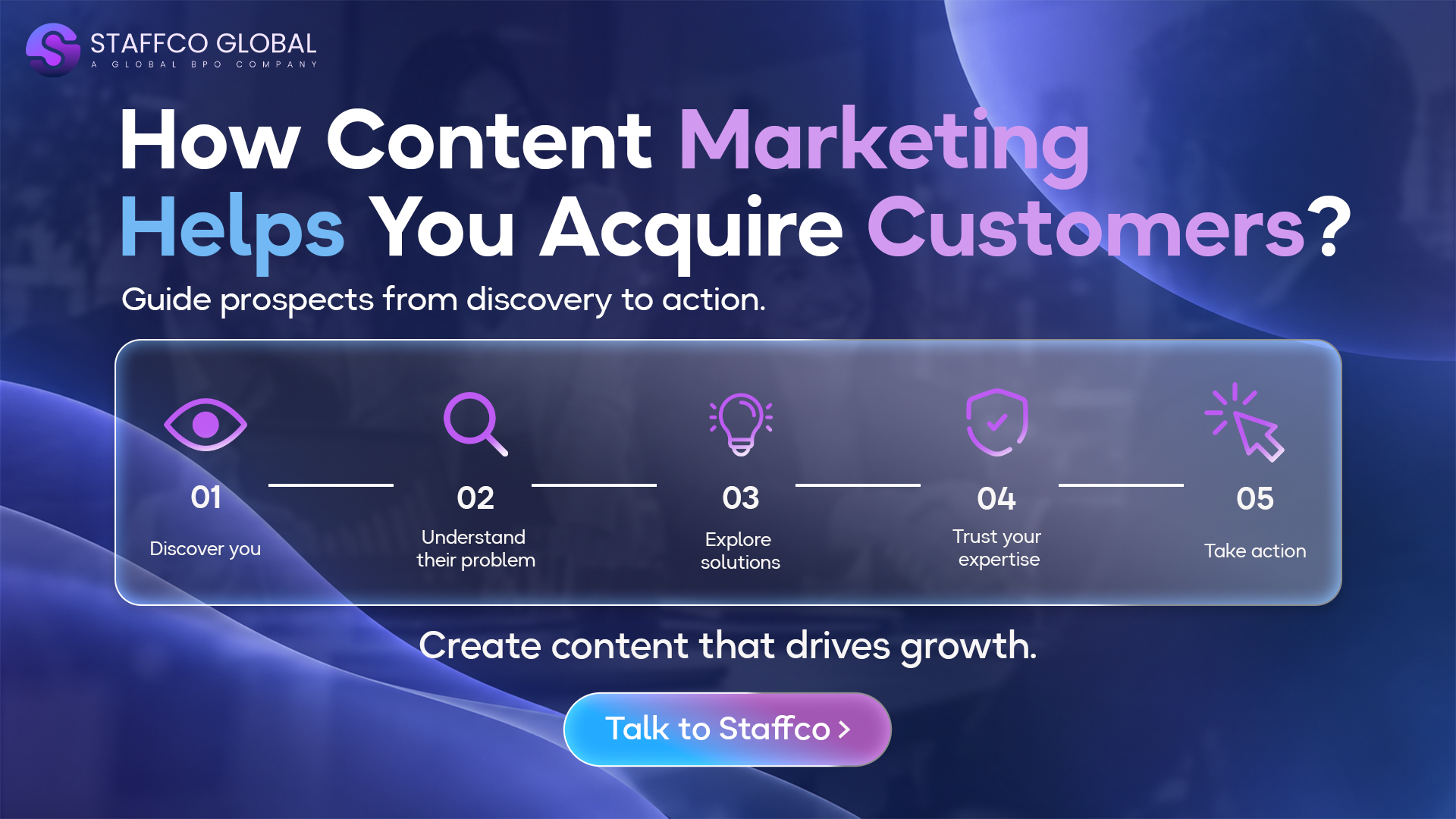
Effective content marketing should do more than fill a social media calendar. It should help potential customers discover your business, understand their problems, learn about possible solutions, trust your expertise, and ultimately take action.
That is where content marketing becomes a customer acquisition tool.
A strong content marketing strategy connects content to the larger customer journey:
Discover → Understand → Learn → Trust → Act → Become a Customer
When these stages work together, content can become an important part of a scalable growth and acquisition strategy.
What Is Content Marketing?
Content marketing is a marketing approach that uses valuable, relevant, and useful content to attract and engage a specific audience.
Content can include:
- Blog articles
- Social media posts
- Videos
- Podcasts
- Guides
- Case studies
- Email newsletters
- Webinars
- Infographics
- Research
- Educational resources
The goal is not simply to publish information.
The goal is to provide something useful to the people you want to become customers.
Instead of constantly telling people to buy, content marketing can help them understand a problem, explore solutions, evaluate options, and become more familiar with your business.
That makes content especially valuable for businesses with longer buying journeys.
How Content Marketing Supports Customer Acquisition
Customer acquisition is the process of attracting and converting new customers.
Content can support that process at multiple stages.
A potential customer may first discover your business through a search engine.
They may then read a blog article.
Later, they may see your social media content.
Then they may watch a video.
Eventually, they may download a resource, request information, or contact your team.
Each interaction can move the prospect closer to becoming a customer.
This is why content should not be viewed as an isolated marketing activity.
It should be part of the acquisition system.
1. Content Helps People Discover You
The first step in customer acquisition is getting discovered.
Potential customers cannot consider your business if they do not know you exist.
Content can create opportunities for people to discover your business through:
- Google searches
- Social media
- YouTube
- Online communities
- Industry publications
- Referrals
- Paid promotion
Search-focused content can be especially valuable because it allows your business to appear when someone is actively looking for information.
For example, someone may search:
"How do I generate more leads for my business?"
A useful article answering that question can introduce the reader to your company.
At that point, the reader may not be ready to buy.
But your business has entered their consideration set.
Content Marketing and SEO
Content marketing and search engine optimization can work together to increase organic visibility.
When you create useful content around topics your audience is actively searching for, you create more opportunities for your website to appear in search results.
Effective SEO content should focus on:
- Search intent
- Relevant topics
- Useful information
- Clear structure
- Strong headings
- Internal linking
- Helpful answers
- Natural keyword usage
The goal should not be to write for search engines alone.
The content needs to be genuinely useful to the person searching.
When useful content earns visibility, SEO can become a long-term customer acquisition channel.
2. Content Helps People Understand Their Problem
Sometimes potential customers know something isn't working, but they don't fully understand why.
Content can help explain the problem.
For example, a business owner may know:
"We aren't getting enough customers."
But they may not know whether the problem is:
- Audience targeting
- Positioning
- Lead generation
- Conversion
- Follow-up
- Customer acquisition
- Marketing consistency
Educational content can help them identify the real issue.
This is valuable because people are more likely to consider a solution once they understand the problem they are trying to solve.
Problem-Focused Content Creates Demand
One of the most powerful roles of content marketing is demand generation.
Instead of immediately promoting your service, you can help your audience recognize an issue that may be limiting their growth.
For example:
"Why Your Business Gets Attention But Not Customers"
can help a business owner recognize the gap between visibility and acquisition.
The content creates awareness.
The explanation creates understanding.
The solution creates demand.
The call to action creates an opportunity.
This is how content can move someone further through the buying journey.
3. Content Helps People Learn About Solutions
Once someone understands their problem, they often begin researching possible solutions.
This is another opportunity for content marketing.
Create content that answers questions such as:
- What solutions are available?
- How does the process work?
- What should businesses look for?
- What mistakes should they avoid?
- How much should they invest?
- What approach is best for their situation?
- How should they compare providers?
This type of content can help prospects make more informed decisions.
It also gives your business an opportunity to demonstrate expertise.
Educational Content Builds Authority
When your business consistently provides useful information, potential customers can begin to associate your brand with expertise.
You are not simply telling them:
"We know what we're doing."
You are showing them through the information you provide.
For example, a business that regularly publishes useful insights about lead generation, customer acquisition, marketing strategy, and growth can begin building authority around those subjects.
That authority can influence future purchasing decisions.
4. Content Helps Build Trust
Trust is one of the most important parts of customer acquisition.
People want to know that a business understands their situation and can deliver what it promises.
Content can help build that confidence.
Useful trust-building content includes:
- Case studies
- Customer stories
- Industry insights
- Educational articles
- Expert opinions
- Research
- Testimonials
- Behind-the-scenes content
- Process explanations
- Frequently asked questions
Each piece gives prospects another reason to understand and evaluate your business.
Content Lets Prospects Get to Know Your Business
Not every potential customer wants to speak with a salesperson immediately.
Some people prefer to research independently.
Content allows them to learn about your business before starting a conversation.
They can explore your website.
Read your articles.
Watch your videos.
Review your case studies.
Follow your social media.
Subscribe to your emails.
By the time they contact you, they may already understand your expertise and approach.
That can make the initial conversation more productive.
5. Content Encourages People to Take Action
Content should not always end with:
"Thanks for reading."
If the content has successfully helped someone understand their problem and the possible solution, there should be a relevant next step.
That could be:
- Book a consultation
- Request an assessment
- Contact your team
- Download a guide
- Schedule a call
- Request more information
- Visit a service page
- Subscribe to your newsletter
The call to action should match the intent of the content.
A person reading an introductory educational article may not be ready for a hard sales pitch.
A person reading a comparison article may be much closer to making a decision.
Your CTA should reflect where the reader is in the customer journey.
Content Should Match the Buying Journey
Not every prospect is at the same stage.
Some are just discovering a problem.
Others are actively researching solutions.
Others are ready to speak with a provider.
Your content strategy should reflect these differences.
Awareness Content
Help people discover your business and understand a problem.
Examples:
- Industry trends
- Common problems
- Educational articles
- Social media insights
- Short videos
Consideration Content
Help prospects evaluate possible solutions.
Examples:
- How-to guides
- Comparisons
- Strategy articles
- Case studies
- Expert insights
Decision Content
Help qualified prospects take action.
Examples:
- Service pages
- Case studies
- Testimonials
- Consultation offers
- Pricing information
- Product demonstrations
A strong content strategy supports the entire journey.
Content Marketing vs. Content Creation
These terms are often treated as the same thing.
They aren't.
Content creation means producing content.
Content marketing means creating content with a marketing objective.
For example:
Creating a video because your calendar says "video day" is content creation.
Creating a video that answers a common customer question, builds trust, and directs qualified viewers toward a relevant offer is content marketing.
The difference is the strategy behind the content.
Don't Create Content Just to Fill Your Feed
This is one of the biggest mistakes businesses make.
They feel pressure to post consistently.
So they create:
Another quote graphic.
Another generic tip.
Another company announcement.
Another promotional post.
Another random video.
The feed stays active.
But the content may not contribute to growth.
Instead of asking:
"What should we post today?"
Ask:
"What does our audience need to know before they become a customer?"
That question changes the entire content strategy.
Build Content Around Customer Problems
The best content ideas often come directly from your customers.
Look at the questions they ask.
Look at the problems they describe.
Look at the objections they have.
Look at the reasons they delay buying.
Look at what they search for.
Then create content that answers those questions.
For example:
If customers ask:
"Why aren't we getting enough leads?"
Create content explaining common lead generation problems.
If they ask:
"How much should we spend on marketing?"
Create a guide explaining how businesses can evaluate marketing investment.
If they ask:
"Do we need a new website?"
Create content explaining when a website redesign can actually contribute to customer acquisition.
Your customers are telling you what content to create.
Content Can Generate Qualified Leads
Not all content produces the same type of lead.
A viral entertainment video may produce a large audience.
A highly specific educational article may attract fewer people but more relevant prospects.
For customer acquisition, relevance matters.
The goal is to create content that attracts people who:
- Have the problem you solve
- Are researching a solution
- Fit your target audience
- Have a reason to take action
- Could potentially become customers
This is why qualified traffic is often more valuable than simply maximizing traffic.
Create Content With a Clear Conversion Path
Every important piece of content should connect to the next stage of the customer journey.
For example:
Blog article
↓
Relevant service page
↓
Case study
↓
Consultation
↓
Lead
↓
Sales conversation
↓
Customer
This creates a clear path from content to acquisition.
Without that path, your content may generate traffic without generating enough business opportunities.
The Role of Social Media Content
Social media can be a powerful distribution channel for content.
A single article can become:
- LinkedIn posts
- Instagram posts
- Short videos
- Reels
- Stories
- Email content
- Quote graphics
- Infographics
This allows businesses to extend the value of one strong idea across multiple channels.
Instead of constantly creating completely new ideas, build a content ecosystem around your strongest topics.
The Role of Video
Video can help prospects understand complex ideas quickly.
Short-form video can create awareness.
Longer educational videos can build authority.
Demonstrations can explain solutions.
Customer stories can build trust.
Expert videos can support thought leadership.
Video can also make your brand more recognizable because prospects can see and hear the people behind the business.
The Role of Email Content
Email allows you to continue communicating with people who have already shown interest.
A visitor may read your blog and leave.
An email subscriber gives you another opportunity to reach them.
You can send:
- Educational content
- Industry insights
- New articles
- Case studies
- Offers
- Events
- Product updates
- Strategic recommendations
Email can help nurture prospects who are not ready to become customers immediately.
The Role of Case Studies
Case studies are particularly powerful because they connect expertise with evidence.
A strong case study can show:
The customer's problem.
↓
The strategy.
↓
The implementation.
↓
The result.
↓
The lesson.
This helps prospects understand what working with your business could look like.
It also provides a form of social proof.
Content Marketing Should Support SEO and Acquisition
Search engine optimization can help people discover your content.
Content can educate them.
Strong positioning can differentiate your business.
Calls to action can generate leads.
Follow-up can nurture those leads.
Sales can convert qualified opportunities.
This creates a connected acquisition system.
The process can look like:
SEO → Content → Awareness → Demand → Lead → Conversation → Customer
That is much more powerful than simply publishing blog posts.
How to Measure Content Marketing Success
Content marketing should be measured based on its purpose.
For awareness content, look at:
- Reach
- Impressions
- Website traffic
- Search visibility
- Engagement
For lead-generation content, look at:
- Leads
- Qualified leads
- Conversion rate
- Cost per lead
- Consultation requests
For customer acquisition, look at:
- Customers acquired
- Customer acquisition cost
- Revenue
- Conversion rate
- Customer lifetime value
The right metric depends on the objective.
A blog article does not need to generate a customer immediately to be valuable.
It may introduce someone to your business today and influence a purchase months later.
That is why content should be evaluated as part of the larger customer journey.
Common Content Marketing Mistakes
1. Creating Content Without a Strategy
Publishing consistently without knowing what the content is supposed to accomplish can waste resources.
2. Targeting Everyone
Content becomes more effective when it speaks to a specific audience and problem.
3. Focusing Only on Promotion
If every post asks people to buy, audiences may stop paying attention.
4. Focusing Only on Engagement
Likes and views are useful, but they are not the same as qualified leads or customers.
5. Ignoring SEO
Useful content that nobody can discover has limited acquisition potential.
6. Not Having a CTA
If interested readers have no next step, potential opportunities can disappear.
7. Not Measuring Results
Without measurement, it is difficult to understand which topics, channels, and formats are contributing to growth.
Build a Content Strategy Around Growth
A growth-focused content strategy should begin with the business objective.
Ask:
What are we trying to achieve?
Who do we want to reach?
What problems do they have?
What do they need to understand?
What questions are they asking?
What content can answer those questions?
What action should they take next?
How will we measure the result?
This turns content from a publishing task into a business-growth tool.
A Simple Content-to-Customer Framework
Use this framework when planning your content:
Discover
Help potential customers find you.
↓
Understand
Help them understand their problem.
↓
Learn
Teach them about possible solutions.
↓
Trust
Demonstrate your expertise and credibility.
↓
Act
Give them a clear next step.
↓
Acquire
Turn qualified opportunities into customers.
This is how content can contribute directly to customer acquisition.
Content Should Create Growth, Not Just Activity
Your business does not need more content simply for the sake of having more content.
It needs content that performs a role.
Some content creates awareness.
Some creates demand.
Some builds trust.
Some generates leads.
Some helps convert prospects.
Some supports retention.
Together, these pieces can create a content ecosystem that supports business growth.
The goal is not to fill your social media calendar.
The goal is to move the right people closer to becoming customers.
Create Content That Contributes to Growth
At Staffco Global, our focus is Growth & Acquisition.
We believe marketing should be connected to a measurable business objective.
Content is one of the tools that can help businesses become more visible, create demand, generate qualified leads, and acquire customers.
The strategy comes first.
The content supports the strategy.
The channels distribute the content.
The conversion process turns interest into opportunity.
And the acquisition system turns qualified opportunities into customers.
Create content that contributes to growth, not just content that fills a feed.
Talk to Staffco About Your Growth Strategy