First-Party Data: The New Foundation of Customer Acquisition
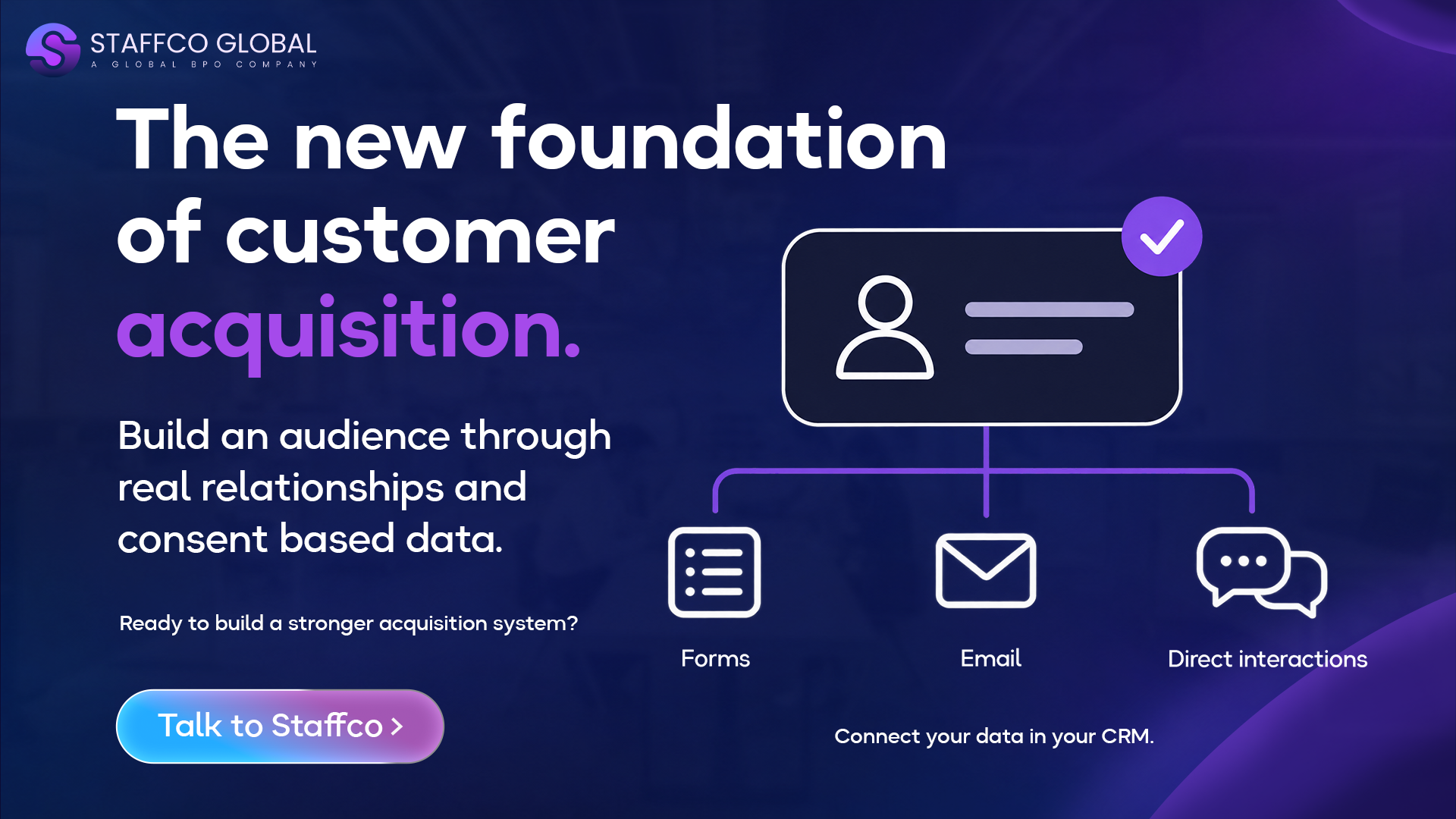
First-Party Data: The New Foundation of Customer Acquisition
STAFFCO GLOBAL · GROWTH & ACQUISITION | NOVEMBER 2026
Imagine spending thousands of dollars attracting website visitors, generating social media engagement, and reaching potential customers through paid advertising.
But what happens when those platforms change their algorithms, increase advertising costs, or limit access to audience data?
If your business depends entirely on audiences controlled by external platforms, your ability to reach and understand potential customers can become increasingly unpredictable.
This is why first-party data is becoming an essential part of modern digital marketing.
Businesses need more than visibility. They need direct relationships with the people interested in their products and services.
From website forms and email subscriptions to CRM systems and customer interactions, first-party data helps businesses understand their audiences, improve marketing decisions, and build more sustainable customer acquisition strategies.
Your strongest marketing data is the information your business earns through real customer relationships.
What Is First-Party Data?
First-party data is information a business collects directly from its customers and audiences through its own channels and interactions.
Unlike third-party data purchased or obtained from external sources, first-party data comes from people who interact directly with your business.
Examples include:
- Information submitted through website contact forms.
- Email addresses provided through newsletter subscriptions.
- Customer inquiries and service requests.
- CRM records and customer interactions.
- Preferences voluntarily shared by customers.
- Purchase and transaction history.
- Feedback, surveys, and customer support interactions.
- Engagement with content, resources, and business communications.
When collected transparently and appropriately, this information helps businesses understand customer needs, recognize patterns, personalize communication, and improve the customer experience.
The key distinction is ownership of the relationship: your business develops a direct connection with its audience rather than relying exclusively on access provided by another platform.
Why First-Party Data Matters for Customer Acquisition
Customer acquisition is becoming more complex.
Advertising platforms, social media networks, and search engines can help businesses reach potential customers, but access to those audiences is not the same as having a direct relationship with them.
First-party data gives businesses a stronger foundation for understanding and engaging the people they attract.
1. Greater Control Over Customer Relationships
When someone follows your social media account, you gain access to a connection within that platform.
However, the platform controls how and when your content reaches that person.
When someone voluntarily subscribes to your email list or submits an inquiry through your website, your business can establish a more direct communication channel, subject to their preferences and applicable requirements.
This creates opportunities to:
- Share relevant updates and information.
- Communicate new products and services.
- Follow up on inquiries.
- Provide educational resources.
- Develop long-term customer relationships.
The objective is to build an audience that your business can engage directly, rather than depending entirely on rented attention.
2. Better Audience Understanding
First-party data can reveal what your customers are interested in, what services they explore, and what problems they are trying to solve.
For example, a business providing outsourcing services might discover that its website visitors frequently inquire about customer support, back-office operations, or recruitment.
These insights can help the marketing team understand which services generate interest and which topics deserve more attention.
Instead of making decisions based entirely on assumptions, businesses can use real customer interactions to guide their marketing priorities.
3. More Relevant Marketing Campaigns
Not every potential customer has the same needs.
A business owner researching operational outsourcing may require different information from an insurance agency looking for dedicated customer support.
First-party data can help businesses organize audiences based on relevant interests, interactions, and preferences.
This makes it easier to develop more relevant campaigns, provided the data is collected and used appropriately.
Relevant communication can improve the customer experience and make marketing efforts more effective.
4. Stronger Customer Retention
Customer acquisition does not end when someone becomes a customer.
Businesses can use appropriate first-party information to maintain relationships, understand customer needs, and identify opportunities for additional support.
For example, CRM records can help teams understand previous interactions, follow up on service requests, and maintain consistent communication.
A business that understands its customers is better positioned to build meaningful long-term relationships.
Five Ways to Build First-Party Data for Your Business
Building a valuable first-party data strategy does not require complicated technology from day one.
It starts with creating useful opportunities for customers to interact with your business and voluntarily share relevant information.
Here are five practical ways to begin.
1. Website Forms: Turn Visitors Into Meaningful Connections
Your website is one of the most important sources of first-party data.
Contact forms, consultation requests, quote requests, and service inquiry forms allow visitors to share information directly with your business.
However, collecting information should be intentional.
Instead of asking for unnecessary details, focus on the information your team actually needs to respond effectively.
For a B2B service provider, a form might collect:
- Full name.
- Business email.
- Company name.
- Industry.
- Required services.
- Project requirements.
A well-designed form creates a straightforward path from website discovery to a meaningful business conversation.
2. Email Marketing: Build an Audience You Can Reach Directly
Email marketing remains an important way to develop direct relationships with potential and existing customers.
Businesses can encourage visitors to subscribe by offering something genuinely useful, such as:
- Industry insights.
- Educational newsletters.
- Business guides.
- Practical resources.
- Product and service updates.
- Relevant research and reports.
The goal is to give people a reason to voluntarily stay connected with your brand.
Once someone subscribes, businesses can share relevant information based on their interests and preferences.
Always use clear subscription practices, maintain accurate consent records where required, and provide appropriate unsubscribe options.
3. CRM Systems: Organize Customer Information
A Customer Relationship Management (CRM) system helps businesses organize information about leads, prospects, and customers.
Instead of storing information across disconnected spreadsheets, inboxes, and individual employee records, a CRM can create a more organized view of customer interactions.
A properly managed CRM can help businesses:
- Track incoming inquiries.
- Record customer communication.
- Organize leads by industry or service interest.
- Monitor sales opportunities.
- Manage follow-up activities.
- Understand customer engagement.
- Identify opportunities for future business.
The value of a CRM is not simply the amount of information it stores.
It is how effectively the business uses that information to improve relationships and make better decisions.
4. Content Offers: Exchange Real Value for Customer Interest
Educational content can create opportunities to collect first-party data.
Instead of asking visitors to provide information without a clear reason, offer resources that solve a real problem.
For example, a business might provide:
- An outsourcing cost assessment guide.
- An insurance operations checklist.
- A recruitment planning resource.
- A digital marketing guide.
- An industry-specific business report.
A visitor interested in the resource may voluntarily submit their information to receive it.
This approach connects content marketing with lead generation while giving potential customers something valuable in return.
Make sure the value exchange is transparent and that receiving a resource does not automatically imply consent to unrelated marketing communications.
5. Direct Customer Interactions: Learn From Real Conversations
Not all valuable customer information comes from digital forms.
Sales conversations, customer support interactions, consultations, feedback requests, and service discussions can provide important insights.
These interactions help businesses understand:
- Common customer concerns.
- Frequently requested services.
- Purchasing priorities.
- Customer expectations.
- Reasons prospects choose or reject a provider.
- Opportunities to improve products and services.
When information is recorded appropriately, these insights can help marketing, sales, and operations teams work from a better understanding of customer needs.
First-Party Data vs. Third-Party Data: Understanding the Difference
Businesses should understand where their marketing data comes from and how much control they have over the relationship.
| First-party data | Third-party data | |---|---| | Collected directly through your business interactions | Obtained from external providers or data sources | | Built through customer relationships | Often based on aggregated or externally sourced information | | Connected to your own channels and systems | Dependent on external availability and permissions | | Can support personalized customer communication | May support broader audience targeting | | Requires responsible collection and management | Requires careful evaluation of source, permitted use, and applicable rules |
First-party data does not eliminate the value of external research or advertising platforms.
Rather, it helps businesses build a stronger foundation that is not entirely dependent on them.
Consent-Based Marketing: Build Trust Alongside Your Data
Collecting customer information creates responsibility.
Businesses need to understand what information they collect, why they collect it, how it will be used, and who can access it.
First-party data should be built through transparent and appropriate interactions.
Important practices include:
Be transparent: Explain why information is being requested and how it will be used.
Collect only what you need: Avoid gathering unnecessary personal or business information.
Respect customer preferences: Honor communication choices, subscription preferences, and applicable opt-out requests.
Protect customer information: Apply appropriate access controls, security practices, and data retention policies.
Maintain accurate records: Keep customer information current and manage consent and communication preferences appropriately.
Review applicable requirements: Privacy and marketing rules vary depending on location, industry, and the type of information being collected.
Trust is an essential part of sustainable customer acquisition. Businesses should never treat customer data as something they are automatically entitled to use.
How to Turn First-Party Data Into a Customer Acquisition System
Collecting information is only the beginning.
The real value comes from connecting data collection with marketing, sales, and customer relationship processes.
A practical framework includes six steps.
Step 1: Define Your Ideal Customer
Identify the industries, business types, decision-makers, and customer needs your company wants to serve.
Clear audience definition helps determine what information is useful to collect.
Step 2: Create Valuable Entry Points
Develop website forms, newsletter subscriptions, educational resources, and consultation opportunities that encourage meaningful interactions.
Make sure each entry point offers a clear reason for people to engage.
Step 3: Connect Your Data Sources
Bring relevant information together through your CRM and other business systems.
The goal is to reduce disconnected records and make customer information easier for authorized teams to understand and use.
Step 4: Organize and Segment Your Audience
Group contacts based on relevant information, such as industry, service interest, stage of the buying journey, or communication preferences.
This can help businesses create more relevant marketing campaigns.
Step 5: Develop Relevant Follow-Up Campaigns
Use email marketing, sales follow-ups, and educational content to maintain communication with interested prospects.
The message should reflect the customer's interests and the stage of their relationship with your business.
Step 6: Measure and Improve
Evaluate how effectively your data collection and marketing processes contribute to business results.
Track metrics such as:
- Website form conversion rates.
- Email subscription growth.
- Qualified lead generation.
- Email engagement.
- Lead-to-customer conversion rates.
- Customer acquisition cost.
- Customer retention.
- Repeat business and customer lifetime value.
Use these insights to identify what is working and where your acquisition system needs improvement.
Common First-Party Data Mistakes Businesses Should Avoid
Even businesses with modern marketing tools can struggle to make effective use of customer information.
Here are several common mistakes:
Collecting data without a clear purpose: Every field on a form should have a reason.
Using disconnected systems: Information spread across multiple platforms can create inconsistent customer records.
Ignoring data quality: Outdated, duplicated, or inaccurate information reduces the usefulness of your marketing database.
Sending irrelevant communications: Having an email address does not mean every marketing message is appropriate.
Focusing on quantity instead of quality: A smaller, relevant audience can be more valuable than a large database of unqualified contacts.
Neglecting data protection: Customer information needs appropriate security, access controls, and retention practices.
A successful first-party data strategy is not about collecting as much information as possible. It is about collecting useful information responsibly and putting it to work.
The Future of Customer Acquisition Belongs to Businesses That Build Relationships
Digital marketing will continue to evolve.
Advertising platforms will change, customer expectations will develop, and new technologies will create additional ways to reach potential buyers.
But one thing remains important: businesses need meaningful relationships with their customers.
First-party data helps create that foundation.
By combining website forms, email marketing, CRM systems, valuable content, and direct customer interactions, businesses can develop a more connected understanding of their audiences.
This creates opportunities for more relevant communication, stronger customer relationships, and more informed acquisition decisions.
At StaffCo Global, we believe sustainable growth requires more than attracting attention. It requires the right systems, processes, technology, and people working together.
Your strongest marketing data is not simply purchased or borrowed. It is earned through real customer relationships.
Ready to Build a Stronger Customer Acquisition System?
If your business is generating traffic but struggling to turn that attention into lasting customer relationships, it may be time to strengthen your acquisition strategy.
StaffCo Global helps businesses connect digital marketing, technology, and operational support to their broader business objectives.
Ready to build a stronger acquisition system? Talk to StaffCo.
📞 +1 (646) 799-5220 ✉️ marketing@staffcoglobal.com
Visit StaffCo Global to explore how strategic marketing and business support can help your company grow.