Brand Awareness vs. Lead Generation: What's the Difference?
Brand Awareness vs. Lead Generation: What's the Difference?
When businesses invest in marketing, they often want one thing: more customers.
But getting more customers requires more than simply promoting your business.
Before someone becomes a customer, they need to discover your business, understand what you offer, recognize the value you provide, and trust that you can solve their problem.
That is where brand awareness and lead generation come into play.
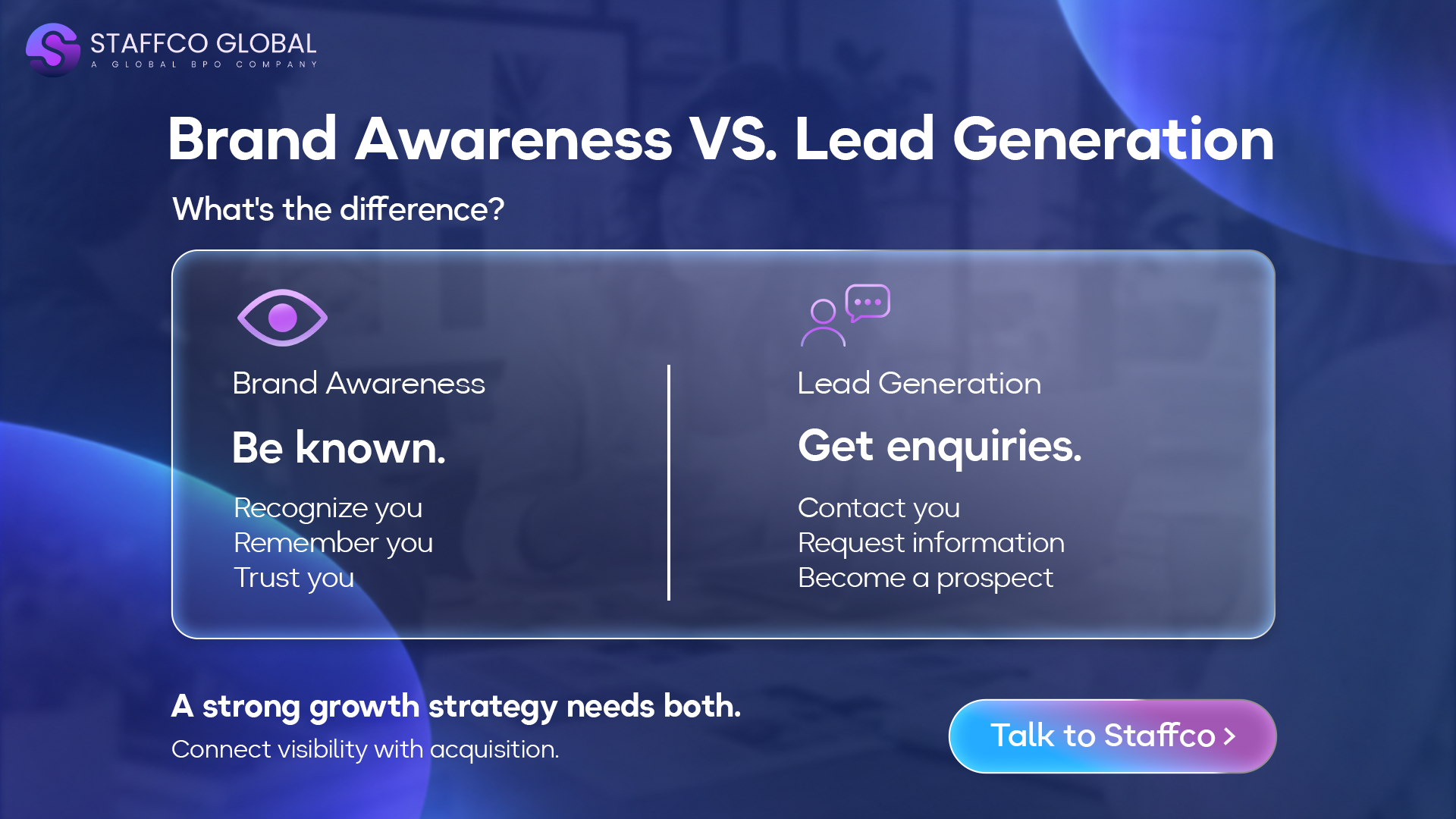
Brand awareness helps people recognize, remember, and trust your business.
Lead generation gives interested people an opportunity to raise their hand, contact you, request information, or become a prospect.
They are different marketing objectives.
But they work best together.
A strong growth strategy connects visibility with acquisition.
What Is Brand Awareness?
Brand awareness is the degree to which people recognize and remember your business, products, services, or brand.
In simple terms, it answers the question:
"Do people know who we are?"
Brand awareness helps potential customers become familiar with your business before they are necessarily ready to buy.
A person may discover your company through:
- Social media
- Search engines
- Online advertising
- Blog content
- Video
- Podcasts
- Events
- Referrals
- Partnerships
- Public relations
At this stage, the goal is to become visible and memorable to the right audience.
Why Is Brand Awareness Important?
People are more likely to consider businesses they recognize and understand.
Imagine a potential customer has a problem and begins searching for a solution.
If your business has already appeared in front of them through useful content, social media, advertising, or other marketing channels, your company may already be familiar to them.
That familiarity can make the next interaction more meaningful.
Brand awareness can help businesses:
- Become recognizable
- Build familiarity
- Establish credibility
- Stay top of mind
- Reach new audiences
- Support future demand
- Create trust over time
However, brand awareness has an important limitation.
Being known does not automatically mean being chosen.
What Is Lead Generation?
Lead generation is the process of attracting potential customers and encouraging them to take an identifiable action that allows your business to begin a relationship with them.
In simple terms, it answers the question:
"Are interested people taking the next step?"
A lead might:
- Fill out a contact form
- Request a consultation
- Call your business
- Send a direct message
- Request a quote
- Book an appointment
- Download a resource
- Schedule a meeting
- Request additional information
Lead generation moves someone from being an anonymous member of your audience to becoming an identifiable prospect.
That makes lead generation an important part of customer acquisition.
Brand Awareness vs. Lead Generation
The easiest way to understand the difference is to look at the objective.
Brand Awareness
The goal is to help people:
- Recognize you
- Remember you
- Understand you
- Trust you
Lead Generation
The goal is to help people:
- Raise their hand
- Contact you
- Request information
- Become a prospect
Brand awareness creates visibility.
Lead generation creates opportunity.
Customer acquisition turns those opportunities into customers.
A strong growth strategy connects all three.
Brand Awareness Creates the Foundation
Before someone can become a lead, they need to know your business exists.
This is why brand awareness is an important part of the customer journey.
For example, a business owner may see one of your LinkedIn posts today.
They may not contact you.
A few days later, they see one of your videos.
Still no contact.
A week later, they search for a solution to a problem and find one of your articles.
Now they recognize your company.
Later, they visit your website.
They understand your services.
Eventually, they may decide they are ready to speak with you.
The earlier marketing activity helped create familiarity.
That familiarity can support the transition from awareness to interest and eventually lead generation.
Lead Generation Turns Interest Into Action
Brand awareness can help someone remember your company.
Lead generation gives that person a reason and opportunity to take action.
For example, someone may see a post about a problem they are currently experiencing.
The post creates awareness.
They read an article explaining how to solve that problem.
Now they are interested.
They see an offer for a free consultation.
They click.
They submit their information.
Now they are a lead.
This is the transition from attention to opportunity.
Why Brand Awareness Alone Is Not Enough
A business can have strong brand awareness and still struggle to generate enough leads.
You may have:
- Thousands of followers
- High website traffic
- Strong social engagement
- Significant video views
- High brand recognition
But if people aren't taking the next step, your marketing may not be contributing enough to customer acquisition.
Awareness is valuable.
But awareness without action can create a gap between marketing performance and business results.
The goal is not simply to become known.
The goal is to become known by the right people and give them a clear path toward becoming customers.
Why Lead Generation Alone Is Not Enough
The opposite can also happen.
A business can focus heavily on lead generation while neglecting brand awareness.
It may constantly promote offers, run advertisements, and ask people to contact the company.
But if potential customers don't recognize the business or understand why they should trust it, conversion can become more difficult.
Strong lead generation often benefits from a foundation of credibility and familiarity.
This is where brand awareness helps.
Brand Awareness and Lead Generation Work Together
Think of brand awareness and lead generation as two connected parts of a larger growth system.
Brand Awareness
"Know us."
↓
Interest
"Understand us."
↓
Demand
"Recognize the problem we solve."
↓
Lead Generation
"Take the next step."
↓
Conversation
"Let's talk."
↓
Customer Acquisition
"Become a customer."
This is how visibility can eventually become business growth.
What Does Brand Awareness Marketing Look Like?
Brand awareness marketing focuses on making your business visible, recognizable, and memorable.
Examples include:
Social Media Content
Consistent content can introduce your business to new audiences while reinforcing your positioning with existing followers.
Video Marketing
Short-form videos can communicate ideas, demonstrate expertise, and introduce your brand to potential customers.
Content Marketing
Articles, guides, and educational content can help your business become associated with specific problems and solutions.
Search Engine Optimization
SEO can help your business appear when people search for topics, problems, and solutions related to your industry.
Digital Advertising
Advertising can increase your visibility among specific audiences and markets.
Thought Leadership
Expert insights can help position your business as a credible source of information.
The objective is to build recognition and familiarity.
What Does Lead Generation Marketing Look Like?
Lead generation marketing focuses more directly on creating identifiable opportunities.
Examples include:
Consultation Offers
Give potential customers an opportunity to speak with your team.
Contact Forms
Make it easy for interested visitors to submit their information.
Lead Magnets
Provide useful resources in exchange for contact information.
Landing Pages
Create focused pages designed around a specific offer or conversion goal.
Paid Lead Campaigns
Use targeted advertising to generate inquiries from specific audiences.
Calls to Action
Tell interested prospects exactly what they should do next.
The objective is to turn interest into opportunity.
The Role of Content in Both
Content marketing can support both brand awareness and lead generation.
At the awareness stage, content can introduce your business and demonstrate your expertise.
At the demand stage, content can help prospects understand a problem.
At the lead generation stage, content can encourage people to take action.
For example:
A social media post can create awareness.
A blog can educate.
A case study can build trust.
A landing page can generate a lead.
A consultation can create a sales opportunity.
The content changes depending on the stage of the customer journey.
The Role of Social Media
Social media is often associated with brand awareness because it can help businesses reach large audiences.
But social media can also support lead generation.
A single platform can perform multiple roles.
It can help you:
- Build awareness
- Educate prospects
- Demonstrate expertise
- Build trust
- Generate demand
- Drive website traffic
- Generate leads
- Retarget interested audiences
The key is having a strategy.
Posting regularly is not the same as having a social media growth strategy.
Your content should connect to your broader marketing and acquisition objectives.
The Role of Your Website
Your website can support both awareness and lead generation.
For awareness, your website should clearly communicate:
- Who you are
- What you do
- Who you help
- What makes you different
For lead generation, it should also provide:
- Clear offers
- Strong calls to action
- Contact opportunities
- Consultation options
- Lead forms
- Relevant landing pages
Your website should be part of the acquisition system.
It should not simply exist as an online brochure.
How to Measure Brand Awareness
Brand awareness can be measured using metrics such as:
- Reach
- Impressions
- Website traffic
- Branded searches
- Social engagement
- Video views
- Audience growth
- Direct traffic
These metrics help you understand whether more people are discovering and interacting with your brand.
However, awareness metrics should be interpreted in context.
High reach is useful when it is reaching the right audience.
High engagement is useful when it contributes to stronger interest and future opportunities.
How to Measure Lead Generation
Lead generation requires more direct performance metrics.
Important metrics include:
- Number of leads
- Qualified leads
- Cost per lead
- Lead conversion rate
- Website conversion rate
- Appointment requests
- Sales opportunities
- Customer acquisition cost
- Customers acquired
These metrics help you understand whether your marketing is creating actual business opportunities.
The Difference Between Attention and Acquisition
This is where many businesses struggle.
They measure:
Views.
Likes.
Followers.
Traffic.
But they don't measure:
Leads.
Appointments.
Sales conversations.
Customers.
Revenue.
Attention matters.
But attention is only the beginning.
The objective is to create a path from attention to action.
That path might look like:
Visibility → Awareness → Demand → Lead → Conversation → Customer
When the stages connect, marketing becomes much more closely aligned with growth.
How Much Should You Invest in Brand Awareness vs. Lead Generation?
There is no universal percentage that every business should use.
The right balance depends on:
- Business stage
- Industry
- Audience
- Sales cycle
- Growth goals
- Competition
- Existing brand recognition
- Customer acquisition cost
- Average customer value
- Available marketing budget
A new business may need significant awareness building.
A business with strong recognition may be ready to focus more heavily on acquisition.
A mature business may need a combination of both.
The important point is that the two objectives should support one another.
A Strong Growth Strategy Needs Both
Brand awareness and lead generation should not compete.
They should work together.
Brand awareness helps create the audience.
Demand generation helps create interest.
Lead generation captures that interest.
Sales converts qualified opportunities.
Customer acquisition creates growth.
Retention increases long-term customer value.
The complete system looks like:
Awareness → Demand → Leads → Conversion → Acquisition → Retention
Every stage contributes to the larger growth objective.
The Goal Is Not More Marketing. It's Better Marketing.
Businesses often respond to slow growth by increasing marketing activity.
More posts.
More advertisements.
More videos.
More content.
More traffic.
But doing more marketing without a clear objective does not necessarily create better results.
The better question is:
"What are we trying to accomplish?"
If the objective is awareness, build visibility.
If the objective is demand, educate and create interest.
If the objective is lead generation, create opportunities for action.
If the objective is acquisition, connect marketing and sales.
If the objective is growth, build a system that connects all of these stages.
Connect Visibility With Acquisition
At Staffco Global, our focus is Growth & Acquisition.
We believe marketing should connect visibility with measurable business outcomes.
Brand awareness helps your business become recognized.
Demand generation helps potential customers understand why they need a solution.
Lead generation creates opportunities.
Conversion turns opportunities into customers.
The strategy connects these stages together.
That is how marketing becomes a growth engine rather than a collection of disconnected activities.
Build a Marketing Strategy Around Growth
The question isn't whether your business needs brand awareness or lead generation.
You need both.
The real question is how they work together.
Your marketing should help people:
Discover you.
↓
Recognize you.
↓
Understand you.
↓
Trust you.
↓
Take action.
↓
Become customers.
When visibility and acquisition work together, your marketing can become more predictable, measurable, and connected to business growth.
Ready to Connect Visibility With Acquisition?
If your business is getting attention but not generating enough qualified opportunities, you may not need more marketing activity.
You may need a better connection between brand awareness, demand generation, lead generation, and customer acquisition.
At Staffco Global, we help businesses build marketing strategies designed around Growth & Acquisition.
Staffco helps businesses connect visibility with acquisition.
Talk to Staffco About Your Growth Strategy