AI Can Create Content. It Can't Create Your Growth Strategy.
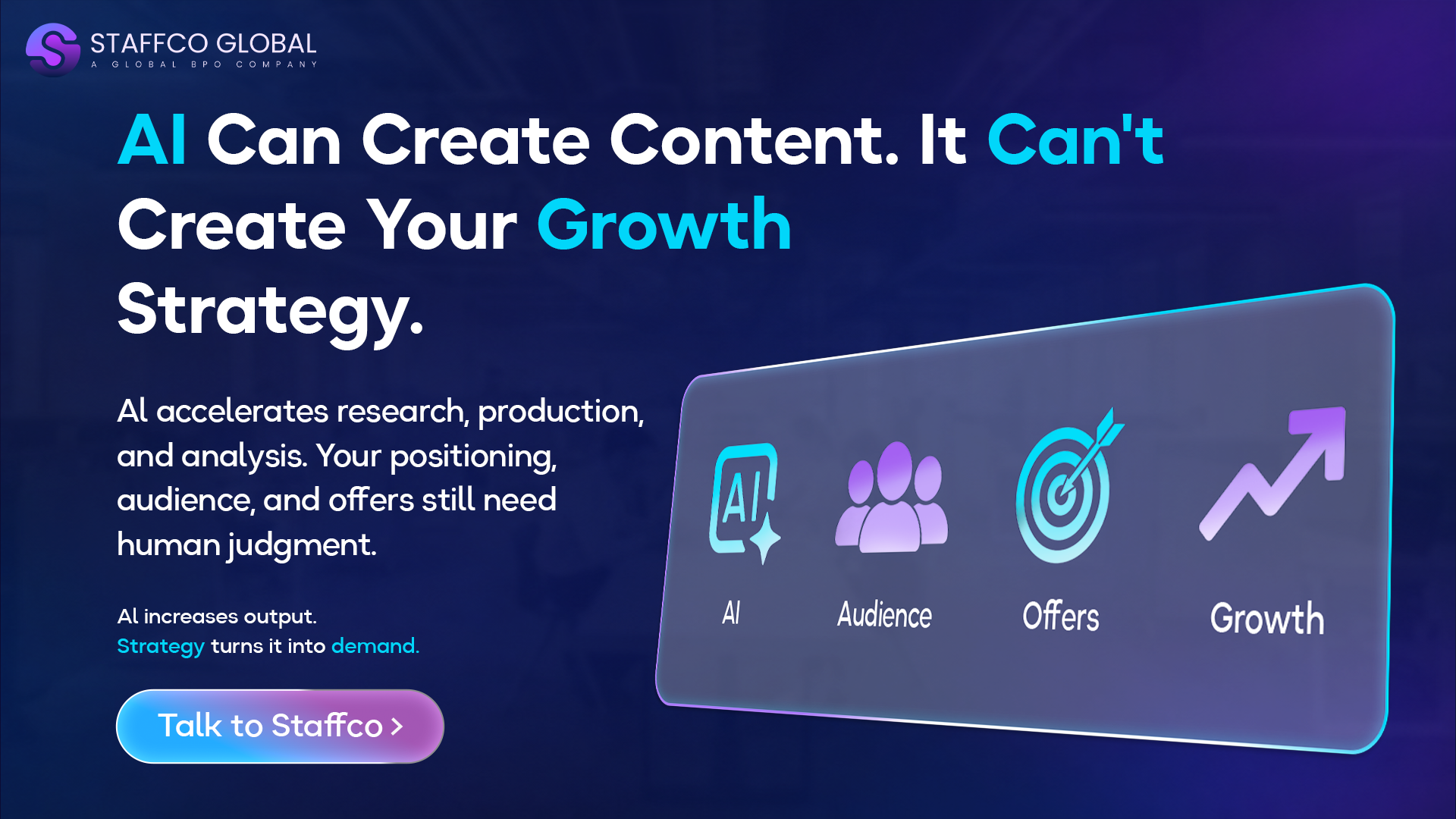
AI Can Create Content. It Can't Create Your Growth Strategy.
AI can increase output. Strategy determines whether that output creates demand, attracts customers, and drives business growth.
Artificial intelligence has transformed the way businesses approach marketing. From generating blog articles and social media posts to researching competitors and analyzing campaign performance, AI tools are making marketing faster, more accessible, and increasingly automated.
But there is one important distinction businesses need to understand: producing more marketing content is not the same as building a successful marketing strategy.
A company can publish dozens of AI-generated articles, launch automated campaigns, and maintain a consistent social media presence without generating meaningful leads or revenue.
Why? Because technology can help execute marketing activities, but it cannot automatically determine what makes a business different, which audience it should target, why customers should choose it, or how to turn attention into long-term growth.
At StaffCo Global, we believe the real opportunity lies in combining AI-powered execution with human expertise, strategic thinking, and structured growth systems.
1. AI Is Changing Marketing Execution
There is no question that AI has become a powerful resource for modern marketing teams. Tasks that once required hours of manual work can now be completed faster, allowing businesses to increase productivity and operate more efficiently.
AI can support almost every stage of the marketing process.
Research and Market Analysis
AI tools can help businesses research competitors, identify industry trends, analyze customer feedback, and organize market information. This gives marketing teams a stronger starting point for making informed decisions.
Content Production
From blog articles and website copy to email campaigns and social media captions, AI can accelerate content production and help maintain a consistent publishing schedule.
Personalization and Automation
AI-powered platforms can help segment audiences, personalize communications, automate follow-ups, and deliver relevant messages based on customer behavior.
Performance Analysis
Marketing teams can use AI to interpret campaign data, identify performance patterns, and uncover opportunities for improvement.
These capabilities create significant advantages. Businesses can accomplish more with fewer manual processes and give their teams additional time to focus on higher-value activities.
However, faster execution only matters when the direction is right.
2. Human Strategy Still Determines Business Growth
AI can generate recommendations, identify patterns, and produce marketing materials. But a successful growth strategy requires a deeper understanding of the business, its customers, its competitive environment, and its long-term objectives.
There are several critical decisions that require strategic judgment.
Understanding Your Audience
Who are your ideal customers? What challenges are they experiencing? What influences their purchasing decisions? What makes them trust one company over another?
These questions require more than generating demographic profiles. They require understanding customer motivations, business priorities, and real purchasing behavior.
Defining Your Positioning
Your business needs a clear reason for customers to choose you.
A marketing strategy must establish what makes your company different, how its value should be communicated, and how that message should remain consistent across every customer touchpoint.
Choosing the Right Acquisition Channels
Not every platform is suitable for every business. Some companies benefit from Google Search campaigns, while others generate stronger opportunities through LinkedIn, industry partnerships, email marketing, or organic search.
The right strategy determines where to invest, who to target, and how to measure success.
Building an Effective Offer
Even excellent content and advertising cannot compensate for an unclear offer. Businesses need to communicate their value, address customer concerns, and provide a compelling reason to take action.
AI can assist with these decisions, but strategic direction must come first.
3. More Content Doesn't Always Mean More Customers
One of the biggest mistakes businesses make when adopting AI is measuring marketing success by output rather than outcomes.
Publishing more articles does not automatically improve lead generation. Increasing social media activity does not guarantee customer acquisition. Launching more advertisements does not necessarily produce a better return on investment.
The real question isn't how much content your business can create.
It's whether that content attracts the right audience, builds credibility, and moves potential customers closer to making a decision.
Consider the difference:
- Content Production: Publishing ten blog articles every month.
- Strategic Content: Publishing articles that address the actual questions your ideal customers search for.
- Social Media Activity: Posting every day to maintain visibility.
- Strategic Engagement: Creating content that establishes expertise and reaches relevant decision-makers.
- Paid Advertising: Increasing advertising spend to generate more traffic.
- Strategic Acquisition: Targeting qualified prospects with relevant offers and measurable conversion goals.
The difference is the thinking behind the execution.
Businesses don't need content for the sake of content. They need marketing that serves a clear commercial objective.
4. Brand Differentiation: The Advantage AI Cannot Simply Generate
As AI-generated content becomes more accessible, the internet is becoming increasingly crowded with similar messages, generic articles, and repetitive marketing campaigns.
When every company uses similar tools to produce similar content, standing out becomes even more important.
Your brand needs a recognizable identity, a distinct value proposition, and a consistent voice.
Strong brand differentiation comes from understanding:
- What makes your business unique.
- Which problems you solve better.
- Why customers should trust your expertise.
- What your competitors are overlooking.
- How your company should be remembered.
AI can help communicate these qualities, but it needs a clear brand strategy to work from.
The strongest businesses will not necessarily be those producing the most content. They will be those communicating the clearest value to the right audience.
5. Build a Growth System, Not Just a Content Calendar
Sustainable marketing requires multiple activities working together.
A successful growth system connects audience research, brand positioning, content production, customer acquisition, lead management, and performance analysis.
Each element has a specific role.
Audience Research: Identify your ideal customers, their challenges, and their buying behavior.
Brand Positioning: Establish a clear message that differentiates your business from competitors.
Content Strategy: Create valuable content that addresses customer needs and builds industry authority.
Customer Acquisition: Use SEO, paid advertising, social media, and other relevant channels to attract qualified prospects.
Lead Nurturing: Develop structured follow-up processes that turn interest into meaningful business conversations.
Performance Optimization: Track conversions, analyze results, and continuously improve your marketing activities.
AI can accelerate many of these processes. Human expertise ensures they work together toward a defined business objective.
6. The Winning Formula: AI-Powered Execution Meets Human Expertise
The future of marketing isn't about choosing between artificial intelligence and human expertise. It's about using both intelligently.
AI gives businesses speed, efficiency, and access to powerful analytical capabilities. Human professionals bring creativity, judgment, industry understanding, strategic direction, and the ability to make decisions based on business context.
When these strengths work together, marketing becomes more than a collection of disconnected activities.
It becomes a structured growth engine.
At StaffCo Global, we help businesses strengthen their operations through professional outsourcing solutions, including digital marketing, SEO, content creation, graphic design, and dedicated operational support.
Our approach focuses on connecting the right people, processes, and technology to support your business objectives.
Whether you need to strengthen your digital presence, improve your marketing execution, or build a more structured acquisition process, the right combination of expertise and technology can help move your business forward.
Final Thoughts: Let Strategy Lead. Let AI Accelerate.
Artificial intelligence is changing what businesses can accomplish, but it doesn't change what successful marketing requires.
You still need to understand your customers, differentiate your brand, communicate meaningful value, and build a reliable system for acquiring new business.
AI can help you do more. A well-defined strategy helps ensure you're doing the right things.
The businesses that win in the AI era won't simply create more content. They'll create more meaningful connections, stronger positioning, and smarter paths to growth.
Using AI but Not Seeing Growth?
It's time to connect your technology with a strategy that delivers business value.
StaffCo Global helps businesses combine skilled professionals, digital marketing expertise, and scalable operational solutions to build more effective growth systems.
Let's turn your marketing efforts into meaningful business opportunities.