7 Marketing Mistakes That Keep Businesses Stuck
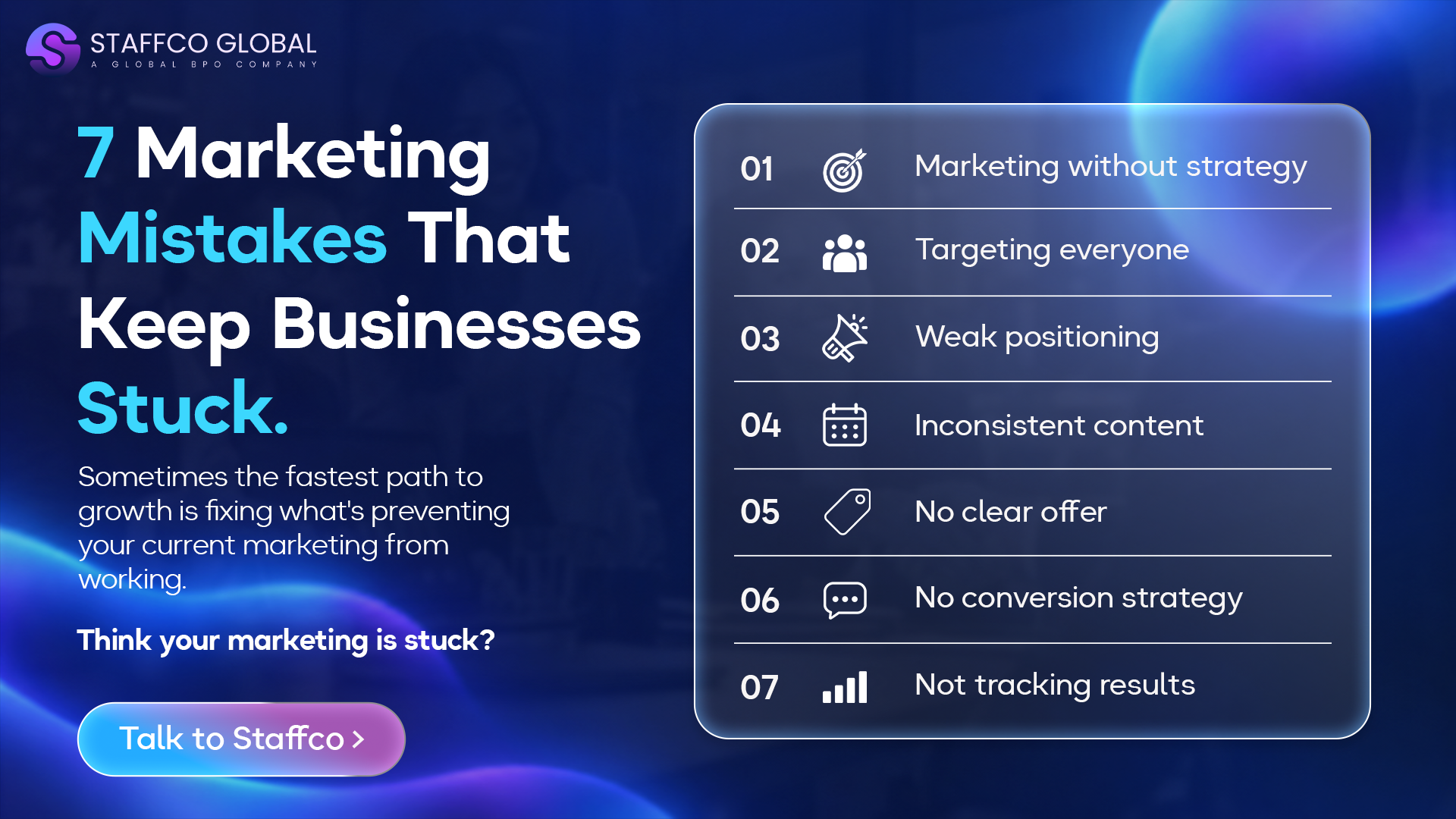
7 Marketing Mistakes That Keep Businesses Stuck
Marketing is supposed to help your business grow.
But sometimes, despite investing time, money, and resources into marketing, the results remain disappointing.
You may be posting consistently.
You may be running advertisements.
You may have a website.
You may be creating videos and social media content.
You may even be getting traffic and engagement.
Yet the number of qualified leads and new customers may not be increasing.
When that happens, the answer is not always to do more marketing.
Sometimes, the fastest path to growth is identifying what is preventing your current marketing from working.
Many businesses make the same strategic mistakes repeatedly without realizing how much those mistakes can limit their growth.
Here are seven marketing mistakes that can keep a business stuck and what you can do about them.
1. Marketing Without a Strategy
One of the biggest marketing mistakes businesses make is starting with tactics instead of strategy.
They ask:
"What should we post this week?"
"Should we run an ad?"
"Should we make a Reel?"
"Should we redesign our website?"
These are tactical questions.
Before choosing a marketing tactic, businesses should understand what they are trying to accomplish.
Are you trying to:
- Increase brand awareness?
- Generate qualified leads?
- Acquire new customers?
- Enter a new market?
- Increase revenue?
- Improve conversion?
- Reduce customer acquisition costs?
Without a clear objective, marketing can quickly become a collection of disconnected activities.
A business may publish content, run advertisements, send emails, and maintain social media without knowing how those activities contribute to growth.
Start With the Goal
A stronger marketing process starts with:
Business Goal → Marketing Strategy → Channels → Campaigns → Measurement
The goal determines the strategy.
The strategy determines the tactics.
The tactics should support the desired business outcome.
This simple shift can make marketing more focused and measurable.
2. Targeting Everyone
Another common marketing mistake is trying to appeal to everyone.
A business may say:
"We work with all businesses."
"Our service is for everyone."
"We can help anyone who needs marketing."
While this sounds like a way to reach a larger market, broad messaging often makes marketing less effective.
When your audience is unclear, your message becomes less specific.
And when your message is less specific, it becomes harder for the right people to recognize that your business is relevant to them.
Define Your Ideal Customer
A strong marketing strategy should identify the people most likely to become customers.
Consider:
- Industry
- Company size
- Location
- Job title
- Business needs
- Pain points
- Goals
- Buying behavior
- Budget
- Decision-making process
The goal is not to reach everyone.
The goal is to reach the right people.
A smaller audience of highly relevant prospects can be more valuable than a large audience with little interest in your offer.
Relevance Beats Reach
Getting your marketing in front of 100,000 people sounds impressive.
But if those people have no reason to buy from you, the reach may not create meaningful business results.
Effective marketing focuses on relevance.
Reach the people who have the problem you solve.
Speak directly to that problem.
Show them the value of solving it.
Then give them a reason to take action.
3. Weak Positioning
You can target the right audience and still struggle to generate leads if your positioning is unclear.
Positioning answers important questions:
Who are you?
Who do you help?
What problem do you solve?
What makes you different?
What outcome do you help create?
If your marketing simply lists services, potential customers may not understand why they should choose you.
For example:
"We provide digital marketing services."
is broad.
Compare that with:
"We help businesses increase visibility, generate qualified leads, and acquire customers through strategic marketing."
The second message communicates an outcome.
Focus on the Customer's Problem
Strong positioning is not simply about describing what your company does.
It is about connecting your capabilities to what your customer needs.
Your audience should be able to quickly understand:
We understand your problem.
We know how to solve it.
We can help you reach your goal.
Clear positioning can make every part of your marketing more effective because the message becomes easier to understand.
4. Inconsistent Content
Content marketing can help businesses build awareness, create demand, demonstrate expertise, and generate leads.
But inconsistent content makes it difficult to build momentum.
A business might publish several posts one week and then disappear for a month.
It may create videos only when someone has an idea.
It may publish blog articles occasionally without a consistent strategy.
This creates an unpredictable customer experience.
Consistency Builds Familiarity
Potential customers often need multiple interactions with a business before they are ready to buy.
They may:
Discover your business.
↓
Read an article.
↓
See your social media content.
↓
Watch a video.
↓
Visit your website.
↓
Read a case study.
↓
Contact your team.
Consistent content gives your business more opportunities to remain visible throughout that journey.
But consistency does not mean creating content simply to fill a calendar.
Every piece should have a purpose.
Content should help your audience:
- Discover you
- Understand a problem
- Learn about solutions
- Trust your expertise
- Take action
5. No Clear Offer
Even strong marketing can struggle to generate leads if there is no compelling offer.
Your audience may understand what you do.
They may even trust your business.
But what should they do next?
If the answer isn't obvious, potential customers may simply leave.
A clear offer gives people a reason to take action.
Examples include:
- Free consultation
- Growth assessment
- Strategy session
- Quote request
- Business evaluation
- Product demonstration
- Downloadable guide
- Discovery call
Make the Value of the Next Step Clear
Compare:
"Contact Us"
with:
"Book Your Growth Strategy Consultation"
The second CTA tells the prospect what they are getting.
A strong offer should communicate:
What is it?
Who is it for?
What value does it provide?
What should I do next?
The easier it is to understand the next step, the easier it can be for an interested prospect to take action.
6. No Conversion Strategy
Generating attention and traffic is only part of marketing.
Your marketing also needs to convert interest into action.
A business may have:
- Strong social media
- High website traffic
- Good content
- Paid advertising
- Brand awareness
But if there is no clear conversion path, those visitors may never become leads.
What Is a Conversion Path?
A conversion path is the journey a potential customer takes from interest to action.
For example:
Social Media Post
↓
Website
↓
Relevant Landing Page
↓
Offer
↓
Contact Form
↓
Sales Conversation
↓
Customer
Every stage should have a purpose.
The prospect should understand what to do next.
Make Conversion Easy
Look at your website and marketing from the perspective of a potential customer.
Can they quickly understand your offer?
Can they find your services?
Can they see why they should trust you?
Can they contact you?
Can they book a consultation?
Is the next step obvious?
If the answer is no, your marketing may be creating attention without creating enough opportunities.
7. Not Tracking Results
One of the most damaging marketing mistakes is failing to measure performance.
Without data, businesses often make decisions based on assumptions.
They may spend more money on a campaign simply because it received many impressions.
They may continue creating content because it gets likes.
They may increase website traffic without checking whether visitors are becoming leads.
But attention does not automatically equal growth.
Track Business Outcomes
Important marketing metrics can include:
- Qualified leads
- Lead conversion rate
- Cost per lead
- Website conversion rate
- Customer acquisition cost
- Appointments
- Sales opportunities
- Customers acquired
- Revenue generated
- Customer lifetime value
The right metrics depend on the business and its goals.
The key is connecting marketing activity to measurable outcomes.
Measure What Matters
Consider the difference:
Marketing Metrics
Views
Likes
Followers
Impressions
Reach
Growth Metrics
Qualified Leads
Appointments
Customers
Customer Acquisition Cost
Revenue
Marketing metrics help you understand visibility.
Growth metrics help you understand business impact.
A strong marketing strategy should understand both.
The Bigger Problem: Disconnected Marketing
These seven mistakes often happen because businesses treat marketing activities as separate tasks.
They have:
A social media strategy.
A website.
Some advertising.
Occasional content.
An email list.
Maybe some SEO.
But none of these activities are connected by a clear growth objective.
That can create a lot of activity without predictable results.
A stronger approach connects everything.
Build Marketing Around a Growth Objective
Start with the business goal.
What does the business actually need?
More qualified leads?
More customers?
More revenue?
A new market?
Lower customer acquisition costs?
Once the goal is clear, build the marketing strategy around it.
For example:
Growth Goal
↓
Target Audience
↓
Positioning
↓
Marketing Strategy
↓
Content & Campaigns
↓
Traffic
↓
Lead Generation
↓
Conversion
↓
Customer Acquisition
↓
Measurement
↓
Optimization
This creates a system rather than a collection of tactics.
How to Fix These Marketing Mistakes
You don't need to rebuild your entire marketing strategy overnight.
Start by identifying the biggest bottleneck.
If You Lack Strategy
Define one measurable growth objective.
If You're Targeting Everyone
Define your ideal customer.
If Your Positioning Is Weak
Clarify the problem you solve and the outcome you provide.
If Your Content Is Inconsistent
Create a structured content strategy.
If Your Offer Is Unclear
Create one compelling next step.
If Your Conversion Is Weak
Map the customer journey and remove unnecessary friction.
If You Don't Track Results
Choose the metrics that connect directly to business growth.
Small strategic improvements can create meaningful changes when they address the right problem.
Don't Confuse More Marketing With Better Marketing
When businesses aren't seeing results, the instinct is often to increase activity.
More posts.
More advertisements.
More videos.
More emails.
More content.
But more activity is not necessarily the answer.
If your strategy is wrong, increasing the volume can simply amplify the problem.
The better approach is to identify what is preventing growth.
Is your audience wrong?
Is your positioning unclear?
Is your content inconsistent?
Is your offer weak?
Is your conversion path broken?
Are you failing to measure results?
Fix the bottleneck before simply adding more marketing.
Marketing Should Move People Toward Customers
A strong marketing strategy creates a clear journey.
Awareness
People discover your business.
↓
Demand
They recognize a problem or opportunity.
↓
Interest
They begin exploring solutions.
↓
Lead
They take an identifiable action.
↓
Conversation
They engage with your business.
↓
Customer
They become a customer.
↓
Growth
Your acquisition system creates repeatable opportunities.
Every marketing activity should support one or more stages of this journey.
Your Marketing Should Have a Job
Every piece of marketing should have a purpose.
A social media post may create awareness.
A blog article may answer a search question.
A video may create demand.
A case study may build trust.
A landing page may generate a lead.
A consultation may create a sales opportunity.
Analytics may reveal where the process needs improvement.
When each component has a role, marketing becomes more strategic.
Build a Marketing System, Not a Collection of Tactics
The businesses that create sustainable growth are not necessarily the businesses doing the most marketing.
They are the businesses that understand how their marketing works together.
They know:
Who they want to reach.
What problem they solve.
What message will resonate.
Which channels reach their audience.
What offer will create action.
How leads are captured.
How prospects are followed up.
How customers are acquired.
How performance is measured.
How the system can be improved.
That is what turns marketing into a growth engine.
Fix the Bottleneck Before You Add More
Sometimes the fastest path to growth is not doing more.
It is fixing what is already holding you back.
If your business is getting traffic but no leads, look at conversion.
If you're getting leads but no customers, look at your sales process.
If you're getting attention from the wrong people, revisit your audience.
If people don't understand your value, improve your positioning.
If your marketing is inconsistent, build a content system.
If you don't know what is working, start measuring.
The right solution depends on where the bottleneck exists.
Growth Starts With the Right Marketing Strategy
Marketing should not be treated as an expense that simply keeps your business visible.
It should be connected to a larger growth objective.
The goal is not:
"How much content can we produce?"
The goal is:
"How can our marketing help us acquire the right customers?"
That shift changes how you approach every marketing decision.
Instead of asking which platform to use, you ask which channel can best reach your audience.
Instead of asking what to post, you ask what your audience needs to understand.
Instead of asking how many followers you gained, you ask whether marketing created qualified opportunities.
Instead of asking how much traffic you generated, you ask whether that traffic converted.
That is growth-focused marketing.
Staffco Global: Growth & Acquisition
At Staffco Global, our focus is Growth & Acquisition.
We help businesses build marketing strategies designed around visibility, demand generation, lead generation, conversion, and customer acquisition.
Our approach starts with the business objective and works backward.
The goal isn't simply to create more content.
It isn't simply to generate more views.
It isn't simply to increase followers.
It is to build marketing that contributes to measurable business growth.
Think Your Marketing Is Stuck?
If your business is investing in marketing but growth still feels inconsistent, there may be a bottleneck somewhere in your acquisition system.
You may not need more marketing.
You may need better marketing.
Start by identifying what is preventing your current strategy from working.
Then fix the bottleneck.
Think your marketing is stuck? Let's find the bottleneck.
Talk to Staffco About Your Growth Strategy