5 Reasons Your Marketing Is Not Generating Enough Leads
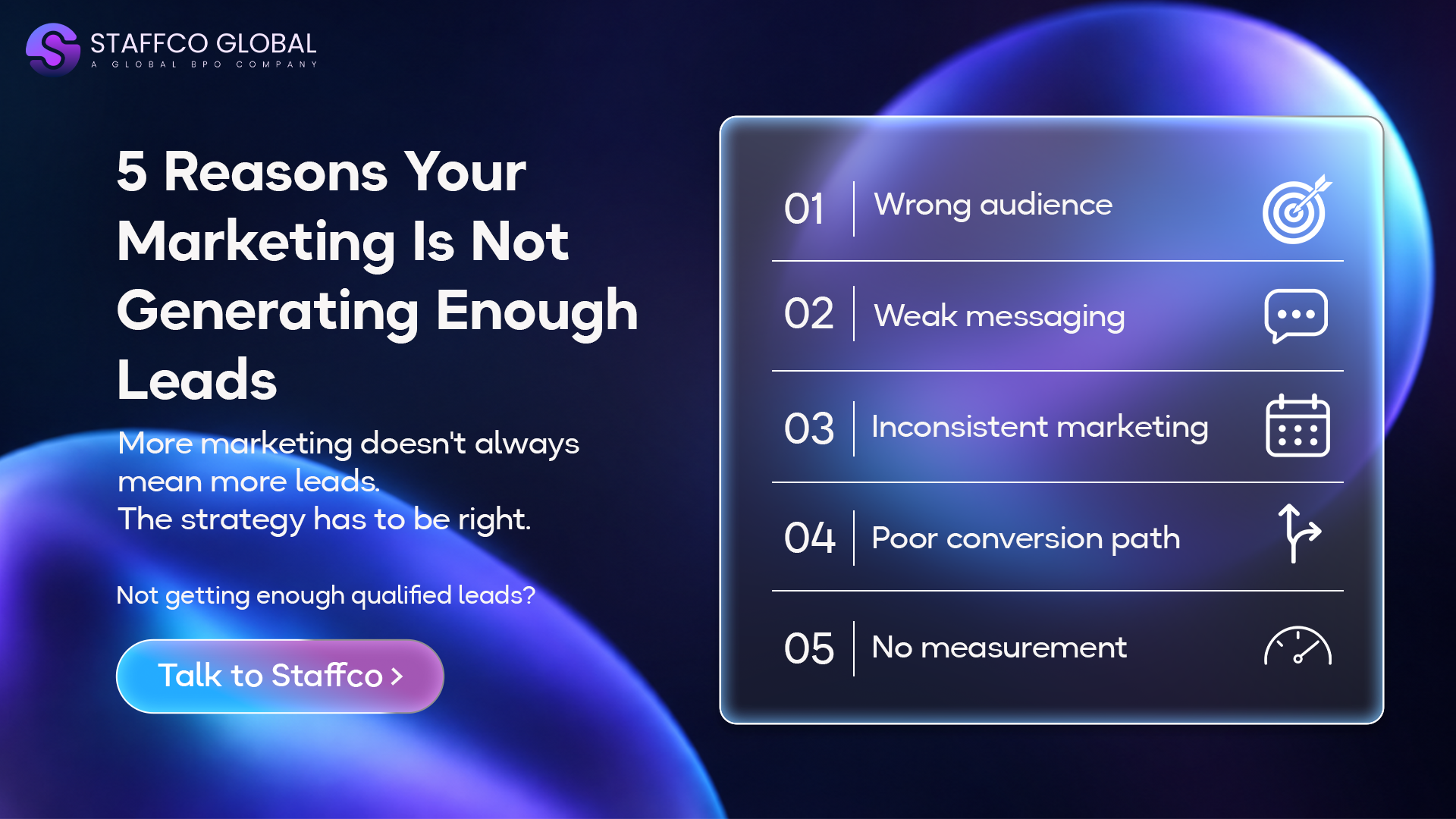
5 Reasons Your Marketing Is Not Generating Enough Leads
You are posting consistently.
You may be running advertisements.
Your website is live.
Your business is active on social media.
So why aren't you getting enough leads?
This is one of the most frustrating problems businesses face.
You can invest significant time and money into marketing and still struggle to generate qualified leads. When that happens, the answer is not always to do more marketing.
Sometimes, the problem is the strategy behind the marketing.
More posts do not automatically create more leads.
More advertising does not automatically create more customers.
More website traffic does not automatically create more revenue.
Effective lead generation requires the right audience, the right message, consistent marketing, a clear conversion path, and a way to measure what is actually working.
Here are five common reasons your marketing may not be generating enough leads.
1. You Are Targeting the Wrong Audience
One of the most common lead generation problems is reaching the wrong people.
Your marketing may look professional.
Your content may be engaging.
Your advertisements may be getting impressions.
But if the people seeing your marketing are not the people who need your product or service, generating qualified leads will be difficult.
Effective marketing starts with understanding your ideal customer.
You need to know:
- Who are you trying to reach?
- What problem are they experiencing?
- What motivates them to look for a solution?
- What concerns might prevent them from buying?
- Where do they look for information?
- What type of message gets their attention?
For example, a business selling professional services to executives should not necessarily use the same messaging, channels, and content strategy as a company selling directly to consumers.
Your audience determines your marketing strategy.
If your audience is unclear, your messaging becomes less specific, your content becomes less relevant, and your lead generation becomes less efficient.
Reach the Right People, Not Just More People
One of the biggest mistakes businesses make is focusing on reach instead of relevance.
Getting your marketing in front of 100,000 people sounds impressive.
But if only a small percentage of those people could realistically become customers, the number doesn't mean much.
A smaller audience of highly relevant prospects can be significantly more valuable.
The goal is not simply to generate more attention.
The goal is to generate attention from people who have a genuine reason to consider your business.
2. Your Messaging Is Too Weak or Unclear
Even when you reach the right audience, your marketing may fail if people don't immediately understand why they should care.
Your potential customer should be able to answer three questions quickly:
What do you do?
Who do you help?
Why should I choose you?
If your marketing only talks about your company and its services, it may not connect with the customer's actual problem.
Compare these two messages:
"We provide digital marketing services."
versus:
"We help businesses generate more qualified leads through strategic digital marketing."
The second message communicates an outcome.
That distinction matters.
Lead Generation Starts With a Strong Message
People do not respond to marketing simply because a company has services.
They respond when they recognize a problem, opportunity, need, or desired outcome.
Your messaging should communicate:
- The problem you solve
- The audience you serve
- The value you provide
- The outcome you help create
- Why your approach is different
Clear positioning makes lead generation more effective because the right prospects can quickly recognize that your business may be relevant to them.
3. Your Marketing Is Inconsistent
Another common reason businesses struggle to generate leads is inconsistency.
A company may publish content for two weeks, stop for a month, run a campaign, stop advertising, and then start posting again when business slows down.
This creates an unpredictable marketing process.
Customers rarely see one piece of content and immediately become ready to buy.
Depending on the product, service, industry, and sales cycle, prospects may need multiple interactions with a business before they take action.
They may:
- See a social media post
- Visit your website
- Read an article
- Watch a video
- Search for your company
- See an advertisement
- Read a case study
- Compare competitors
- Return to your website
- Finally contact you
This is why consistent marketing matters.
Consistency Builds Familiarity
Consistent marketing keeps your business visible while prospects move through the buying process.
But consistency does not mean posting just to stay active.
The content should have a purpose.
Your marketing should consistently reinforce:
- Your positioning
- Your expertise
- Your value
- Your solutions
- Your credibility
- Your call to action
The goal is to build familiarity while moving potential customers closer to taking action.
4. Your Conversion Path Is Poor
You can have the right audience.
You can have strong messaging.
You can market consistently.
And you can still struggle to generate leads if there is no clear path for people to become prospects.
This is where conversion becomes critical.
Imagine someone sees your social media post and becomes interested in your service.
What happens next?
Can they easily find your website?
Can they quickly understand your offer?
Can they contact you?
Can they book a consultation?
Can they submit a form?
Can they find your phone number?
If the next step is unclear or difficult, potential leads can disappear.
Make the Next Step Obvious
Every marketing campaign should give the audience a clear next action.
Depending on your business, that action could be:
- Request a consultation
- Book an appointment
- Contact your team
- Request a quote
- Download a resource
- Schedule a demonstration
- Send a message
- Visit a landing page
Your call to action should match the stage of the customer journey.
Someone discovering your company for the first time may not be ready to buy immediately.
They may need more information first.
Someone who has already researched your company may be ready to speak with your team.
A strong conversion path accounts for these differences.
5. You Are Not Measuring What Works
One of the biggest obstacles to effective lead generation is not knowing what is actually producing results.
Many businesses track basic marketing metrics such as:
- Followers
- Likes
- Views
- Impressions
- Website visits
These metrics can provide useful information.
But they don't necessarily tell you whether your marketing is producing qualified business opportunities.
For lead generation, you should also understand metrics such as:
- Number of qualified leads
- Lead conversion rate
- Cost per lead
- Customer acquisition cost
- Conversion rate by channel
- Website conversion rate
- Lead source
- Campaign performance
- Customer lifetime value
The objective is not to measure everything.
The objective is to understand what is contributing to growth.
Stop Guessing and Start Optimizing
Imagine your business receives 100 leads in a month.
If you don't know where those leads came from, you have limited information about where to invest your next marketing dollar.
But if you know:
30 came from organic search
25 came from paid advertising
20 came from social media
15 came from referrals
10 came from email
you can begin asking better questions.
Which source produced the most qualified leads?
Which source produced the most customers?
Which channel had the lowest acquisition cost?
Which campaigns should receive more investment?
That is how measurement turns marketing into an optimization process.
More Marketing Does Not Always Mean More Leads
When businesses are not generating enough leads, the natural reaction is often:
"We need to do more marketing."
More content.
More ads.
More posts.
More emails.
More traffic.
But doing more of something that isn't working will not necessarily solve the problem.
The better question is:
"Which part of our acquisition strategy is not working?"
Maybe you're reaching the wrong audience.
Maybe your message isn't clear.
Maybe your marketing is inconsistent.
Maybe prospects don't have a clear next step.
Maybe you don't know which channels are producing qualified opportunities.
Before increasing your marketing activity, identify the bottleneck.
The Lead Generation Process
A strong lead generation strategy connects multiple stages:
1. Audience
Identify the people most likely to become customers.
↓
2. Positioning
Communicate why your business is relevant to them.
↓
3. Awareness
Get your business discovered through the right channels.
↓
4. Demand
Give prospects a reason to care about the problem you solve.
↓
5. Lead Generation
Create opportunities for interested prospects to take action.
↓
6. Conversion
Turn those opportunities into conversations and customers.
↓
7. Measurement
Understand what is producing results.
↓
8. Optimization
Continuously improve the system.
This is the difference between simply doing marketing and building a marketing system designed for growth.
How to Improve Your Lead Generation Strategy
If your marketing is not generating enough leads, start by reviewing five areas.
Review Your Audience
Are you reaching the people who actually need your product or service?
Review Your Messaging
Can someone understand your value within a few seconds?
Review Your Consistency
Are you consistently showing up across the channels that matter to your audience?
Review Your Conversion Path
Is it easy for an interested prospect to take the next step?
Review Your Data
Do you know which marketing channels and campaigns are producing qualified leads?
These five areas can reveal where your marketing strategy needs improvement.
Marketing Should Support Customer Acquisition
Marketing should not exist simply to keep your business active online.
The purpose of a growth-focused marketing strategy is to help your business become more visible, create demand, generate qualified leads, and acquire customers.
That requires more than individual marketing tactics.
Social media is a channel.
Advertising is a channel.
Content is a tool.
Your website is a conversion asset.
SEO is a visibility strategy.
Email is a communication channel.
The real value comes from connecting these pieces around a common objective.
That objective is growth.
Build a Better Acquisition Strategy
If your business is investing in marketing but not seeing enough qualified leads, don't automatically assume you need to spend more.
You may need a better strategy.
The right audience.
The right positioning.
The right message.
The right channels.
The right conversion path.
The right measurement.
When these elements work together, marketing becomes more predictable and more closely connected to business growth.
At Staffco Global, our focus is Growth & Acquisition.
We help businesses build marketing strategies designed to increase visibility, generate demand, create qualified leads, and support customer acquisition.
The goal is not simply more marketing activity.
The goal is marketing that contributes to measurable business growth.
Not Getting Enough Qualified Leads?
If your business is getting attention but not enough qualified leads, it may be time to look beyond individual marketing tactics and examine the acquisition strategy behind them.
Not getting enough qualified leads? Let's look at your acquisition strategy.
Talk to Staffco About Your Growth Strategy